Back
USMLE Step 1 Study Schedule for IMGs: Week-by-Week 3-Month Plan for Non-US Graduates 2026
Complete 12-week USMLE Step 1 study schedule for IMGs and non-US graduates. Address curriculum gaps, realistic timelines, and score targets for competitive residency matching in 2026.
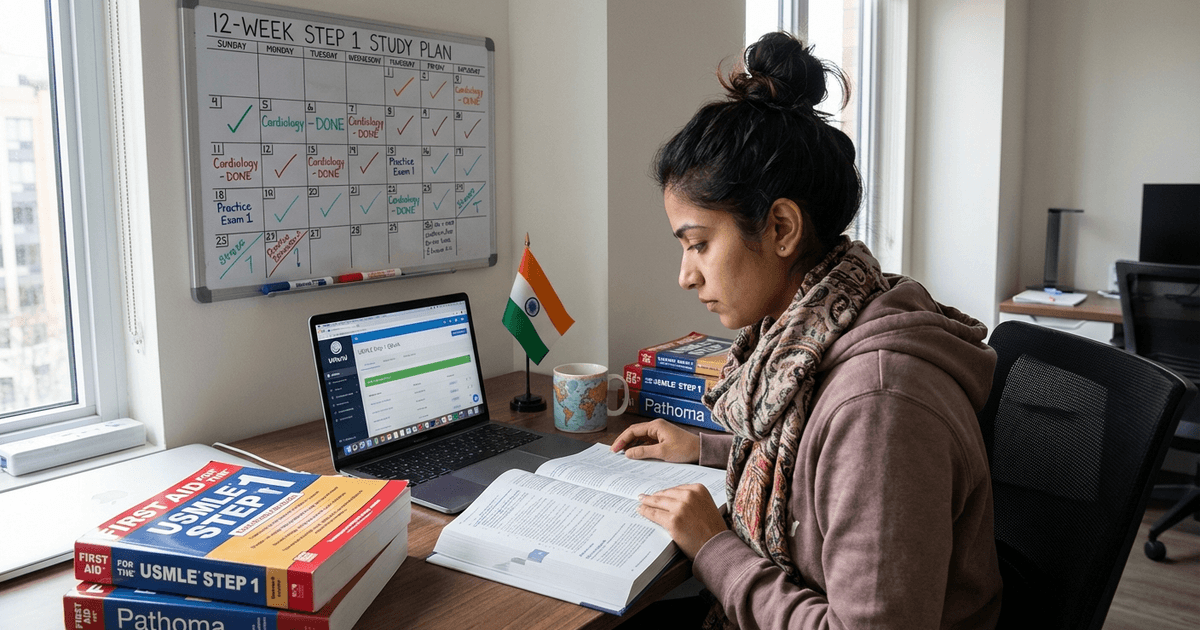
USMLE Step 1 Study Schedule for IMGs: Week-by-Week 3-Month Plan for Non-US Graduates 2026
You are probably staring at First Aid feeling overwhelmed. As an IMG, you dont have the luxury of a dedicated prep year or residency program guidance. You are essentially building the plane while flying it — managing visa timelines, family obligations, and the crushing weight of knowing Step 1 can make or break your US residency dreams.
USMLE Step 1 has 280 questions. You have 7 hours. For most IMGs, this single exam determines whether 4+ years of medical school translate into a US medical career or a pivot to something else entirely. The margin for error is razor-thin, especially in competitive specialties where a 240+ is often the unofficial cutoff.
Here's the reality: IMG prep is fundamentally different from US allopathic student prep. Your MBBS curriculum likely covered pathology and pharmacology brilliantly but barely touched behavioral science, biostatistics, or medical ethics. You are probably studying solo without access to senior guidance or peer study groups. Most IMG-focused advice online is either too generic ("just do UWorld") or assumes you have 6-12 months to prepare.
This 12-week schedule is built specifically for IMGs who need to maximize efficiency, address curriculum gaps, and achieve a competitive score in 3 months. It assumes 8-10 hours of daily study time and acknowledges the unique pressures you face.
Prerequisites: What You Need Before Week 1
Before starting this schedule, you need these resources locked down:
Core Materials:
First Aid for the USMLE Step 1 (2026 edition)
Pathoma (Fundamentals of Pathology)
Sketchy Medical (Micro and Pharm)
UWorld Question Bank (2,500+ questions)
NBME Practice Exams (Forms 25-30)
Digital Tools:
Anki (with premade deck like Anking or Zanki)
Question bank with adaptive targeting
Spaced repetition system for long-term retention
Baseline Assessment:
Take an NBME diagnostic before Week 1. This isnt optional. You need to know where you stand and which systems need the most work. Target breakdown:
Score 180-200: Follow this schedule exactly
Score 200-220: Compress Weeks 1-4 into 2-3 weeks, extend practice phase
Score <180: Consider extending to 4-5 months or addressing fundamental gaps first
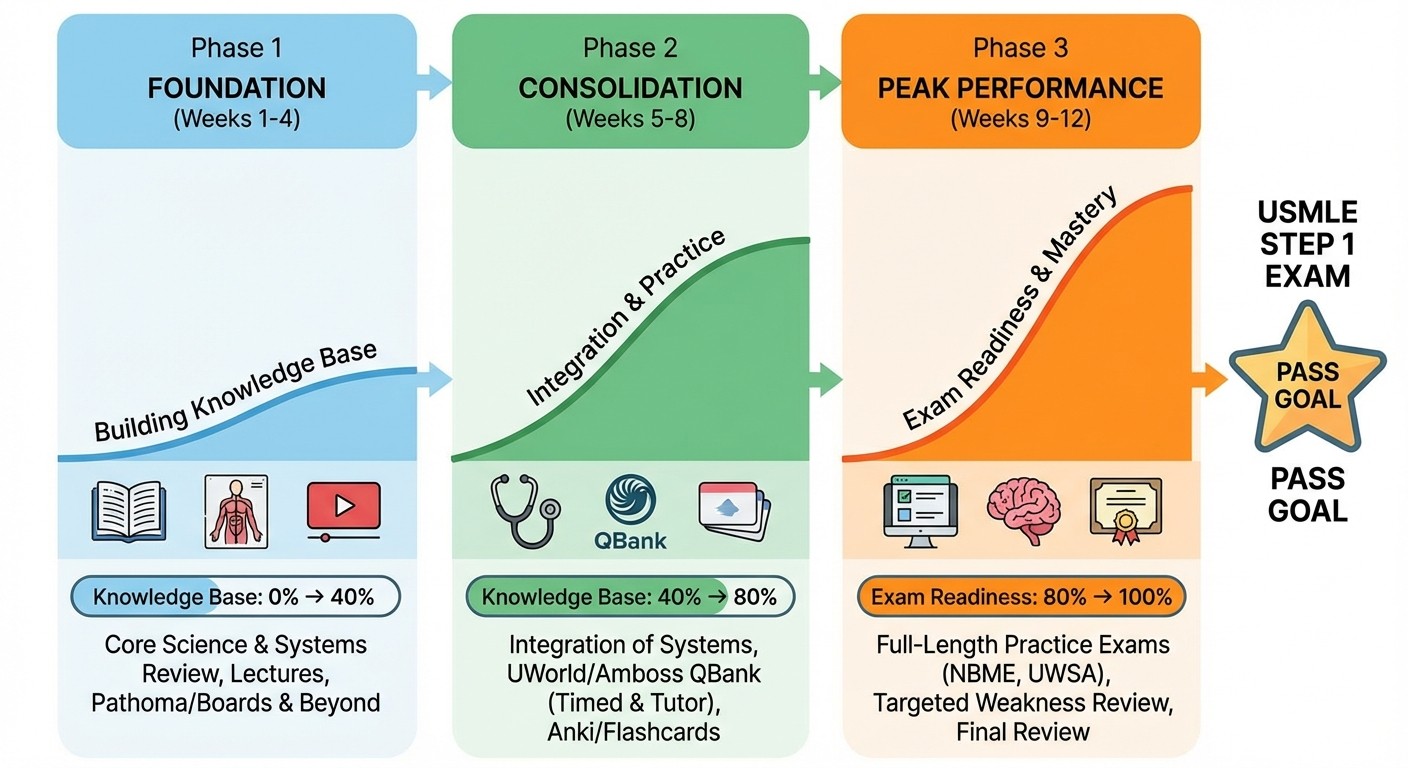
The 3-Phase Approach: Foundation → Consolidation → Peak Performance
Weeks 1-4: Foundation Phase
Build comprehensive knowledge base, address IMG-specific gaps, establish review rhythm
Weeks 5-8: Consolidation Phase
System-wide integration, weakness targeting, practice exam introduction
Weeks 9-12: Peak Performance
Full-length testing, score prediction, final polishing
Each week targets 8-10 study hours daily with one rest day. Adjust based on your schedule, but maintain the content ratios.
Weeks 1-4: Foundation Phase
Week 1: Cardiology & Pulmonology
Daily Breakdown (8-9 hours):
3 hours: First Aid reading + Pathoma videos
2 hours: Sketchy Micro/Pharm (relevant topics)
2 hours: UWorld practice (30-40 questions)
1 hour: Anki reviews (new + mature cards)
IMG Focus Points:
Congenital heart disease (often undertaught in non-US curricula)
Heart failure staging and guidelines (US-specific)
Ventilation/perfusion relationships
During this foundation phase, Oncourse's spaced repetition engine becomes critical for IMGs studying without coaching. Every question you get wrong automatically feeds into your next review session, so you are not manually tracking weak spots across multiple resources. Day 7: Rest day — light Anki reviews only
Week 2: GI & Hepatology
Daily Focus:
GI embryology and anatomy (high-yield for IMGs)
Liver function tests interpretation
IBD vs IBS differentials
Sketchy GI bugs (C. diff, H. pylori protocols)
Common IMG Mistake: Memorizing drug names without understanding mechanisms. US Step 1 tests WHY drugs work, not just what they treat.
Week 3: Renal & Electrolytes
High-Yield for IMGs:
Acid-base interpretation (stepwise approach)
Electrolyte disorders (hyponatremia subtypes)
Diuretic mechanisms and side effects
Renal pathology (glomerulonephritis patterns)
Week 4: Endocrine & Reproductive
IMG Gap Areas:
Diabetes management guidelines (US protocols)
Thyroid function test interpretation
PCOS diagnostic criteria
Menstrual cycle hormonal changes
By Week 4, you should be hitting 60-65% on UWorld questions. If you are below 55%, extend the foundation phase by 1-2 weeks before moving to consolidation.
Weeks 5-8: Consolidation Phase
Week 5: Neuro & Psychiatry + First NBME
New Addition: Take your first full-length NBME (Form 25 or 26) Daily Structure (9-10 hours):
2.5 hours: System review (Neuro anatomy, psychiatric disorders)
3 hours: UWorld blocks (40-50 questions)
2 hours: Wrong answer analysis
1.5 hours: Anki + weak area drilling
IMG Critical Areas:
Psychiatric medication mechanisms (often glossed over in MBBS)
Neuroanatomy lesion localization
Behavioral science concepts (US healthcare system, medical ethics)
Oncourse's adaptive question bank becomes invaluable here — it automatically identifies that IMGs typically struggle with behavioral science and biostatistics, surfacing more practice in these domains during your consolidation phase.
Week 6: Hematology & Oncology
Focus Shifts:
Less passive reading, more active recall
Emphasize UWorld explanations over First Aid
Begin targeting your specific weak systems
Week-Specific Goals:
UWorld average: 65-70%
Complete heme/onc question blocks
Master coagulation cascade (always tested)
Week 7: MSK & Dermatology
IMG Advantage: Most international curricula cover orthopedics well Time Allocation:
MSK: 60% of effort (high-yield, plays to your strengths)
Derm: 40% (lower yield but frequently tested)
New Strategy: Begin mixed-system UWorld blocks instead of system-specific. This mirrors actual exam format and tests knowledge integration.
Week 8: Microbiology & Immunology + Second NBME
Take NBME Form 27 or 28
By now, you should see a 15-20 point improvement from your first NBME. If not, extend consolidation phase by 1 week and delay peak performance.
Focus Areas:
Bug-drug matching (Sketchy pays off here)
Immunodeficiency patterns
Vaccine schedules (US-specific)
Weeks 9-12: Peak Performance Phase
Week 9: Systems Integration + UWSA1
New Format: Only mixed blocks and full-length exams Daily Schedule (10+ hours):
4 hours: UWorld mixed blocks (80+ questions)
3 hours: Comprehensive review of wrong answers
2 hours: Weak system drilling
1 hour: High-yield fact review (First Aid rapid pass)
Take UWSA1 (UWorld Self-Assessment) — this predicts your score range most accurately.
Week 10: Weakness Elimination
Data-Driven Approach:
Based on your NBME and UWSA1 results, identify your bottom 3 systems. Spend 70% of this week on those systems only.
Oncourse's performance analytics dashboard gives IMGs objective feedback without needing a tutor. You can see exactly which topics need work instead of guessing based on how questions "felt."
Common IMG Weak Areas:
Biostatistics (study design, statistical tests)
Medical ethics and patient communication
Pharmacokinetics and drug interactions
US healthcare system specifics
Week 11: Practice Marathon
Daily Structure:
Morning: Full NBME (Forms 29, 30, or Free 120)
Afternoon: Detailed review of every wrong answer
Evening: Light review of high-yield facts
Goal: Take 3-4 full practice exams this week Target Scores:
Competitive specialties: 240+ on practice exams
Less competitive: 225+ on practice exams
Safety: 210+ on practice exams
Week 12: Final Polish + Exam Week
Days 1-4: Light Review Only
No new material
Quick pass through First Aid high-yield sections
Anki reviews for retention
Light question practice (20-30 questions max)
Day 5: Pre-Exam Day
No studying after 6 PM
Review test day logistics
Get full sleep
Exam Day:
Light breakfast
Arrive early
Trust your preparation
IMG-Specific Adjustments
If You Have a Job (Part-Time Study)
Extend to 16-20 weeks following the same phase structure:
Foundation: 6-8 weeks
Consolidation: 6-8 weeks
Peak Performance: 4-6 weeks
Maintain daily minimums:
4-5 hours weekdays
8-10 hours weekends
If You Have Family Obligations
Early Morning Strategy (5-9 AM):
Most productive hours before family responsibilities begin. IMGs with children often find 4 AM starts necessary but manageable.
Micro-Sessions:
30-minute Anki sessions during commute
UWorld questions during lunch breaks
Pathoma videos while exercising
Score Targets by Specialty
Specialty | Target Score | IMG Recommendation |
|---|---|---|
Dermatology, Radiology | 250+ | Consider delaying if practice <245 |
Anesthesia, Pathology | 235+ | Solid target for most IMGs |
Internal Medicine | 220+ | Achievable with disciplined prep |
Family Medicine, Psychiatry | 210+ | Good safety net |
Common IMG Mistakes to Avoid
1. Underestimating Behavioral Science
US medical ethics, healthcare economics, and patient communication are foreign concepts to most IMGs. These make up 8-12% of the exam.
2. Ignoring Biostatistics Your MBBS program probably skipped this entirely. Dedicate 2-3 hours weekly from Week 1. Practice with targeted questions and use flashcards for retention. 3. Over-Relying on Passive Resources
Videos feel productive but dont build active recall. After Week 4, 70% of study time should be questions and active review.
4. Not Taking Practice Exams Seriously
Simulate real conditions: 7-hour exam, proper breaks, no phone. Your practice score predicts your real score within 10-15 points.
5. Cramming New Material in Final Week
IMGs often panic and try to learn new systems in Week 12. This backfires. Trust your preparation and focus on retention.
Week-by-Week Score Expectations
Using this schedule, typical IMG score progression:
Baseline NBME: 180-200
Week 4: 195-215 (foundation complete)
Week 8: 210-230 (consolidation complete)
Week 11: 220-245 (peak performance)
Actual Step 1: Usually 5-10 points higher than final NBME
The performance analytics in modern adaptive platforms help IMGs track this progression objectively, identifying exactly when to advance phases or extend preparation.
Final Week Mindset
You have studied 800+ hours over 12 weeks. You have seen 2,500+ questions. You know the material. Step 1 success for IMGs isnt about perfection — it is about consistent performance under pressure.
Remember: 65% correct answers typically scores 230+. You dont need to know everything. You need to know the high-yield material cold and make educated guesses on the rest.
Frequently Asked Questions
Is 3 months enough for USMLE Step 1 as an IMG?
Yes, if you can dedicate 8-10 hours daily and have a strong foundation from medical school. IMGs with weaker English or significant curriculum gaps may need 4-5 months.
Should I postpone Step 1 if my practice scores are low?
If you are consistently scoring <210 on NBMEs in Week 10, consider postponing. The fee loss is better than a failing score that limits residency options permanently.
How important is Step 1 for IMG residency matching?
Critical. Step 1 is often the primary screening tool for IMGs since program directors cant evaluate your clinical rotations easily. A competitive score opens doors; a low score closes them.
Can I work while preparing for Step 1?
Part-time work (20-30 hours/week) is manageable if you extend the timeline to 16-20 weeks. Full-time work makes quality preparation nearly impossible.
What if I fail Step 1 as an IMG?
You can retake it, but failing scores are permanently reported. Focus on thorough preparation the first time. Most programs prefer a 230 on first attempt over a 250 on second attempt.
How do I handle test anxiety on exam day?
Practice full-length exams under real conditions during Weeks 9-12. Familiarity with the 7-hour format reduces anxiety significantly. Consider meditation or breathing exercises if anxiety is severe.
Prepare smarter with Oncourse AI — adaptive MCQs, spaced repetition, and AI explanations built for USMLE Step 1. Download free on Android and iOS.