Back
How to Study Physiology for NEET PG 2026: Complete Strategy, High-Yield Systems and Exam Checklist
Master physiology for NEET PG 2026 with this complete strategy guide. Learn high-yield systems, exam patterns, MCQ approach, and 30-day study plan to boost your score.
How to Study Physiology for NEET PG 2026: Complete Strategy, High-Yield Systems and Exam Checklist
You are probably thinking physiology is your weakest link. Most final-year students push it to the bottom of their NEET PG priority list — after all, you covered it in second year, right? Here's the counterintuitive truth: physiology questions in NEET PG 2026 dont test basic definitions anymore. They test applied physiology. Clinical scenarios where you need to understand WHY the body responds the way it does.
NEET PG has 200 questions. Physiology gets 16-18 questions consistently — that's 8-9% weightage. Each correct answer is worth 4 marks, each wrong costs you 1. Miss half your physiology questions and you lose 60+ marks. In a rank-sensitive exam where 10 marks can shift your rank by 1000+ positions, physiology is not optional.
The students who crack physiology don't memorise facts. They understand regulation mechanisms. They can predict what happens when one system fails. They see the connections between cardiovascular, respiratory, and renal physiology that turn complex scenarios into obvious answers.
This guide breaks down exactly how to master physiology for NEET PG 2026. You will learn which systems dominate the exam, what to study in each, and how to think through applied physiology questions that trip up most candidates.
Why Physiology Matters More Than You Think in NEET PG
Physiology questions in NEET PG 2026 follow a predictable pattern. 60% test regulatory mechanisms — how systems maintain homeostasis and what happens when they fail. 30% focus on clinical correlations — interpreting lab values, understanding disease pathophysiology, connecting symptoms to underlying physiology. Only 10% are straightforward factual recall.
Here's what this means: if you only memorise normal values and basic functions, you will struggle with 90% of physiology questions. The exam tests whether you can apply physiological principles to solve clinical problems.
Consider this typical NEET PG physiology question pattern: A 45-year-old patient presents with severe dehydration. His plasma ADH levels are elevated, but urine output remains high with low specific gravity. What is the most likely diagnosis?
This isn't testing ADH function directly. It's testing whether you understand the complete ADH pathway, recognize when the hormone is present but not working, and can differentiate between central vs nephrogenic diabetes insipidus. Most students know ADH reduces urine output — few can work backwards from clinical findings to identify pathway disruptions.
NEET PG 2026 Physiology Weightage Breakdown
Based on recent NEET PG patterns, here's how physiology questions distribute across systems:
System | Question Count | Percentage | Key Topics |
|---|---|---|---|
Cardiovascular | 4-5 | 25% | ECG, cardiac cycle, BP regulation, heart failure |
Respiratory | 3-4 | 20% | V/Q matching, gas transport, respiratory failure |
Renal | 3 | 15% | GFR regulation, acid-base, electrolyte balance |
Endocrine | 2-3 | 15% | HPG axis, thyroid, insulin, stress response |
Neurophysiology | 2 | 12% | Action potentials, synaptic transmission, reflexes |
GI Physiology | 2 | 8% | Digestion, absorption, GI hormones |
Others | 1 | 5% | Exercise, temperature regulation, sleep |
The pattern is clear: cardiovascular and respiratory physiology dominate. Master these two systems and you secure 45% of your physiology marks. Add renal physiology and you're looking at 60%. These three systems also interconnect heavily — understanding one strengthens your grasp of the others.
High-Yield Physiology Systems for NEET PG 2026
Cardiovascular Physiology: The Foundation
CVS physiology appears in 4-5 questions every year. Focus on regulation rather than anatomy. Here are the must-know topics:
Cardiac Cycle & Pressure-Volume Relationships
Frank-Starling mechanism and its clinical applications
Pressure-volume loops in different cardiac conditions
Heart sounds and their physiological basis
Effects of preload, afterload, and contractility changes
ECG Interpretation from Physiological Perspective
Ion channel activities during different ECG phases
Why certain conditions cause specific ECG changes
Relationship between action potential duration and refractory periods
Effects of electrolyte imbalances on cardiac electrophysiology
Blood Pressure Regulation
Baroreceptor reflex and its components
RAAS system activation and feedback loops
Role of kidneys in long-term BP control
Autoregulation in different organ systems
The key insight: CVS questions usually present a clinical scenario and ask you to predict the physiological response. Practice with cardiovascular physiology MCQs that connect pathophysiology to underlying mechanisms. Pro tip: When studying cardiac cycle, Oncourse's Synapses feature helped me memorize the timing of heart sounds using the mnemonic "S1-Start, S2-Stop" where S1 marks ventricular systole start and S2 marks its end. Understanding this timing makes murmur questions much clearer.
Respiratory Physiology: Gas Exchange Mastery
Respiratory physiology consistently appears in 3-4 questions. The emphasis is on gas transport and V/Q relationships.
Ventilation-Perfusion Relationships
Normal V/Q ratio and its significance
High V/Q conditions (dead space) and compensations
Low V/Q conditions (shunt) and their effects
Hypoxic pulmonary vasoconstriction mechanism
Gas Transport Mechanisms
Oxygen-hemoglobin dissociation curve shifts
CO2 transport methods and their relative contributions
Bohr effect and Haldane effect
Effects of 2,3-DPG on oxygen affinity
Respiratory Control
Central and peripheral chemoreceptor functions
Response to hypoxia vs hypercapnia
Exercise-induced ventilatory changes
Altitude adaptation mechanisms
Most respiratory physiology questions test your ability to predict gas exchange changes in disease states. Study how COPD, pneumonia, pulmonary embolism, and high altitude affect V/Q matching. Practice identifying these patterns in respiratory system questions.
Renal Physiology: Filtration and Balance
Renal physiology appears in 3 questions typically, focusing on regulation rather than anatomy.
GFR Regulation and Measurement
Autoregulation mechanisms (myogenic and tubuloglomerular feedback)
Hormonal control of GFR (angiotensin II, prostaglandins)
Clearance concepts and their clinical applications
Factors affecting filtration fraction
Acid-Base Physiology
Henderson-Hasselbalch equation applications
Metabolic vs respiratory acidosis/alkalosis
Compensatory mechanisms and their time courses
Anion gap calculations and interpretations
Electrolyte and Water Balance
ADH mechanism and regulation
Aldosterone effects on sodium and potassium
Calcium regulation involving PTH and vitamin D
Osmolarity vs osmolality concepts
The pattern in renal questions: they give you lab values and ask you to work backwards to the underlying physiological problem. Master the normal ranges and understand what drives each parameter. Use renal physiology flashcards to drill these values until they're automatic. Study hack: Rezzy AI helped me connect the dots between different electrolyte disorders. When I asked "Why does hyperaldosteronism cause hypokalemia?", it explained the complete ENaC channel mechanism and linked it to clinical manifestations like muscle weakness and arrhythmias.
Best Books and Resources for NEET PG Physiology 2026
Primary Textbook: Choose Your Level
KD Tripathi Physiology (7th Edition)
Best for: Building conceptual foundation, understanding mechanisms
Strength: Excellent diagrams, clinical correlations throughout
How to use: Read once for concepts, then refer specific chapters during revision
Time needed: 2-3 weeks for complete first reading
Ganong's Medical Physiology (26th Edition)
Best for: Deep understanding, complex regulatory mechanisms
Strength: Detailed explanations of homeostatic controls
How to use: Reference book for difficult concepts, not for initial reading
Time needed: Use for specific topic clarification, not linear reading
Quick Reference Materials
Marrow/Dams Physiology Notes
Best for: Last-minute revision, high-yield fact compilation
Strength: Exam-focused content, previous year question coverage
How to use: Final month revision, quick fact checking
Time needed: 1 week for complete revision
Physiology MCQ Books
Recommended: Previous NEET PG questions + explanations
Focus on: Understanding question patterns, not just memorizing answers
Practice schedule: 20-30 MCQs daily after studying each system
The winning combination: KD Tripathi for foundation + Marrow notes for revision + extensive MCQ practice. Don't try to read multiple detailed textbooks — you'll get stuck in analysis paralysis.
Common NEET PG Physiology Question Patterns
Understanding how NEET PG tests physiology helps you study smarter. Here are the 5 most common question types:
Pattern 1: Regulatory Mechanism Disruption
"A patient has elevated cortisol but normal ACTH. What is the most likely diagnosis?"
This tests your understanding of feedback loops. High cortisol should suppress ACTH via negative feedback. If ACTH is normal despite high cortisol, the problem is adrenal (primary hyperaldosteronism) not pituitary.
How to approach: Map out the complete regulatory axis. Identify where feedback should occur. Determine what's broken based on the lab pattern.
Pattern 2: Compensatory Response Prediction
"A patient with severe anemia shows increased cardiac output. Which parameter is most likely responsible?"
The body compensates for reduced oxygen-carrying capacity by increasing heart rate and stroke volume. This tests whether you can predict physiological adaptations.
How to approach: Identify the primary problem. List all body systems affected. Predict how each system compensates. Choose the most significant compensation.
Pattern 3: Clinical Correlation
"A patient has metabolic acidosis with normal anion gap. Which condition is most likely?"
This connects physiology to clinical medicine. Normal anion gap acidosis suggests bicarbonate loss (diarrhea, RTA) rather than acid accumulation (diabetic ketoacidosis).
How to approach: Connect the physiological finding to possible causes. Eliminate options that don't fit the pattern. Focus on the most common clinical scenarios.
Study these patterns by working through comprehensive physiology questions that mirror actual NEET PG complexity. Don't just read explanations — try to solve similar questions using the same logical approach.
30-Day Physiology Sprint Plan for NEET PG 2026
If you are starting physiology prep with limited time, this 30-day plan maximizes your score potential:
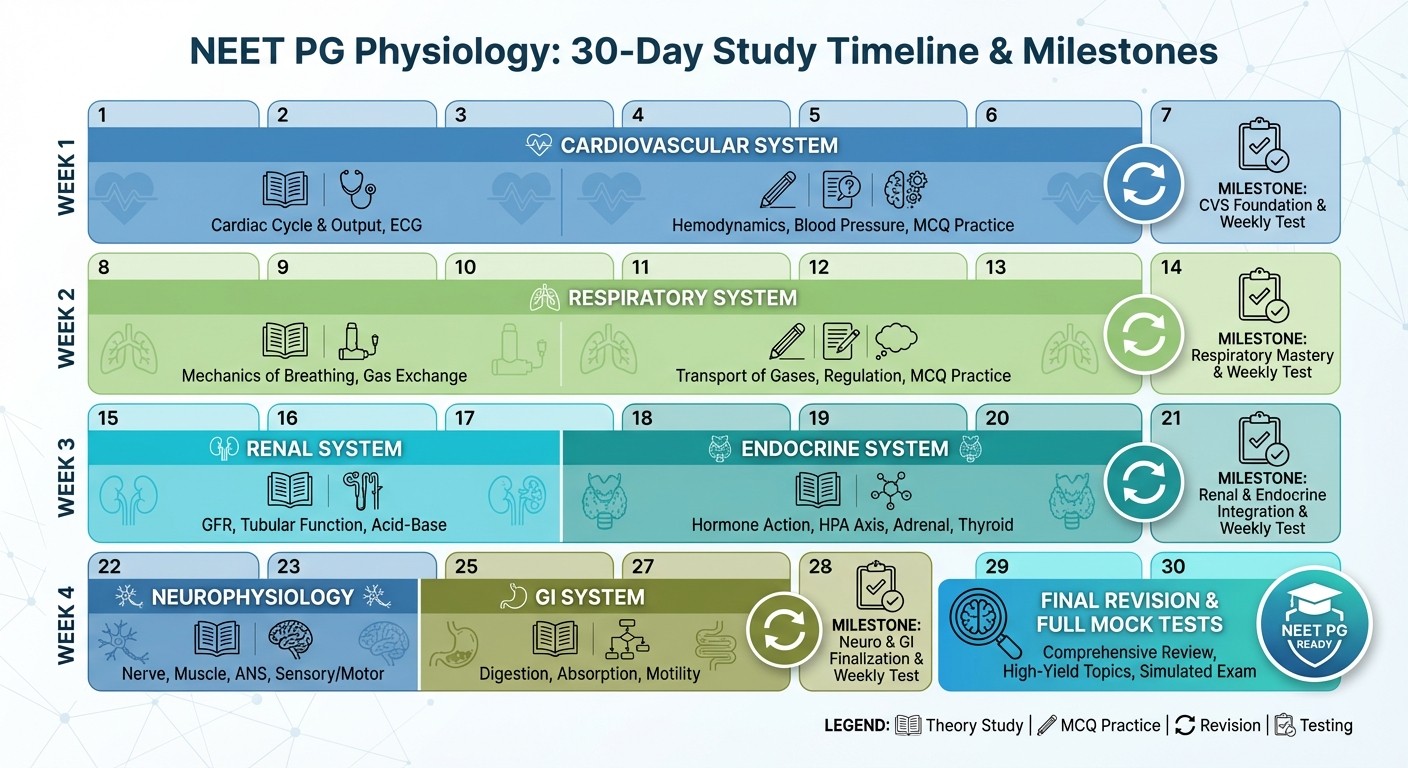
Week 1: Foundation Systems (Days 1-7)
Days 1-3: Cardiovascular physiology (cardiac cycle, ECG, BP regulation)
Days 4-5: Respiratory physiology (V/Q matching, gas transport)
Days 6-7: MCQ practice on CVS + Respiratory (50 questions each)
Daily schedule: 4 hours reading + 1 hour MCQ practice + 30 minutes flashcard review
Week 2: Regulation Systems (Days 8-14)
Days 8-10: Renal physiology (GFR, acid-base, electrolytes)
Days 11-12: Endocrine physiology (HPG axis, thyroid, adrenal)
Days 13-14: MCQ practice on Renal + Endocrine + revision
Focus on interconnections — how kidneys affect BP, how hormones regulate metabolism, how acid-base affects electrolytes.
Week 3: Integration & Application (Days 15-21)
Days 15-16: Neurophysiology + GI physiology
Days 17-18: Mixed system MCQs (clinical scenarios)
Days 19-21: Weak area identification and targeted revision
This week identifies your knowledge gaps. Use Oncourse's adaptive daily plans to focus extra time on your weakest physiology systems.
Week 4: Mastery & Testing (Days 22-30)
Days 22-24: High-yield topic revision using Marrow notes
Days 25-27: Full-length physiology tests (50-60 questions)
Days 28-30: Final revision of formulas, normal values, key concepts
The final week should feel like review, not new learning. If you are still discovering new concepts, you need to adjust your timeline.
Daily tracking: Log your MCQ accuracy by system. Aim for 75%+ by week 4. If any system is below 70%, allocate extra review time.
Prepare smarter with Oncourse AI — adaptive MCQs, spaced repetition, and AI explanations built for NEET PG success. Download free on Android and iOS and transform your physiology preparation from random facts into connected understanding.