Back
How Oncourse Probe Works: AI-Powered Viva and Oral Exam Simulation for NEET PG and USMLE (2026)
Discover how Oncourse Probe's clue-based AI viva simulation trains medical students for oral exams through progressive recall challenges, daily practice, and clinical reasoning under pressure.
How Oncourse Probe Works: AI-Powered Viva and Oral Exam Simulation for NEET PG and USMLE (2026)
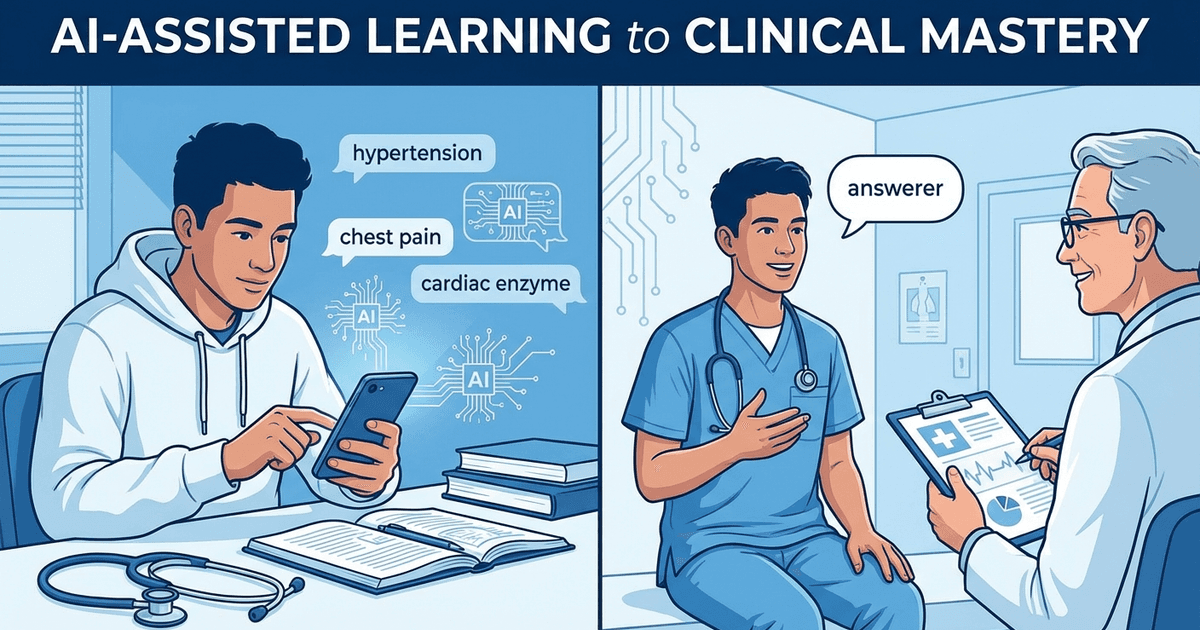
You know that sinking feeling when your consultant starts rapid-firing clinical questions during ward rounds? Or when you're staring at a NEET PG viva examiner who just asked about a drug mechanism using only 3 cryptic clues?
Traditional question banks cant simulate this. MCQs give you 4 options to choose from. Real viva situations give you blank stares and awkward silence until you piece together what they're actually asking about.
That gap between multiple-choice practice and oral examination reality is exactly what Oncourse Probe bridges. Its not another quiz app — its a clue-based medical recall game that mimics how senior doctors and examiners actually test your knowledge in real clinical settings.
Here's how this AI-powered viva simulation works, why it trains your brain differently than passive studying, and how NEET PG and USMLE students are using it to ace oral examinations and clinical rounds.
What Is Oncourse Probe?
Oncourse Probe is a daily medical recall challenge that flips the traditional study model. Instead of reading definitions and selecting answers, you work backwards from progressive clues to identify hidden medical terms.
Each Probe game contains 5 rounds. In every round, the AI presents a hidden medical term and reveals up to 5 clues about it, one at a time. You type your guess after each clue. The AI evaluates your answer, provides semantic feedback (how close you were), and either confirms you're correct or nudges you toward the right answer with the next clue.
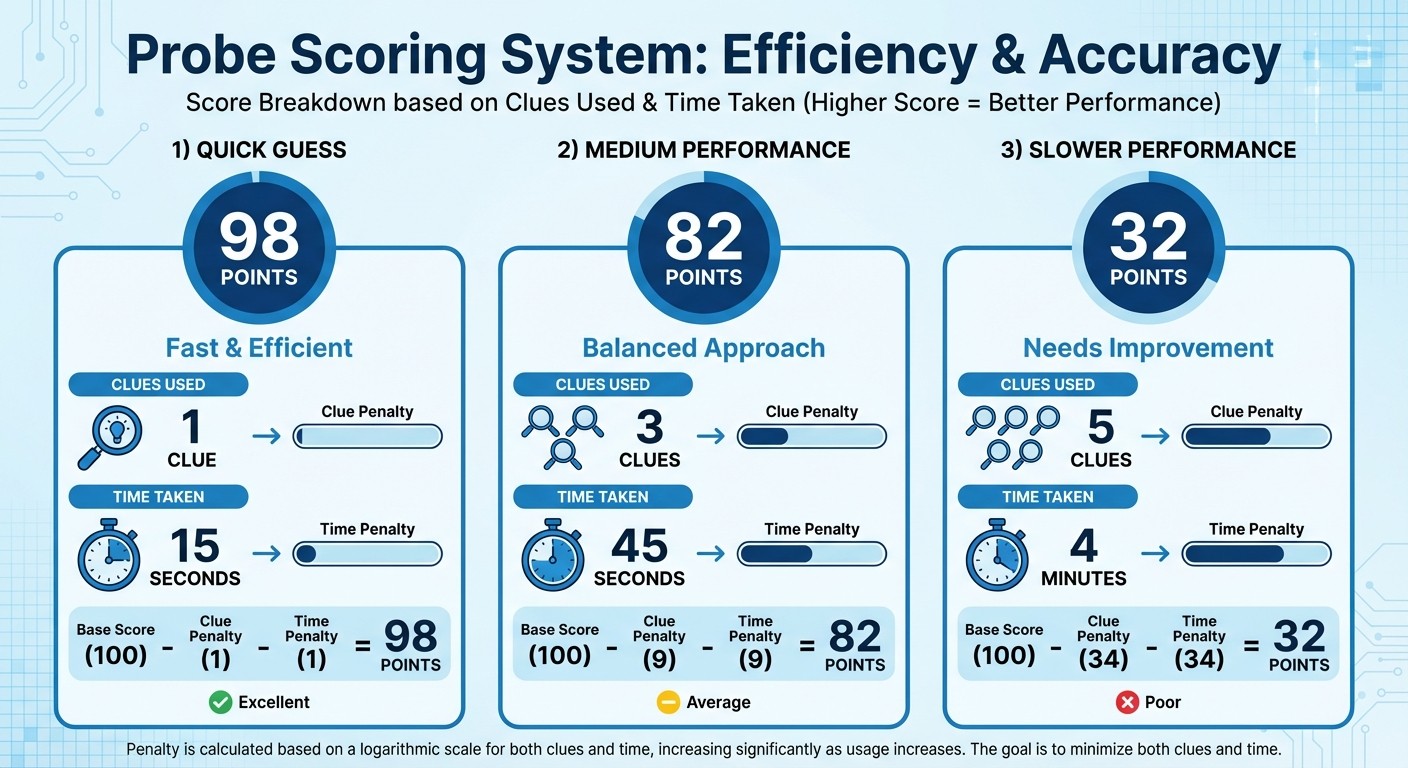
The scoring system rewards speed and efficiency: guess correctly with just the first clue and you score close to 100 points for that round. Need all 5 clues and take 4 minutes? Your score drops significantly.
This mirrors exactly what happens during clinical viva examinations. The examiner starts broad ("tell me about this patient's chest pain"), then gets more specific if you're struggling ("what about the character of the pain?", "any associated symptoms?"), until you finally connect the dots or run out of time.
How the 5-Clue Progressive System Works
The clue progression in Probe follows clinical reasoning patterns that senior doctors use when testing students:
Clue 1: Usually the broadest context — symptom category, body system, or clinical presentation Clue 2: Narrows down the mechanism, pathophysiology, or specific condition type Clue 3: Adds diagnostic criteria, characteristic features, or treatment categories Clue 4: Gets quite specific — dosages, timelines, contraindications, or rare presentations Clue 5: Practically gives away the answer with highly specific details
For example, if the hidden term is "Digoxin":
Clue 1: "Cardiac glycoside used in heart failure"
Clue 2: "Inhibits sodium-potassium ATPase pump"
Clue 3: "Narrow therapeutic window, requires monitoring"
Clue 4: "Toxicity causes yellow vision and arrhythmias"
Clue 5: "Derived from foxglove plant, therapeutic range 0.5-2.0 ng/mL"
Most students who know Digoxin well will guess it by Clue 2. Students with weaker pharmacology knowledge might need Clue 4. The scoring reflects this knowledge gradient.
The AI doesn't just mark you right or wrong — it provides a semantic distance score showing how close your guess was. Guess "Digitalis" when the answer is "Digoxin"? You'll get positive feedback and a nudge that you're on the right track but need to be more specific.
This active feedback loop teaches pattern recognition and clinical reasoning under time pressure, exactly what viva examiners test for.
Daily Challenge vs Solo Mode: Two Ways to Play
Probe offers two distinct game modes, each serving different study needs:
Daily Probe Challenge
Fresh set of 5 medical terms every day. Once you complete that day's challenge, its locked — you get one attempt per day, just like a real exam.
This creates what behavioral psychologists call a "commitment device." Students check their daily Probe score against friends, similar to how people share Wordle results. The social element and limited attempts make each game feel meaningful.
The daily format also ensures consistent recall practice. Instead of cramming recall exercises right before exams, students develop a 5-minute daily habit that builds long-term retention.
Solo Mode
On-demand practice with unlimited new term sets. Perfect for targeted drilling when you identify weak areas through the daily challenge.
Failed badly on cardiology terms in today's Daily Probe? Jump into Solo mode and generate more cardiovascular challenges until those patterns stick.
Both modes use the same 5-clue system and AI feedback, but Solo mode lets you practice specific topics or play multiple rounds when you have extra study time.
The Scoring System: Speed + Efficiency = Clinical Competence
Probe scoring reflects how clinical competence actually works in practice. Quick, accurate recall with minimal information demonstrates deeper understanding than slow, methodical elimination.
Here's the exact scoring formula:
Base score: 100 points per round
Time penalty: floor(seconds_elapsed / 10) × 2
Clue penalty: (clues_used - 1) × 5
Real examples:
Guess correctly with Clue 1 in 15 seconds = 100 - 2 - 0 = 98 points
Need Clue 3 and take 45 seconds = 100 - 8 - 10 = 82 points
Use all 5 clues and take 4 minutes = 100 - 48 - 20 = 32 points
Your final score is the average across all 5 rounds, ranked on global leaderboards against other medical students.
This scoring system teaches clinical efficiency. In real ward rounds or viva situations, confident, quick responses demonstrate competence. Hesitant, methodical thinking (even if eventually correct) signals knowledge gaps.
When a student realizes they scored low because they needed multiple clues for basic cardiology terms, they naturally focus more attention on cardiology review — exactly the kind of targeted studying that viva preparation requires.
Why Clue-Based Learning Beats Traditional Flashcards
Standard flashcards show you a question and flip to reveal the answer. Probe forces active reconstruction from partial information. This difference is crucial for oral exam preparation.
Traditional Flashcard Flow:
1. Read: "What is the mechanism of action of digoxin?"
2. Think: "Something about sodium-potassium pump..."
3. Flip: "Inhibits Na+/K+ ATPase pump"
4. Mark: Correct or incorrect
Probe Flow:
1. See: "Cardiac glycoside used in heart failure"
2. Think: "Could be digoxin, digitalis, maybe dobutamine?"
3. Guess: "digoxin"
4. AI: "Close! Think about the specific mechanism..."
5. Refine: Based on semantic feedback and next clue
The Probe method builds the same neural pathways that oral examiners test. When your NEET PG viva examiner says "tell me about a drug that helps with heart failure but has a narrow therapeutic window," your brain has practiced working backwards from these exact clue patterns.
For USMLE Step 2 CK students preparing for clinical reasoning scenarios, this reverse-engineering skill is essential. Instead of recognizing symptoms from a complete case presentation, you learn to build differential diagnoses from incomplete information — exactly what happens in real clinical practice.
Game Modes and Study Integration
Connecting Probe to Your Existing Study Routine
The real power of Probe emerges when you connect it to your broader study system. When you fail a round (AI wins), that failure points to a specific knowledge gap that needs targeted review.
Say you needed all 5 clues to identify "Acute Coronary Syndrome" — that signals weak cardiology recall. You can immediately jump into Rezzy AI tutor and ask "explain ACS pathophysiology step by step" to build deeper understanding of why you missed those clues.
Or convert that missed term into a spaced repetition flashcard using Oncourse Synapses. The next time Probe surfaces a similar cardiology term, your brain has the recall pathway already established.
This creates a natural study loop: Probe reveals gaps → targeted learning fills gaps → improved Probe performance → confidence in clinical scenarios.
Leaderboard Psychology and Peer Learning
The global leaderboard ranks students by average score across the 5 daily rounds. Two timeframes available: daily rankings and all-time rankings.
This isn't just gamification for fun — it mirrors the competitive environment of clinical training. Residency spots, clinical rotations, and specialty matching all involve performance comparison against peers.
Students naturally form study groups around Probe scores. "I scored 87 today, what did you get?" leads to discussing which terms they found challenging, sharing study resources for weak areas, and friendly competition that drives consistent practice.
The daily ranking system also creates urgency. You cant go back and improve yesterday's score — just like you cant redo a viva examination or clinical presentation. This teaches students to perform under pressure with limited attempts, building mental resilience for high-stakes medical exams.
Technical Implementation: How the AI Evaluates Your Answers
The AI evaluation system behind Probe goes beyond simple keyword matching. When you submit a guess, the system analyzes semantic similarity, provides distance scoring, and generates contextual feedback based on the entire conversation history.
Semantic Distance Scoring
Instead of binary right/wrong feedback, Probe calculates how conceptually close your answer is to the target term.
Guess "myocardial infarction" when the answer is "acute coronary syndrome"? You'll get high semantic similarity and feedback like "you're in the right clinical area — think broader category that includes this condition."
This mirrors how good clinical teachers provide feedback. They dont just say "wrong" — they guide your thinking toward the correct pathway while acknowledging what you got right.
Contextual AI Guidance
The AI uses your full conversation transcript to provide personalized nudges. If you guessed two cardiology drugs incorrectly before getting the third right, it might say "good job connecting the cardiac mechanism — consider the specific receptor this one targets."
This contextual awareness makes each Probe interaction feel like a real conversation with a knowledgeable senior resident who knows your thought patterns and can guide your reasoning effectively.
NEET PG Viva Preparation: From Written MCQs to Oral Confidence
NEET PG students face a unique challenge: most preparation focuses on written MCQs, but clinical postings and some specialties require strong oral examination skills. Ward rounds, case presentations, and viva scenarios all test rapid recall and clinical reasoning under pressure.
Probe trains exactly these skills. When your consultant asks about differential diagnosis during rounds, you've practiced building answers from progressive clues hundreds of times. When a viva examiner starts with "tell me about chest pain," your brain automatically starts connecting symptom patterns to specific conditions.
The daily 5-minute habit also fits perfectly into packed NEET PG study schedules. Between lectures, clinical postings, and MCQ practice, finding time for additional oral exam preparation is challenging. Probe delivers focused viva practice in the same time it takes to grab coffee.
Students preparing for clinical subjects like Medicine, Surgery, and Pediatrics particularly benefit from Probe's clinical reasoning approach. These specialties heavily emphasize bedside manner, case presentation skills, and rapid diagnostic thinking — all areas where clue-based recall practice provides direct preparation benefit.
For those focusing on clinical anatomy or clinical examination skills, Probe's progressive clue system mirrors how senior doctors test anatomical knowledge during patient examinations.
USMLE Step 2 CK: Building Clinical Reasoning Skills
USMLE Step 2 CK tests clinical knowledge application, diagnostic reasoning, and patient management decisions. While the exam format is multiple choice, the underlying skills — rapid pattern recognition and clinical reasoning under time pressure — align perfectly with Probe's training methodology.
Step 2 CK questions often present incomplete clinical scenarios where you must identify the most likely diagnosis or next best step. This requires the same backward-reasoning skills that Probe develops: taking limited information and reconstructing the complete clinical picture.
The time pressure element is crucial. Step 2 CK gives you roughly 90 seconds per question. Students who practice quick recall and efficient clinical reasoning through Probe perform better when facing time constraints during the actual exam.
For students strengthening their clinical reasoning foundations, Probe provides active practice in pattern recognition and hypothetico-deductive reasoning — core competencies tested throughout USMLE Step 2 CK.
Real Student Success Stories and Usage Patterns
Students who use Probe consistently report improved confidence during clinical interactions and oral examinations. The daily habit builds mental muscle memory for quick recall under pressure.
Common usage patterns:
Morning routine: Start the day with Daily Probe before clinical rotations or study sessions
Between classes: Quick 5-minute Solo mode sessions during breaks
Post-lecture review: Use Probe to test recall of topics just covered in class
Pre-exam drilling: Intensive Solo mode practice focusing on weak subject areas
The most successful users treat Probe as complement to, not replacement for, comprehensive study. They use daily challenges to identify knowledge gaps, then address those gaps through targeted review using other Oncourse features or external resources.
Students also report that Probe improves their ability to think quickly during patient presentations and clinical rounds. The training in working with incomplete information translates directly to bedside clinical reasoning.
Getting Started: Your First Probe Session
Ready to try Probe? Here's what your first session looks like:
1. Visit Oncourse Probe and choose Daily Challenge or Solo mode
2. Read the first clue for Round 1 and type your best guess
3. Receive AI feedback — semantic distance score and guidance toward the answer
4. Continue with additional clues until you guess correctly or exhaust all 5 clues
5. Move to Round 2 and repeat for all 5 rounds
6. Review your results — see your score breakdown and global leaderboard ranking
The interface feels like messaging with a knowledgeable senior resident who drops hints until you connect the dots. Sound effects provide immediate feedback, and the clean chat-style design keeps you focused on the medical content rather than complex game mechanics.
Start with Daily Challenge to build the habit, then use Solo mode for targeted practice on topics where you scored poorly.
Frequently Asked Questions
How long does each Probe session take?
A complete 5-round session typically takes 10-15 minutes. Each individual round has a 5-minute timer, but most students finish rounds in 1-3 minutes when they know the terms well.
Can I replay the same Daily Challenge?
No — Daily Challenges lock after completion to maintain the one-attempt-per-day format. This mimics real exam conditions and encourages consistent daily practice. Use Solo mode for additional practice sessions.
What medical topics does Probe cover?
Probe draws from the same comprehensive medical database as other Oncourse features, covering all major subjects tested in NEET PG and USMLE examinations: internal medicine, surgery, pediatrics, gynecology, pathology, pharmacology, and more.
How does the AI decide which clues to give?
The AI analyzes the target term and generates clues that progress from general to specific, following clinical reasoning patterns. Clues are designed to mirror how senior doctors and examiners actually test medical knowledge in practice.
Is Probe included in the free tier?
Yes, Probe is available to all Oncourse users. Daily Challenges are unlimited, and Solo mode has generous usage limits even on the free tier.
How do I improve my Probe scores?
Focus on speed and pattern recognition. When you miss terms, review those specific topics using Oncourse lessons or convert them into Synapses flashcards for spaced repetition review. Consistent daily practice naturally improves your clinical recall speed.
---
Prepare smarter with Oncourse AI — adaptive MCQs, spaced repetition, and AI explanations built for NEET PG and USMLE. Download free on Android and iOS.