The Complete Study Plan for USMLE Step 1: Week-by-Week Schedule and High-Yield Strategy (2026)
Master USMLE Step 1 with our comprehensive 24-week study plan. Get week-by-week schedules, high-yield strategies, and proven methods for 2026 success.
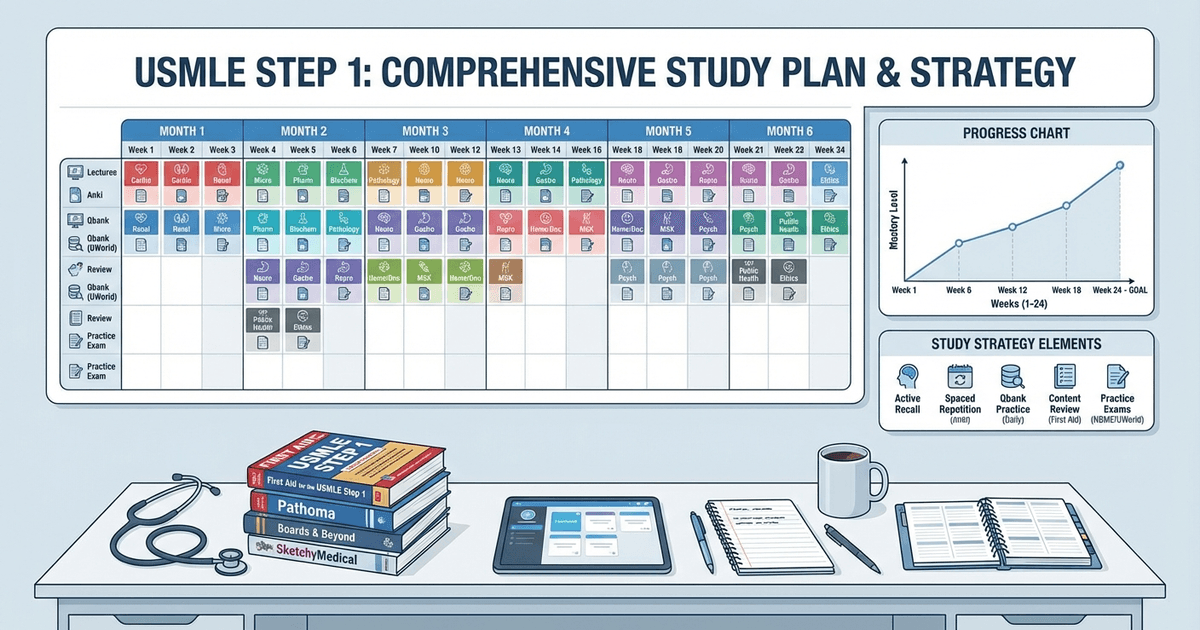
The Complete Study Plan for USMLE Step 1: Week-by-Week Schedule and High-Yield Strategy (2026)
The USMLE Step 1 transition to pass/fail scoring has fundamentally changed how medical students approach this critical exam. With the pressure of numerical scores removed, the focus has shifted to mastering high-yield concepts and developing a robust understanding of basic science foundations. In 2026, success requires a strategic, systematic approach that balances comprehensive knowledge building with efficient time management.
Creating the perfect USMLE Step 1 study plan isn't just about logging hours—it's about maximizing retention, targeting high-yield topics, and building the clinical reasoning skills that will serve you throughout your medical career. This comprehensive guide provides a detailed 24-week preparation strategy that has helped thousands of medical students achieve passing scores while building a strong foundation for Step 2 CK and beyond.
Understanding USMLE Step 1 in 2026: What You Need to Know
Since the transition to pass/fail in January 2022, USMLE Step 1 has evolved from a competition-based exam to a competency assessment. However, this doesn't mean the exam has become easier. The passing standard remains rigorous, and comprehensive preparation is essential for success.
Current Exam Structure and Format
The USMLE Step 1 consists of:
280 questions divided into 7 blocks of 40 questions each
8 hours total testing time (approximately 1 hour per block)
45 minutes of break time distributed throughout the day
Computer-based testing at Prometric centers worldwide
The exam covers fundamental sciences with an emphasis on:
Pathology (25-30%)
Physiology (20-25%)
Pharmacology (15-20%)
Anatomy (10-15%)
Biochemistry (10-15%)
Microbiology (8-12%)
Behavioral Sciences (5-8%)
Why a Structured Study Plan Matters
Research shows that medical students who follow a structured study plan are 65% more likely to pass Step 1 on their first attempt compared to those who study without a clear schedule. A well-designed plan helps you:
Avoid knowledge gaps by ensuring comprehensive coverage
Optimize retention through spaced repetition and active recall
Build confidence with progressive difficulty and regular assessments
Prevent burnout by balancing intensive study with strategic breaks
Track progress and adjust strategies based on performance metrics
The Complete 24-Week USMLE Step 1 Study Schedule
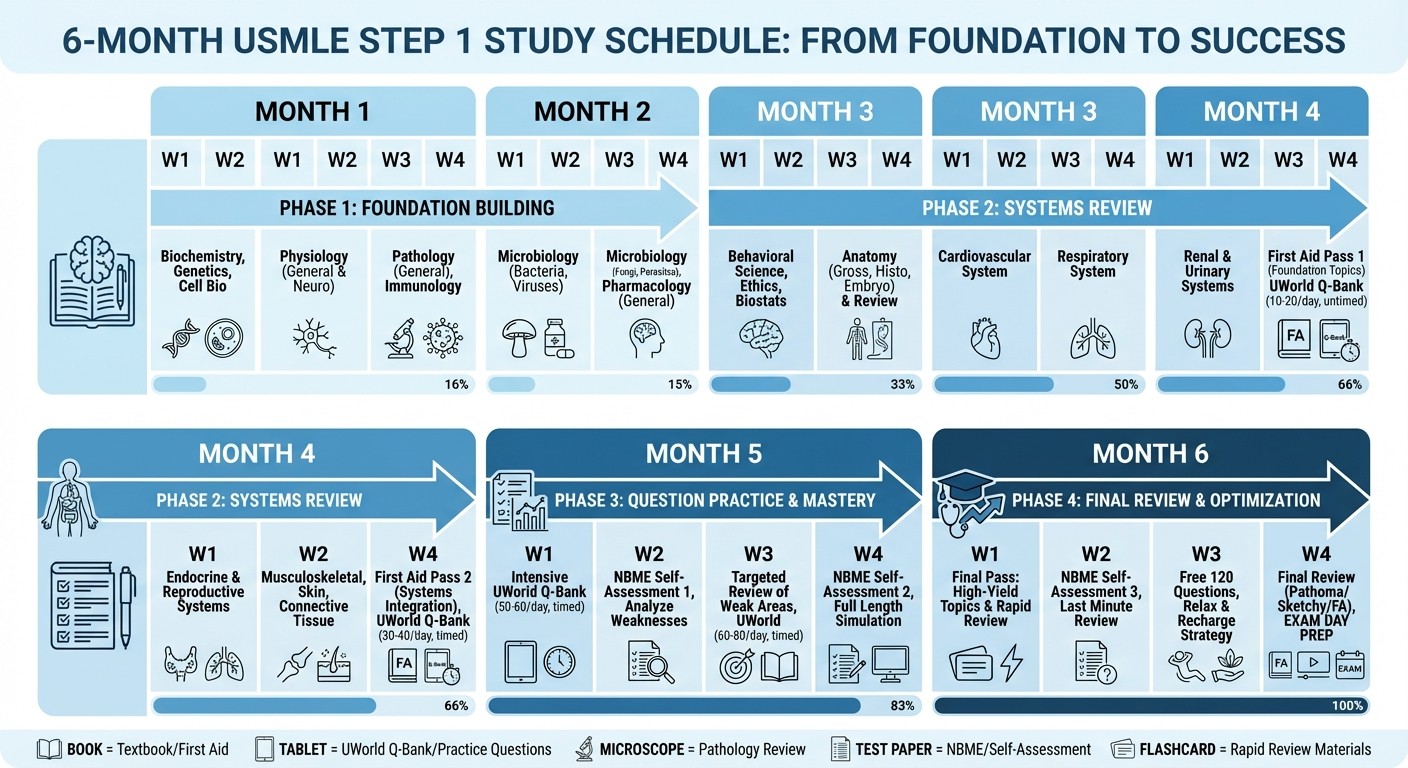
Our comprehensive 24-week study plan is divided into four distinct phases, each designed to build upon previous knowledge while gradually increasing exam readiness. This timeline accommodates both full-time students and those balancing clinical rotations.
Phase 1: Foundation Building (Weeks 1-8)
Objective: Establish strong basic science foundations across all major systems Daily Schedule: 6-8 hours of focused study
Morning (3-4 hours): Content review using primary resources
Afternoon (2-3 hours): Practice questions (20-30 per day)
Evening (1 hour): Flashcard review and spaced repetition
#### Week 1-2: Cardiovascular and Respiratory Systems
Week 1 Focus Areas:
Cardiac anatomy and physiology
ECG interpretation fundamentals
Heart failure pathophysiology
Coronary artery disease
Valvular disorders
Daily Breakdown:
Days 1-3: Cardiovascular anatomy and normal physiology
Days 4-5: Cardiac pathology (ischemic heart disease, cardiomyopathies)
Days 6-7: Cardiovascular pharmacology and review
Week 2 Focus Areas:
Respiratory anatomy and physiology
Lung pathology and diseases
Pulmonary function tests
Acid-base disorders
Respiratory pharmacology
Key Study Tip: Use active learning techniques like concept mapping to connect cardiovascular and respiratory physiology. Understanding the integrated nature of these systems is crucial for Step 1 success.
#### Week 3-4: Renal and Endocrine Systems
Week 3 Focus Areas:
Kidney anatomy and nephron physiology
Glomerular diseases
Acid-base balance
Electrolyte disorders
Renal pharmacology
Week 4 Focus Areas:
Endocrine system overview
Diabetes mellitus and glucose metabolism
Thyroid and parathyroid disorders
Adrenal gland pathology
Reproductive endocrinology
Study Strategy: Create detailed flowcharts for hormone pathways and feedback loops. Visual representations significantly improve retention for endocrine concepts.
#### Week 5-6: Gastrointestinal and Hepatobiliary Systems
Week 5 Focus Areas:
GI anatomy and physiology
Peptic ulcer disease
Inflammatory bowel disease
Malabsorption syndromes
GI pharmacology
Week 6 Focus Areas:
Liver anatomy and function
Hepatitis and cirrhosis
Biliary system disorders
Pancreatic diseases
Hepatic metabolism
#### Week 7-8: Musculoskeletal and Nervous Systems
Week 7 Focus Areas:
Bone and joint anatomy
Fracture healing
Arthritis and joint disorders
Muscle physiology
Connective tissue diseases
Week 8 Focus Areas:
Neuroanatomy fundamentals
Cranial nerves
Motor and sensory pathways
Neurotransmitters
Basic neuropathology
Phase 2: Systems Integration and Pathology Focus (Weeks 9-16)
Objective: Deepen pathology understanding while integrating systems knowledge Daily Schedule: 7-9 hours of intensive study
Morning (4-5 hours): Advanced pathology review
Afternoon (2-3 hours): Practice questions (40-50 per day)
Evening (1 hour): Weak area reinforcement
#### Week 9-10: Advanced Cardiovascular and Respiratory Pathology
Focus Areas:
Complex arrhythmias and conduction disorders
Advanced heart failure mechanisms
Pulmonary embolism and thrombosis
Acute respiratory distress syndrome
Interstitial lung diseases
High-Yield Topics:
Starling forces and edema formation
Ventilation-perfusion relationships
Oxygen-hemoglobin dissociation curve
Cardiac cycle and pressure-volume loops
#### Week 11-12: Renal Pathophysiology and Endocrine Disorders
Focus Areas:
Glomerulonephritis classification
Acute kidney injury mechanisms
Chronic kidney disease complications
Complex diabetes complications
Thyroid cancer and nodules
Practice Focus: Emphasize interpretation of laboratory values and diagnostic tests. Step 1 heavily tests the ability to analyze clinical data.
#### Week 13-14: Gastrointestinal Pathology and Oncology
Focus Areas:
Inflammatory bowel disease complications
GI malignancies and staging
Liver failure and transplantation
Pancreatic cancer
GI bleeding evaluation
Study Approach: Use case-based learning to understand disease progressions and complications. This mirrors the clinical reasoning tested on Step 1.
#### Week 15-16: Neurological Disorders and Psychiatry
Focus Areas:
Stroke mechanisms and management
Neurodegenerative diseases
Seizure disorders
Psychiatric medication mechanisms
Behavioral science concepts
Phase 3: Question-Based Learning and Weak Area Reinforcement (Weeks 17-20)
Objective: Shift focus to application of knowledge through intensive question practice Daily Schedule: 8-10 hours with question emphasis
Morning (4-5 hours): Practice questions (80-120 per day)
Afternoon (3-4 hours): Detailed question review and explanations
Evening (1 hour): Targeted weak area study
#### Week 17-18: Comprehensive Question Practice
Daily Question Distribution:
Block 1 (40 questions): Mixed systems, timed
Block 2 (40 questions): Weak areas focus, untimed
Block 3 (40 questions): High-yield topics, timed
Review Strategy:
Analyze every incorrect answer
Identify knowledge gaps
Review related concepts
Create weakness-specific study notes
#### Week 19-20: Simulated Exam Conditions
Practice Schedule:
Full-length practice exams (280 questions) twice weekly
Detailed performance analysis after each exam
Targeted review of consistently missed topics
Time management practice and optimization
Key Metrics to Track:
Overall percentage correct
Performance by subject area
Question completion time
Confidence level accuracy
Phase 4: Final Review and Exam Optimization (Weeks 21-24)
Objective: Polish knowledge, optimize test-taking strategies, and maintain peak performance Daily Schedule: 6-8 hours of focused review
Morning (3-4 hours): High-yield topic review
Afternoon (2-3 hours): Practice questions (40-60 per day)
Evening (1 hour): Relaxation and stress management
#### Week 21-22: High-Yield Topic Mastery
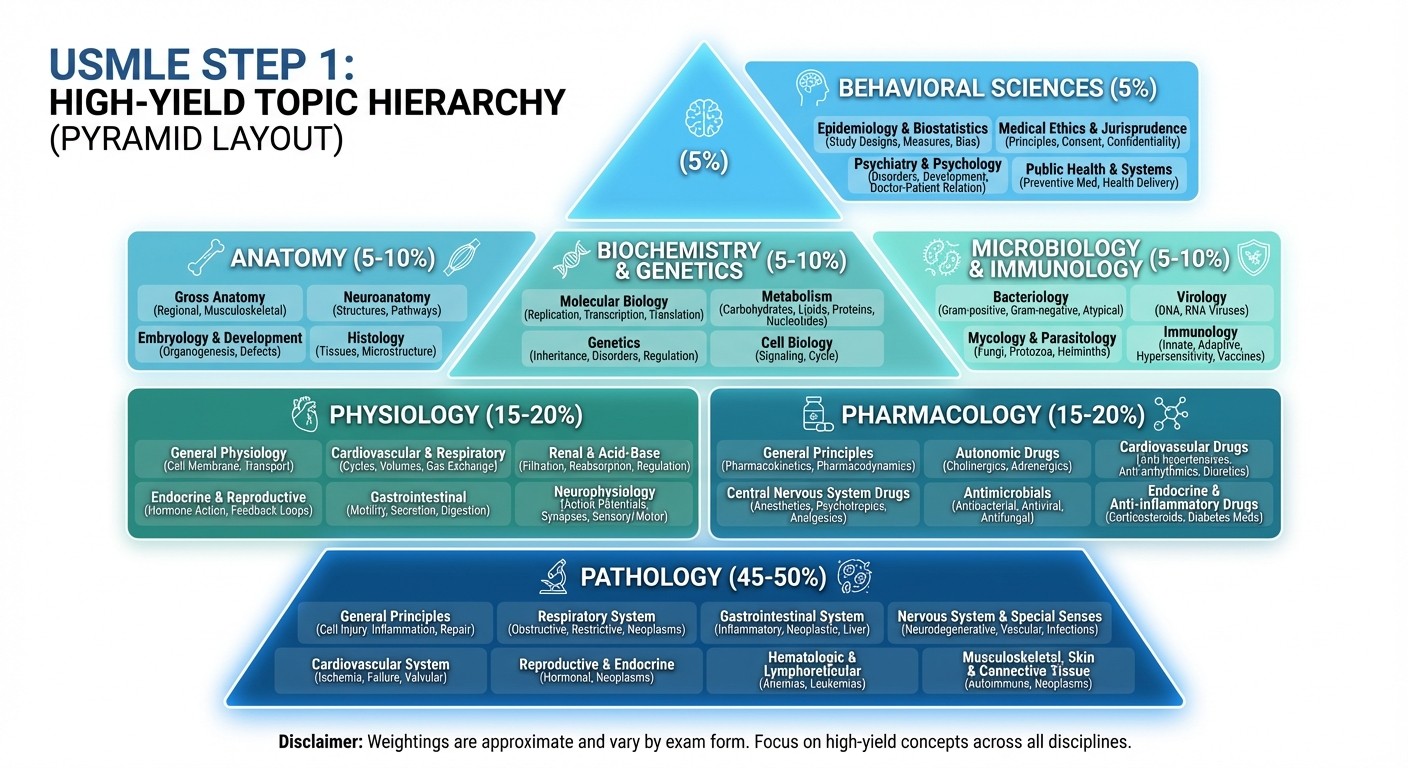
Priority Review Areas: 1. Pathology (30% of exam weight)
- Cell injury mechanisms
- Inflammation and healing
- Neoplasia principles
- Genetic disorders
2. Pharmacology (20% of exam weight)
- Drug mechanisms of action
- Adverse effects and contraindications
- Drug interactions
- Pharmacokinetics
3. Physiology (20% of exam weight)
- Cardiovascular physiology
- Respiratory physiology
- Renal physiology
- Endocrine physiology
Study Method: Focus on understanding mechanisms rather than memorization. Use comprehensive physiology lessons to reinforce key concepts.
#### Week 23: Final Knowledge Consolidation
Daily Focus Areas:
Monday: Cardiovascular and respiratory review
Tuesday: Renal and endocrine review
Wednesday: GI and hepatic review
Thursday: Neurological and psychiatric review
Friday: Pharmacology and pathology review
Weekend: Light review and stress management
Study Resources:
High-yield flashcards for rapid review
Summary notes and concept maps
Quick reference charts and mnemonics
Practice questions for continued reinforcement
#### Week 24: Pre-Exam Optimization
Exam Week Strategy:
4 days before exam: Light review only, no new material
3 days before exam: Relaxation and stress management
2 days before exam: Brief high-yield review (2-3 hours max)
1 day before exam: Complete rest, exam logistics preparation
Exam day: Confidence and optimal performance
High-Yield Study Strategies for Maximum Efficiency
Active Recall and Spaced Repetition
Research demonstrates that active recall improves long-term retention by 67% compared to passive review methods. Implement these techniques:
Spaced Repetition Schedule:
Day 1: Learn new material
Day 3: First review
Day 7: Second review
Day 21: Third review
Day 60: Final reinforcement
Active Recall Methods:
Flashcard systems with spaced intervals
Practice questions without looking at answers first
Teaching concepts to study partners
Creating concept maps from memory
Question-Based Learning Strategy
Questions should constitute 60-70% of your total study time during the final 8 weeks. Effective question practice involves:
Question Analysis Framework: 1. Read the question stem carefully - identify key clinical information 2. Predict the answer before looking at choices 3. Eliminate incorrect options systematically 4. Analyze your reasoning for both correct and incorrect answers 5. Review related concepts for any missed questions Daily Question Goals:
Weeks 1-8: 20-30 questions daily
Weeks 9-16: 40-60 questions daily
Weeks 17-20: 80-120 questions daily
Weeks 21-24: 40-80 questions daily
Integrated Learning Approach
USMLE Step 1 tests integrated knowledge across multiple systems. Develop connections between:
System Integration Examples:
Cardiovascular-renal interactions in hypertension
Endocrine-metabolic connections in diabetes
Neurological-psychiatric overlaps in mood disorders
GI-hepatic relationships in liver disease
Use comprehensive lessons that demonstrate these connections to strengthen your understanding.
Essential Study Resources and Tools
Primary Content Resources
Tier 1 Resources (Must-have):
First Aid for the USMLE Step 1 - Essential reference guide
Pathoma - Outstanding pathology resource
Boards and Beyond - Comprehensive video lectures
UWorld Question Bank - Gold standard for practice questions
Tier 2 Resources (Highly Recommended):
Sketchy Medical - Visual learning for pharmacology and microbiology
Physeo - High-yield physiology videos
Goljan Rapid Review Pathology - Additional pathology reinforcement
Kaplan Question Bank - Supplemental practice questions
Digital Learning Platforms
Oncourse: Your AI-Powered Study Companion Oncourse stands out as the premier AI-powered medical education platform for USMLE preparation. With over 10,000+ members and a 4.8+ rating, Oncourse offers: Key Features:
40,000+ high-yield flashcards with spaced repetition algorithms
Comprehensive question bank with detailed explanations
5,000+ lessons covering all Step 1 topics
Rezzy AI tutor for personalized learning assistance
Performance analytics to track progress and identify weak areas
Free Tier Benefits:
Limited Rezzy AI conversations
Access to select flashcards and questions
Daily quizzes and learning games
Community features and study groups
Premium Features:
Unlimited AI tutor access
Complete flashcard and question library
Personalized study plans
Advanced analytics and progress tracking
Unlimited practice tests and simulations
Visit Oncourse's USMLE Step 1 page to explore comprehensive resources tailored specifically for Step 1 success. Other Notable Platforms:
Anki - Customizable flashcard system for spaced repetition
Notion - Study organization and note-taking platform
Quizlet - Quick review flashcards and study sets
Forest - Productivity app for focused study sessions
Mobile Study Apps
Essential Apps for Step 1 Prep:
UWorld Mobile - Practice questions on-the-go
First Aid Q&A - Quick reference and practice
Medscape - Clinical reference and drug information
Lecturio - Video lectures and mobile learning
Time Management and Study Schedule Optimization
Creating Your Personalized Schedule
Assessment Phase (Week before starting): 1. Take a diagnostic exam to identify baseline knowledge 2. Assess available study time (full-time vs. part-time) 3. Identify learning preferences (visual, auditory, kinesthetic) 4. Set realistic goals and milestones Schedule Customization Factors:
Medical school curriculum requirements
Clinical rotation schedules
Personal commitments and responsibilities
Peak performance times throughout the day
Daily Study Routine Template
Optimal Daily Schedule (8-10 hour study days): 6:00-7:00 AM: Morning routine and review
Quick review of previous day's weak areas
High-yield flashcards (100-150 cards)
Light breakfast and exercise
7:00-11:00 AM: Deep learning session
Primary content review (new material)
Video lectures or textbook reading
Active note-taking and concept mapping
15-minute breaks every hour
11:00 AM-12:00 PM: Practice questions (Block 1)
Timed 40-question block
Immediate review of incorrect answers
Note-taking on weak areas
12:00-1:00 PM: Lunch and break 1:00-4:00 PM: Reinforcement session
Review question explanations in detail
Targeted study of missed topics
Additional practice questions (Block 2)
Flashcard review
4:00-5:00 PM: Active recall practice
Concept teaching (to study partner or mirror)
Memory palace or mnemonic creation
Quick quiz on day's material
5:00-6:00 PM: Dinner and relaxation 6:00-8:00 PM: Evening study session
Light review of high-yield topics
Flashcard maintenance
Planning next day's schedule
8:00 PM onwards: Personal time and rest
Weekly Schedule Structure
Monday-Friday: Intensive study days (8-10 hours) Saturday: Extended practice exam (full-length) + review Sunday: Light review, planning, and rest Monthly Assessments:
Full-length practice exam
Performance analysis and strategy adjustment
Goal reassessment and schedule modifications
Weak area identification and targeted plans
Managing Stress and Maintaining Peak Performance
Stress Management Strategies
Physical Wellness:
Exercise regularly - 30 minutes daily minimum
Maintain sleep schedule - 7-8 hours nightly
Eat nutritious meals - brain-healthy foods
Stay hydrated - adequate water intake
Mental Health Maintenance:
Mindfulness meditation - 10-15 minutes daily
Social connections - regular contact with friends/family
Hobby time - maintain interests outside medicine
Professional support - counseling if needed
Study-Related Stress Relief:
Realistic goal setting - achievable daily targets
Progress celebration - acknowledge improvements
Flexibility - adjust plans when needed
Perspective - remember long-term career goals
Avoiding Burnout
Warning Signs of Burnout:
Consistent fatigue despite adequate sleep
Decreased motivation for studying
Increased irritability or mood changes
Physical symptoms (headaches, GI issues)
Declining practice exam scores
Prevention Strategies:
Scheduled rest days - complete study breaks
Variety in study methods - prevent monotony
Social support - study groups and peer connections
Professional help - academic advisors or counselors
Final Month Strategy and Exam Day Preparation
Last 4 Weeks Optimization
Week 21-22: High-yield review with continued question practice Week 23: Final knowledge consolidation and weak area targeting Week 24: Stress reduction and exam logistics preparation Final Month Priorities: 1. Maintain knowledge rather than learning new material 2. Optimize test-taking strategies through practice 3. Manage stress levels for peak performance 4. Prepare logistically for exam day
Exam Day Strategy
Pre-Exam Preparation:
Visit test center beforehand to familiarize yourself
Prepare required documents (ID, confirmation)
Plan travel route and timing
Get adequate sleep (7-8 hours) for 2-3 nights before
Day-of-Exam Strategy:
Arrive early - 30 minutes before appointment
Bring nutritious snacks - energy maintenance
Use break time wisely - stretch, hydrate, refocus
Stay confident - trust your preparation
During the Exam:
Read questions carefully - avoid rushing
Manage time effectively - approximately 1.5 minutes per question
Skip difficult questions - return if time permits
Stay calm - deep breathing during stress
Trust first instincts - avoid overthinking
Common Mistakes to Avoid
Study Plan Pitfalls
Over-ambitious scheduling: Creating unrealistic daily study hours that lead to burnout Solution: Start with achievable goals and gradually increase intensity Resource overload: Using too many different study materials without mastery Solution: Stick to 2-3 primary resources and supplement selectively Passive learning: Reading without active engagement or testing Solution: Emphasize practice questions and active recall methods Neglecting weak areas: Avoiding difficult topics instead of addressing them Solution: Use performance data to identify and target weak subjects
Question Practice Errors
Speed over accuracy: Rushing through questions without understanding Solution: Focus on understanding explanations thoroughly Answer memorization: Remembering specific questions rather than concepts Solution: Focus on underlying principles and reasoning Limited question sources: Using only one question bank Solution: Use multiple sources for broader question exposure Insufficient review: Moving to new questions without reviewing incorrect ones Solution: Spend equal time reviewing as answering questions
Success Metrics and Progress Tracking
Key Performance Indicators
Weekly Metrics to Track:
Question accuracy percentage - aim for >70% by week 16
Knowledge retention rate - flashcard performance
Study hour completion - adherence to schedule
Weak area improvement - targeted progress
Monthly Assessment Benchmarks:
Month 1-2: Establishing study habits and basic knowledge
Month 3-4: Knowledge integration and question improvement
Month 5: Practice exam scores reaching passing range
Month 6: Consistent performance above passing threshold
Progress Monitoring Tools
Use Oncourse's analytics platform to track detailed performance metrics including:
Subject-wise performance trends
Question difficulty analysis
Time management patterns
Retention rates for different topics
Prediction models for exam readiness
Manual Tracking Methods:
Daily study log with hours and topics covered
Weekly performance summaries
Monthly goal assessments
Practice exam score tracking spreadsheet
Conclusion: Your Path to USMLE Step 1 Success
Success on USMLE Step 1 in 2026 requires more than just hard work—it demands strategic preparation, consistent execution, and adaptive learning strategies. This comprehensive 24-week study plan provides the framework for systematic knowledge building while maintaining the flexibility to accommodate individual learning styles and circumstances.
Remember that the transition to pass/fail scoring hasn't made Step 1 easier; it has simply shifted the focus from competitive scoring to competency demonstration. Your goal is to build a robust foundation of medical knowledge that will serve you throughout your career, not just for exam day.
Key Takeaways for Success:
Start early and maintain consistency throughout your preparation
Use active learning methods and spaced repetition for optimal retention
Practice extensively with high-quality question banks
Monitor progress regularly and adjust strategies based on performance
Maintain balance between intensive study and personal wellness
Trust the process and stay confident in your preparation
The journey to Step 1 success is challenging but achievable with the right strategy and resources. Use this guide as your roadmap, adapt it to your specific needs, and remember that consistent daily progress leads to exceptional results.
Start your USMLE Step 1 preparation today with Oncourse's comprehensive study platform, featuring AI-powered personalization, extensive question banks, and proven study methodologies. Your medical career success begins with a single step—make it a confident one.
Ready to begin your USMLE Step 1 journey? Explore Oncourse's complete learning system and join thousands of successful medical students who have achieved their goals with our proven preparation methods.