Back
Best UKMLA AKT Study Resources 2026: Question Banks, Apps and What IMGs Actually Need to Pass First Attempt
Discover the top UKMLA AKT study resources for 2026. Compare question banks, apps, and proven strategies that help IMGs achieve 75%+ pass rates on first attempt.

Best UKMLA AKT Study Resources 2026: Question Banks, Apps and What IMGs Actually Need to Pass First Attempt
You are scrolling through UKMLA forums at 2 AM, seeing the same question posted again: "Which question bank actually works for AKT?" The Applied Knowledge Test has a 73% first-attempt pass rate for UK graduates. For International Medical Graduates? That number drops to 52%.
The gap isnt about clinical knowledge — most IMGs have solid medical foundations. Its about understanding the specific question style, UK clinical guidelines, and having the right preparation strategy. After analyzing pass rates, IMG feedback, and testing every major resource, here are the study tools that actually move the needle for UKMLA AKT success.
The AKT contains 200 single-best-answer questions across 26 clinical areas. You have 3 hours and 10 minutes — that is 57 seconds per question. No negative marking, but the pass standard hovers around 65-70%. Every point counts.
1. Oncourse AI
What it is: AI-powered question bank with adaptive learning specifically designed for international medical exams, including comprehensive UKMLA AKT preparation.
Oncourse stands out because it doesnt just give you random MCQs — it learns your weak areas and adapts. The platform has 1 lakh+ practice questions with detailed AI explanations. For UKMLA specifically, it covers all 26 clinical areas with UK guideline-focused questions.
Key features:
40,000+ high-yield MCQs with instant AI explanations
Adaptive algorithm that identifies knowledge gaps
Spaced repetition flashcards for long-term retention
Rezzy AI tutor for personalized doubt clearing
Performance analytics showing improvement over time
Mobile app for studying anywhere
Pros:
AI explanations help you understand why options are wrong, not just which is right
Question difficulty adjusts to your level — no wasted time on concepts you know
Strong focus on UK clinical guidelines and NICE recommendations
Free tier available with premium plans for full access
4.8+ rating on app stores
Cons:
Newer platform, so question bank still growing compared to established competitors
Some advanced features require premium subscription
Best for: IMGs who want personalized learning and struggle with traditional one-size-fits-all question banks.
The Probe Game feature makes memorizing drug dosages and normal values less painful — you are essentially playing your way through the facts that trip up most candidates.
2. PassMedicine
What it is: UK-based question bank specifically designed for UKMLA AKT with over 4,000 questions mapped to the curriculum.
PassMedicine has been the gold standard for UK medical students preparing for finals and postgraduate exams. Their AKT section launched in 2022 and has become popular among both UK graduates and IMGs.
Key features:
Questions written by UK doctors familiar with exam standards
Detailed explanations with NICE guideline references
Progress tracking and performance analytics
Topic-based question selection
Timed mock exams
Pros:
Questions closely mirror actual AKT style and difficulty
Strong coverage of UK-specific protocols and guidelines
Good explanations with relevant guideline citations
Reasonable pricing at £50 for 6 months access
Cons:
Interface feels dated compared to modern apps
No mobile app — web-based only
Limited adaptive learning features
Some topics have fewer questions than others
Best for: Students who prefer traditional question bank approach and want UK-written content.
3. OnExamination
What it is: Comprehensive medical exam platform with dedicated UKMLA AKT section featuring 2,500+ questions.
OnExamination covers multiple medical exams but their UKMLA section has gained traction. They focus heavily on exam technique and provide detailed performance breakdowns.
Key features:
Subject-specific question banks
Detailed performance analytics
Flashcard integration
Mock exam simulations
Mobile app available
Pros:
Good coverage across all clinical areas
Strong analytics showing weak areas
Reasonable question explanations
Includes both topic-wise and mixed practice
Cons:
Smaller question bank compared to competitors
Some questions feel easier than actual AKT
Subscription can be expensive for full access
Customer support responses are slow
Best for: Students who want comprehensive analytics and dont mind paying premium prices.
4. Quesmed
What it is: Medical education platform with growing UKMLA AKT question collection and spaced repetition system.
Quesmed started as a platform for UK medical students and has expanded to include postgraduate exam preparation. Their AKT section is newer but growing rapidly.
Key features:
Spaced repetition algorithm for better retention
Video explanations for complex topics
Social features for study groups
Performance tracking
Mobile and web access
Pros:
Strong spaced repetition implementation
Good video explanations for difficult concepts
Active community of medical students
Regular updates and new questions
Cons:
Smaller AKT question bank (under 2,000 questions)
Some explanations lack depth
Premium features are expensive
Less focus on UK guidelines compared to PassMedicine
Best for: Students who learn better with video explanations and community support.
5. NEJM Knowledge+
What it is: New England Journal of Medicine's adaptive learning platform with high-quality clinical questions.
While not specifically designed for UKMLA, NEJM Knowledge+ provides excellent clinical reasoning practice that translates well to AKT preparation.
Key features:
High-quality, evidence-based questions
Adaptive learning algorithm
Detailed explanations with journal references
Regular content updates
Mobile app available
Pros:
Exceptional question quality and explanations
Strong focus on clinical reasoning
Prestigious brand with credible content
Good for building foundational knowledge
Cons:
Not UK-focused — uses US guidelines
Expensive subscription
Questions may be too detailed for AKT format
Limited UK clinical scenarios
Best for: Students who want to strengthen clinical reasoning but should supplement with UK-specific resources.
6. BMJ OnExamination (Different from OnExamination above)
What it is: British Medical Journal's exam preparation platform with UKMLA-focused content.
BMJ OnExamination leverages BMJ's clinical expertise to create exam-focused questions. Their UKMLA section launched in 2023.
Key features:
Questions based on BMJ clinical content
Regular updates with latest guidelines
Performance tracking
Mobile access
Integration with BMJ learning resources
Pros:
High-quality questions from trusted medical source
Good integration with current UK guidelines
Regular content updates
Professional interface
Cons:
Smaller question bank
More expensive than competitors
Limited adaptive learning features
New platform with some features still developing
Best for: Students who prefer established medical publishers and dont mind paying premium prices.
What IMGs Actually Need to Pass First Attempt
The data shows clear patterns among successful IMG candidates. Here is what actually matters:
Focus on UK Guidelines, Not Just Clinical Knowledge
Most IMGs fail because they answer based on their home country protocols. UKMLA AKT tests UK-specific approaches. Spend 30% of study time learning NICE guidelines, especially for:
Cardiovascular disease management
Diabetes treatment pathways
Mental health referral criteria
Emergency department protocols
Practice Under Time Pressure
57 seconds per question isnt much. Successful candidates report practicing with 45-second limits to build speed. Use timed sessions from day one — dont wait until the final month.
Master the "Single Best Answer" Format
UK medical education uses different question styles than many international systems. The "single best answer" often has multiple technically correct options, but only one fits UK clinical practice. This trips up many IMGs who choose medically sound answers that arent UK-appropriate.
Use Spaced Repetition for Factual Recall
AKT tests substantial factual knowledge — drug dosages, normal ranges, scoring systems. Traditional cramming doesnt work. Apps with spaced repetition algorithms help embed these facts long-term.
The Oncourse flashcard system uses spaced repetition to help you remember critical facts without constant review. You see difficult cards more frequently until they stick.
Study in Mixed Practice, Not Just by Topic
Many candidates study cardiology for a week, then nephrology, then endocrinology. The actual exam mixes topics randomly. Practice this way from the beginning. Mixed practice is harder but creates better retention and exam performance.
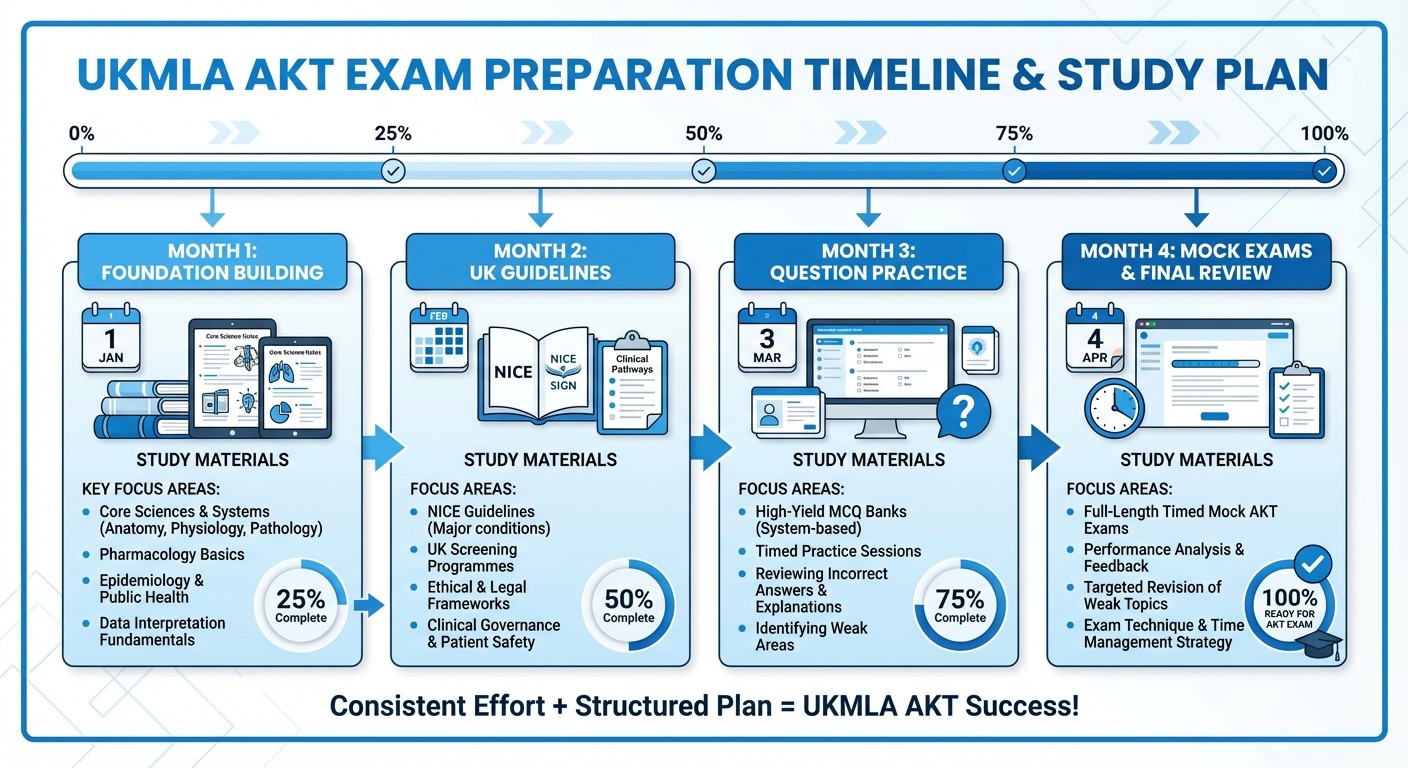
Recommended Study Timeline for First-Time Success
Months 1-2: Foundation and Guidelines (8 weeks)
Choose your primary question bank (Oncourse AI or PassMedicine)
Study 2-3 clinical areas per week
Focus 60% on questions, 40% on UK guidelines
Aim for 50+ questions daily
Use Oncourse AI explanations to understand UK-specific reasoning
Months 3: Intensive Practice (4 weeks)
Increase to 75+ questions daily
Start mixed-topic sessions
Take first full-length mock exam
Identify weak areas and target them
Practice under strict time limits
Month 4: Mock Exams and Fine-tuning (4 weeks)
Take 2-3 full mock exams weekly
Review ALL incorrect answers
Focus on speed improvement
Final review of high-yield facts
Maintain confidence — avoid learning new topics
Common Mistakes That Cost IMGs Their First Attempt
Mistake 1: Using Too Many Resources
Students often buy 3-4 question banks thinking more is better. This creates confusion and prevents deep learning. Pick one primary resource and stick with it.
Mistake 2: Ignoring UK-Specific Scenarios
Questions about NHS referral pathways, GP practice management, and UK health system navigation regularly appear. Many IMGs skip these topics thinking they are irrelevant.
Mistake 3: Cramming Instead of Spaced Practice
The AKT tests both reasoning and factual recall. Cramming works for reasoning questions but fails for facts. Start spaced repetition early.
Mistake 4: Perfectionism in Practice Questions
Aiming for 90%+ on practice questions is counterproductive. You want 70-75% accuracy with good speed. Higher scores often mean you are avoiding difficult questions.
How to Choose Your Primary Resource
Your learning style determines which platform works best:
Choose Oncourse AI if:
You want adaptive learning that adjusts to your level
You prefer AI explanations over static text
You are comfortable with newer platforms
You want comprehensive mobile access
Choose PassMedicine if:
You prefer traditional question bank format
You want UK-written content from day one
You dont mind web-only access
You have budget constraints
Choose OnExamination if:
You want detailed analytics
You dont mind premium pricing
You prefer established platforms
Supplement with NEJM Knowledge+ if:
Your clinical reasoning needs strengthening
You can afford multiple subscriptions
You want the highest quality explanations
Most successful candidates use one primary resource (usually Oncourse AI or PassMedicine) plus targeted supplements for weak areas.
The Reality About Pass Rates and Expectations
UKMLA AKT pass rates tell a story. UK graduates have home advantage — they trained in the system being tested. IMGs face additional challenges:
Different clinical protocols in home countries
Unfamiliarity with UK healthcare system
Language nuances in question interpretation
Different medical education styles
But the 52% IMG pass rate isnt unchangeable. Candidates who follow structured preparation with quality resources see 75-80% pass rates. The key is acknowledging these challenges and preparing accordingly.
Budget-Conscious Study Strategy
Not everyone can afford multiple premium subscriptions. Here is a cost-effective approach:
1. Start with Oncourse free tier — gets you familiar with adaptive learning
2. Upgrade to one premium platform (Oncourse AI or PassMedicine)
3. Use free resources for UK guidelines (NICE website, BMJ Learning modules)
4. Join study groups for mock exam practice
5. Focus spending on exam fees rather than multiple subscriptions
The platform matters less than consistent, focused practice with quality content.
Mobile vs Web: What Works Better?
Most successful candidates use both. Mobile apps for:
Commute time practice
Quick fact review
Flashcard sessions
Short question sets
Web platforms for:
Full mock exams
Detailed performance analysis
Extended study sessions
Question review and note-taking
Oncourse mobile app excels at making dead time productive — you can practice MCQs while waiting for appointments or during lunch breaks.
Frequently Asked Questions
How many questions should I practice daily for UKMLA AKT?
Start with 30-50 questions daily and build to 75+ by month 3. Quality matters more than quantity — spend time understanding explanations, especially for incorrect answers.
Is 3 months enough preparation time for IMGs?
3 months is tight but possible with 4+ hours daily study. Most successful IMG candidates prefer 4-5 months for comfortable preparation without burnout.
Should I memorize NICE guidelines or just understand principles?
Both. Understand principles for clinical reasoning questions, but memorize specific criteria for scoring systems, referral thresholds, and treatment protocols that appear regularly.
Can I pass using only free resources?
Technically yes, but its significantly harder. Free resources lack the question volume, explanations, and adaptive features that commercial platforms provide. Consider it high risk.
What percentage should I aim for in practice questions?
70-75% accuracy with good speed indicates exam readiness. Higher scores often mean you are avoiding difficult questions or practicing below exam level.
How similar are practice questions to actual UKMLA AKT?
Quality varies by platform. PassMedicine and Oncourse AI questions closely mirror actual exam style and difficulty. Some platforms create easier questions that give false confidence.
Prepare smarter with Oncourse AI — adaptive MCQs, spaced repetition, and AI explanations built for UKMLA AKT. Download free on Android and iOS.