
Neonatal infections
Complete Neonatal infections study resources for USMLE. Part of Pediatrics.
Study Resources
Choose how you want to study Neonatal infections
Lessons
13 lessons in Neonatal infections

Early-onset sepsis

Late-onset sepsis

Group B streptococcal disease

Neonatal meningitis

Congenital TORCH infections

Neonatal HSV

Neonatal candidiasis

Necrotizing enterocolitis

Omphalitis

Nursery outbreaks

Antibiotic stewardship in NICU

Diagnostic approach to neonatal sepsis

Maternal factors and neonatal infection risk
Practice Questions
10 MCQs for Neonatal infections
Sample Questions: Neonatal infections
Test your understanding with these related questions
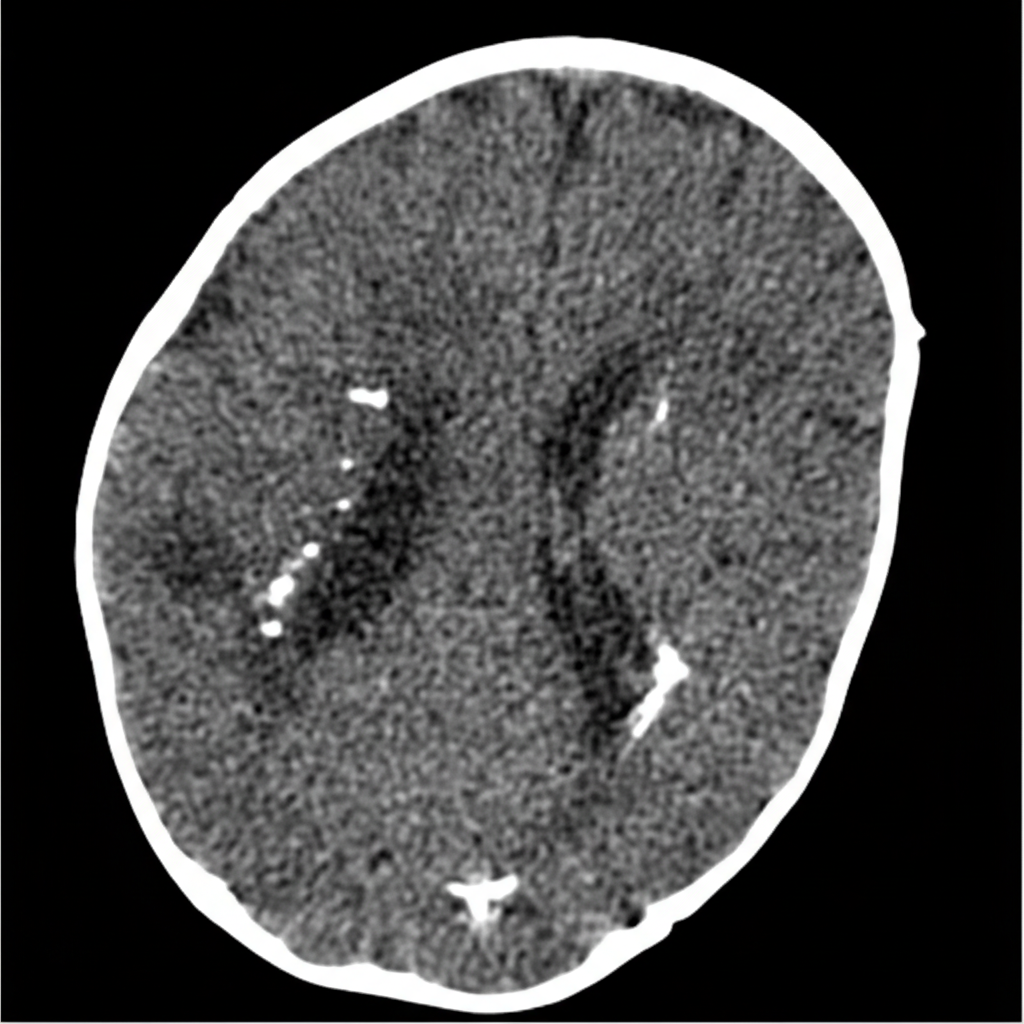
A 2-day-old boy, born at 38-weeks gestation, presents with jaundice and microcephaly. Social history reveals his mother is an animal caretaker. The vital signs include: temperature 37.0°C (98.6°F), blood pressure 75/40 mm Hg, pulse 150/min, respiratory rate 40/min, and oxygen saturation 99% on room air. Physical examination reveals hepatosplenomegaly. A CT and MRI of the head are significant for the following findings (see picture). Which of the following diseases contracted during pregnancy is the most likely cause of this patient's condition?
Neonatal infections US Medical PG Practice Questions and MCQs
Practice US Medical PG questions for Neonatal infections. These multiple choice questions (MCQs) cover important concepts and help you prepare for your exams.
Neonatal infections US Medical PG Question 1: A 2-day-old boy, born at 38-weeks gestation, presents with jaundice and microcephaly. Social history reveals his mother is an animal caretaker. The vital signs include: temperature 37.0°C (98.6°F), blood pressure 75/40 mm Hg, pulse 150/min, respiratory rate 40/min, and oxygen saturation 99% on room air. Physical examination reveals hepatosplenomegaly. A CT and MRI of the head are significant for the following findings (see picture). Which of the following diseases contracted during pregnancy is the most likely cause of this patient's condition?
- A. Toxoplasmosis
- B. Syphilis
- C. Varicella
- D. CMV (Correct Answer)
- E. Rubella
Neonatal infections Explanation: ***CMV*** - The combination of **jaundice**, **microcephaly**, **hepatosplenomegaly**, and **periventricular calcifications** on neuroimaging (as seen in the image) is highly characteristic of congenital CMV infection. - While other congenital infections can cause some of these symptoms, the specific pattern of **periventricular calcifications** is a hallmark of CMV. *Toxoplasmosis* - Congenital toxoplasmosis also causes **microcephaly** and **hydrocephalus**, but the calcifications are typically **scattered throughout the brain parenchyma**, not predominantly periventricular. - While **hepatosplenomegaly** and **jaundice** can occur, the neuroimaging findings help differentiate it from CMV. *Syphilis* - Congenital syphilis can present with **hepatosplenomegaly** and **jaundice**, but typically involves findings like **maculopapular rash**, **bone abnormalities** (e.g., osteochondritis), and **snuffles**, which are not mentioned. - **Intracranial calcifications** are not a typical feature of congenital syphilis. *Varicella* - Congenital varicella syndrome is rare and typically presents with **skin scarring (cicatricial lesions)**, **limb hypoplasia**, and **ophthalmologic abnormalities**. - **Microcephaly** and **intracranial calcifications** are not primary features, nor is significant **hepatosplenomegaly** or **jaundice**. *Rubella* - Congenital rubella syndrome (CRS) classical triad includes **cataracts/glaucoma**, **sensorineural hearing loss**, and **congenital heart defects** (e.g., PDA, pulmonary artery stenosis). - While **microcephaly** and **hepatosplenomegaly** can occur, the characteristic **periventricular calcifications** seen in the image are not typical for CRS.
Neonatal infections US Medical PG Question 2: A neonate born at 33 weeks is transferred to the NICU after a complicated pregnancy and C-section. A week after being admitted, he developed a fever and became lethargic and minimally responsive to stimuli. A lumbar puncture is performed that reveals the following: Appearance Cloudy Protein 64 mg/dL Glucose 22 mg/dL Pressure 330 mm H20 Cells 295 cells/mm³ (> 90% PMN) A specimen is sent to microbiology and reveals gram-negative rods. Which of the following is the next appropriate step in management?
- A. MRI scan of the head
- B. Start the patient on IV ceftriaxone
- C. Provide supportive measures only
- D. Start the patient on IV cefotaxime (Correct Answer)
- E. Start the patient on oral rifampin
Neonatal infections Explanation: ***Start the patient on IV cefotaxime*** - The cerebrospinal fluid (CSF) analysis with **cloudy appearance, elevated protein, low glucose, high pressure, and predominant PMNs**, coupled with **gram-negative rods** on microscopy, is highly suggestive of **bacterial meningitis** in a neonate. - **Cefotaxime** is a third-generation cephalosporin commonly used for neonatal meningitis caused by gram-negative organisms due to its excellent CSF penetration and broad-spectrum activity, particularly against common neonatal pathogens like *E. coli* which can present as gram-negative rods. *MRI scan of the head* - An MRI would be considered **after initiating appropriate antibiotic treatment** to assess for complications like abscess formation or ventriculitis, not as the immediate next step in an acute, life-threatening infection. - Delaying antibiotic treatment for imaging in acute bacterial meningitis can lead to increased morbidity and mortality. *Start the patient on IV ceftriaxone* - While ceftriaxone is a third-generation cephalosporin, it is **generally avoided in neonates** due to the risk of **biliary sludging** and **kernicterus**. - Ceftriaxone competes with bilirubin for albumin binding sites, which is particularly risky in neonates who are already prone to hyperbilirubinemia. *Provide supportive measures only* - Given the strong evidence of **bacterial meningitis**, providing only supportive measures without specific antibiotic treatment would be inadequate and would lead to rapid deterioration and potentially fatal outcomes. - Bacterial meningitis requires prompt and aggressive antimicrobial therapy. *Start the patient on oral rifampin* - **Rifampin is never used as monotherapy for bacterial meningitis** due to rapid resistance development and its primary role is in specific infections like tuberculosis or as part of combination therapy for certain resistant bacteria. - Oral administration is also not ideal for acutely ill neonates with meningitis needing rapid, high-concentration antibiotics in the CSF.
Neonatal infections US Medical PG Question 3: A 2-day-old newborn male delivered at 38 weeks' gestation is evaluated for poor feeding and irritability. His temperature is 35°C (95°F), pulse is 168/min, respirations are 80/min, and blood pressure is 60/30 mm Hg. Blood culture on sheep agar grows motile, gram-positive bacteria surrounded by a narrow clear zone. Further testing confirms the presence of a pore-forming toxin. Which of the following is the most important factor in successful clearance of the causal pathogen?
- A. Secretion of interferon-α from infected cells
- B. Secretion of interleukin 10 by regulatory T cells
- C. Interferon-γ-induced macrophage activation (Correct Answer)
- D. Secretion of immunoglobulin G from plasma cells
- E. Formation of the membrane attack complex
Neonatal infections Explanation: ***Interferon-γ-induced macrophage activation*** - This clinical presentation of severe sepsis in a neonate, with a gram-positive, motile, pore-forming bacterium, is highly suggestive of **Listeria monocytogenes infection**. - **Listeria** is an intracellular bacterium that primarily targets macrophages and monocytes, and its clearance crucially depends on a strong **cell-mediated immune response**, specifically **IFN-γ-mediated macrophage activation** to kill the intracellular pathogens. *Secretion of interferon-α from infected cells* - **Interferon-α** is mainly involved in the antiviral response, inhibiting viral replication and activating natural killer (NK) cells. - While it has some role in innate immunity against bacteria, it is not the primary or most critical mechanism for clearing an intracellular bacterial infection like *Listeria*. *Secretion of interleukin 10 by regulatory T cells* - **Interleukin 10 (IL-10)** is an anti-inflammatory cytokine that downregulates the immune response, often associated with immune suppression and tolerance. - Secreting IL-10 would likely **hinder** the effective clearance of an active bacterial infection rather than promote it. *Secretion of immunoglobulin G from plasma cells* - **Immunoglobulin G (IgG)** provides humoral immunity against extracellular bacteria and toxins, mediating opsonization and neutralization. - While IgG may have some role in controlling the extracellular phase of *Listeria* infection, it is **ineffective** against the intracellular forms, which are the main challenge for clearance. *Formation of the membrane attack complex* - The **membrane attack complex (MAC)** is part of the complement system, which primarily targets and lyses extracellular bacteria. - *Listeria* is an intracellular pathogen, meaning the MAC would not be able to reach and effectively lyse the bacteria once inside host cells.
Neonatal infections US Medical PG Question 4: A 6-day-old newborn is brought to the emergency department by his mother due to a high fever that started last night. His mother says that he was born via an uneventful vaginal delivery at home at 38 weeks gestation and was doing fine up until yesterday when he became disinterested in breastfeeding and spit up several times. His temperature is 39.5°C (103.1°F), pulse is 155/min, respirations are 45/min, and O2 sats are 92% on room air. He is lethargic and minimally responsive to stimuli. While on his back, his head is quickly lifted towards his chest which causes his legs to flex. The mother had only a few prenatal care visits and none at the end of the pregnancy. What is the most likely source of this patients infection?
- A. Tick bite
- B. During birth (Correct Answer)
- C. Infection from surgery
- D. Contaminated food
- E. Mother’s roommate
Neonatal infections Explanation: ***During birth*** - The newborn's age (6 days old) and presentation with **fever**, **lethargy**, and **meningeal signs** (legs flexing upon lifting head, likely Brudzinski sign) are highly suggestive of **neonatal sepsis** or **meningitis**. - Given the history of a home birth with limited prenatal care, the most probable source of infection would be vertical transmission **during passage through the birth canal**, especially if the mother was colonized with pathogens like Group B Streptococcus (GBS), E. coli, or had an untreated sexually transmitted infection. *Tick bite* - While tick-borne illnesses can cause fever, they are generally less common in this age group and the symptoms presented are more indicative of a widespread bacterial infection rather than a localized vector-borne illness. - The neurological signs (meningeal irritation) are more consistent with meningitis, which is typically bacterial in newborns, rather than a common manifestation of a tick-borne disease in this age group. *Infection from surgery* - The patient had an **uneventful vaginal delivery at home**, meaning there was no surgical procedure involved, ruling out a surgical site infection. - Surgical infections are typically seen after procedures like C-sections or circumcisions and would present differently. *Contaminated food* - A 6-day-old newborn is typically fed breast milk or formula and has no exposure to **solid or contaminated food** that would cause such an infection. - Foodborne illnesses would usually present with prominent gastrointestinal symptoms like severe vomiting and diarrhea, which are not the primary features here. *Mother’s roommate* - While exposure to sick individuals can cause illness, the severe symptoms and rapid progression of the newborn's condition, along with the meningeal signs, point more towards a serious **vertical transmission during birth** rather than horizontal transmission from casual contact with a roommate. - Diseases transmitted this way would also typically affect the respiratory tract before causing severe systemic illness.
Neonatal infections US Medical PG Question 5: A 5-day-old male newborn is brought to the emergency department 1 hour after having a seizure. It lasted approximately 1 minute, and involved blinking and lip-smacking movements as well as left-sided jerking of the hand and foot. His mother says she measured a temperature of 38.2°C (100.7°F) at that time. He has had increasing difficulty feeding since yesterday. He was born at 39 weeks' gestation and weighed 3189 g (7 lb, 1 oz); he currently weighs 2980 g (6 lb, 9 oz). The mother's prenatal course was significant for gonorrhea infection diagnosed early in pregnancy and treated with ceftriaxone and azithromycin combination therapy. The boy appears irritable and lethargic. His temperature is 36.0°C (96.8°F). Examination shows clusters of vesicular lesions with an erythematous base on the patient's face and trunk. There is profuse lacrimation. Laboratory studies show: Leukocyte count 16,200/mm3 Segmented neutrophils 25% Bands 5% Lymphocytes 65% Monocytes 3% Eosinophils 2% Serum Glucose 80 mg/dL A lumbar puncture is performed. Cerebrospinal fluid analysis shows a leukocyte count of 117/μL, a protein concentration of 52 mg/dL, and a glucose concentration of 58 mg/dL. Results of blood cultures are pending. Which of the following is the most appropriate pharmacotherapy?
- A. IV acyclovir (Correct Answer)
- B. IV ceftriaxone
- C. Pyrimethamine
- D. IV ganciclovir
- E. IV vancomycin
Neonatal infections Explanation: ***IV acyclovir*** - The combination of **seizures**, **vesicular lesions** on the face and trunk, **profuse lacrimation**, and **lymphocytic pleocytosis** in the CSF in a newborn is highly suggestive of **Neonatal Herpes Simplex Virus (HSV) infection**. - **Acyclovir** is the antiviral drug of choice for treating HSV infections, especially severe systemic or CNS forms in neonates, to reduce morbidity and mortality. *IV ceftriaxone* - **Ceftriaxone** is a broad-spectrum antibiotic primarily used to treat bacterial infections like neonatal sepsis or meningitis, but it has no activity against viruses. - The patient's clinical presentation, including vesicular lesions and specific CSF findings, points away from a primary bacterial infection. *Pyrimethamine* - **Pyrimethamine** is an antiparasitic drug used in combination with sulfadiazine for treating **toxoplasmosis**. - The patient's symptoms are not consistent with congenital toxoplasmosis, which typically involves chorioretinitis, hydrocephalus, and intracranial calcifications. *IV ganciclovir* - **Ganciclovir** is an antiviral primarily used for treating **cytomegalovirus (CMV) infections**, particularly in immunocompromised patients. - While CMV can cause CNS disease in neonates, the characteristic **vesicular lesions** and **profuse lacrimation** are far more indicative of HSV. *IV vancomycin* - **Vancomycin** is an antibiotic used to treat severe bacterial infections, especially those caused by **methicillin-resistant Staphylococcus aureus (MRSA)** or other gram-positive bacteria. - It is not effective against viral infections, and the clinical picture does not suggest a bacterial etiology requiring vancomycin.
More Neonatal infections US Medical PG questions available in the OnCourse app. Practice MCQs, flashcards, and get detailed explanations.
Flashcards
10 cards for Neonatal infections
Sample Flashcards: Neonatal infections
What is the first type of immunoglobulin produced in a neonate? _____
What is the first type of immunoglobulin produced in a neonate? _____
IgM
Neonatal infections Flashcards - Medical Study Cards by OnCourse
Master Neonatal infections with OnCourse flashcards. These spaced repetition flashcards are designed for medical students preparing for NEET PG, USMLE Step 1, USMLE Step 2, MBBS exams, and other medical licensing examinations.
OnCourse flashcards use active recall and spaced repetition techniques similar to Anki to help you memorize and retain medical concepts effectively. Each card is crafted by medical experts to cover high-yield topics.
Why use OnCourse Flashcards for Neonatal infections?
- Spaced repetition algorithm for optimal retention
- Anki-style cloze deletions for active recall
- Created by medical professionals and educators
- Covers NEET PG, USMLE, PLAB, and MBBS curricula
- Mobile app available for studying on the go
Neonatal infections Flashcard Deck - 5 Cards
Neonatal infections Flashcard 1 of 5
Question: What is the first type of immunoglobulin produced in a neonate? _____
Answer: IgM
Neonatal infections Flashcard 2 of 5
Question: HSV-_____ commonly causes neonatal herpes
Answer: 2
Neonatal infections Flashcard 3 of 5
Question: What GI pathology is associated with neonatal respiratory distress syndrome due to hypoxemia? _____
Answer: Necrotizing enterocolitis
Neonatal infections Flashcard 4 of 5
Question: What is the most common cause of meningitis in neonates?_____
Answer: Group B Strep (Streptococcus agalactiae)
Neonatal infections Flashcard 5 of 5
Question: What is the treatment of neonatal HSV infection?_____
Answer: IV acyclovir
Download the OnCourse app to access all 5 flashcards for Neonatal infections, plus thousands more covering Anatomy, Physiology, Pathology, Pharmacology, Microbiology, Biochemistry, and all medical subjects. Better than Anki for medical students!
Keywords: Neonatal infections flashcards, medical flashcards, NEET PG preparation, USMLE Step 1 flashcards, Anki alternative, spaced repetition medical, OnCourse flashcards, medical exam preparation, MBBS study material, active recall medical education

Have doubts about this lesson?
Ask Rezzy, your AI Study Mate, to explain anything you didn't understand
About Neonatal infections for USMLE
Neonatal infections is a key topic within Pediatrics for USMLE preparation. OnCourse provides 13 comprehensive lessons, 10 practice MCQs, and 10 flashcards to help you master this topic.
Lessons in Neonatal infections
- Early-onset sepsis
- Late-onset sepsis
- Group B streptococcal disease
- Neonatal meningitis
- Congenital TORCH infections
- Neonatal HSV
- Neonatal candidiasis
- Necrotizing enterocolitis
- Omphalitis
- Nursery outbreaks
- Antibiotic stewardship in NICU
- Diagnostic approach to neonatal sepsis
- Maternal factors and neonatal infection risk
Part of Pediatrics for USMLE preparation on OnCourse.
Master Neonatal infections
Get full access to all 13 lessons, 10 questions, and AI-powered study tools.
START FOR FREE