
Neuroanatomy
Complete Neuroanatomy study resources for USMLE. Part of Anatomy.
Study Resources
Choose how you want to study Neuroanatomy
Lessons
12 lessons in Neuroanatomy


Practice Questions
10 MCQs for Neuroanatomy
Sample Questions: Neuroanatomy
Test your understanding with these related questions
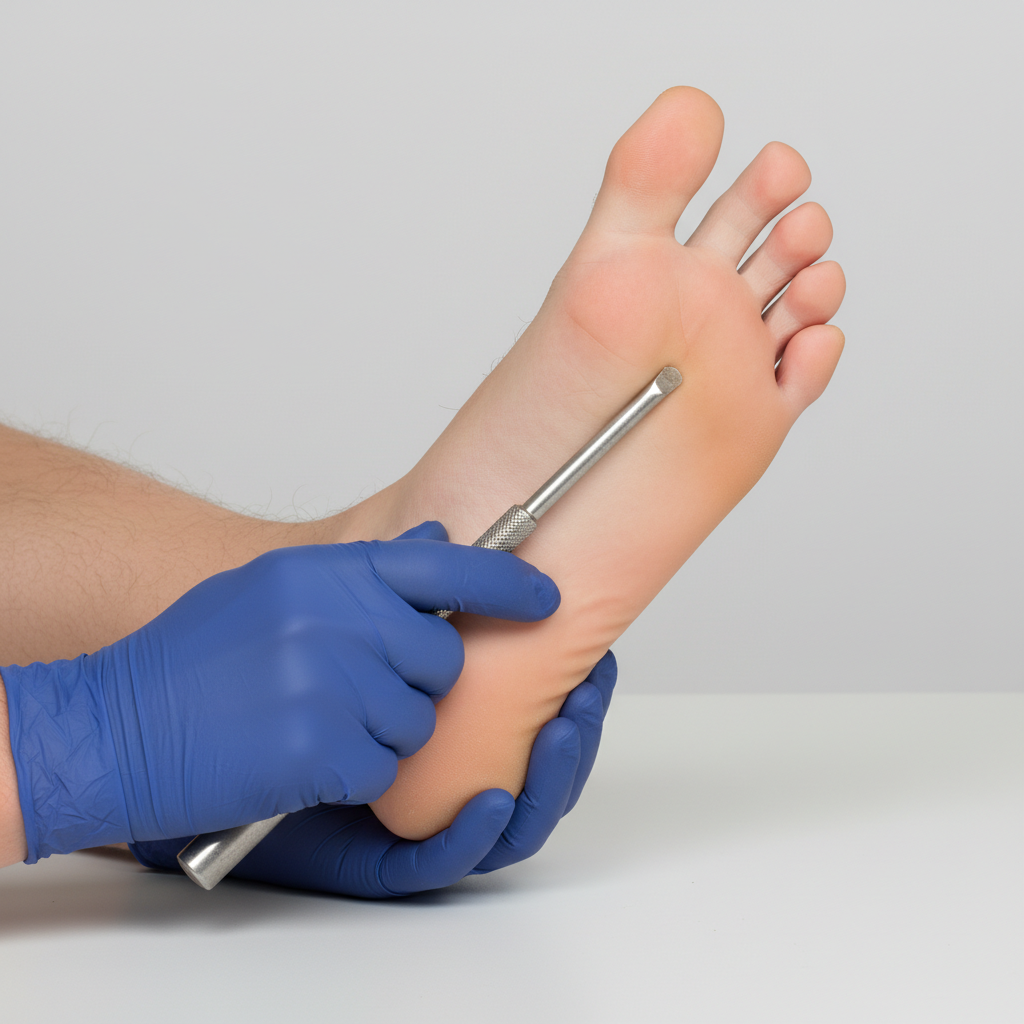
You are seeing a patient in clinic who presents with complaints of weakness. Her physical exam is notable for right sided hyperreflexia, as well as the reflex finding shown in the image below. Where is the most likely location of this patient's lesion?
Neuroanatomy US Medical PG Practice Questions and MCQs
Practice US Medical PG questions for Neuroanatomy. These multiple choice questions (MCQs) cover important concepts and help you prepare for your exams.
Neuroanatomy US Medical PG Question 1: You are seeing a patient in clinic who presents with complaints of weakness. Her physical exam is notable for right sided hyperreflexia, as well as the reflex finding shown in the image below. Where is the most likely location of this patient's lesion?
- A. Postcentral gyrus
- B. Neuromuscular junction
- C. Lateral geniculate nucleus
- D. Internal capsule (Correct Answer)
- E. Subthalamic nucleus
Neuroanatomy Explanation: ***Internal capsule*** - The combination of **right-sided hyperreflexia** (an upper motor neuron sign) and a positive **Babinski sign** (as implied by a video demonstrating this reflex) points to an upper motor neuron lesion. - The **internal capsule** contains descending motor pathways, and a lesion here would affect the contralateral side of the body, causing **weakness** and upper motor neuron signs. *Postcentral gyrus* - The **postcentral gyrus** is the primary somatosensory cortex and primarily deals with sensory processing, not motor output. - A lesion here would typically cause **contralateral sensory deficits**, such as numbness or loss of proprioception, rather than motor weakness with hyperreflexia. *Neuromuscular junction* - Diseases of the **neuromuscular junction**, such as myasthenia gravis, cause **fatigable weakness** without hyperreflexia or other upper motor neuron signs. - Reflexes are typically normal or decreased in these conditions. *Lateral geniculate nucleus* - The **lateral geniculate nucleus** is a thalamic relay center for visual information. - Lesions here would result in **visual field deficits** (e.g., homonymous hemianopsia), not motor weakness or hyperreflexia. *Subthalamic nucleus* - The **subthalamic nucleus** is part of the basal ganglia and is involved in motor control, particularly in regulating movement initiation and stopping. - Lesions here are classically associated with **hemiballismus**, which is characterized by wild, flinging movements, rather than weakness and hyperreflexia.
Neuroanatomy US Medical PG Question 2: A 69-year-old man is brought in by his wife with acute onset aphasia for the past 5 hours. The patient's wife says that they were sitting having dinner when suddenly he was not able to speak. They delayed coming to the hospital because he had a similar episode 2 months ago which resolved within an hour. His past medical history is significant for hypercholesterolemia, managed with rosuvastatin, and a myocardial infarction (MI) 2 months ago, status post percutaneous transluminal coronary angioplasty complicated by residual angina. His family history is significant for his father who died of MI at age 60. The patient reports a 15-pack-year smoking history but denies any alcohol or recreational drug use. The vital signs include: temperature 37.0℃ (98.6℉), blood pressure 125/85 mm Hg, pulse 96/min, and respiratory rate 19/min. On physical examination, the patient has expressive aphasia. There is a weakness of the right-sided lower facial muscles. The strength in his upper and lower extremities is 4/5 on the right and 5/5 on the left. There is also a decreased sensation on his right side. A noncontrast computed tomography (CT) scan of the head is unremarkable. CT angiography (CTA) and diffusion-weighted magnetic resonance imaging (MRI) of the brain are acquired, and the findings are shown in the exhibit (see image). Which of the following is the best course of treatment in this patient?
- A. Aspirin
- B. Mannitol
- C. Mechanical thrombectomy (Correct Answer)
- D. IV tPA
- E. Low molecular weight heparin
Neuroanatomy Explanation: ***Mechanical thrombectomy*** - The patient presents with **acute ischemic stroke** symptoms (aphasia, right-sided weakness, sensory deficits) at **5 hours from symptom onset**. Imaging (CTA showing large vessel occlusion and MRI confirming diffusion restriction) demonstrates a **large vessel occlusion**, making him a candidate for **mechanical thrombectomy**. - Since the patient is **beyond the 4.5-hour window for IV tPA**, mechanical thrombectomy is the **primary reperfusion therapy** indicated for large vessel occlusion strokes up to **24 hours** (with appropriate imaging showing salvageable tissue). - Mechanical thrombectomy offers the best chance for complete recanalization and improved neurological outcomes in large vessel occlusion strokes, particularly when IV tPA is not an option. *Aspirin* - While **aspirin** is crucial for **secondary stroke prevention**, it is not the primary acute treatment for a large vessel occlusion stroke due to its limited ability to achieve rapid and complete recanalization. - Aspirin (or other antiplatelet therapy) is typically initiated **within 24-48 hours after stroke onset**, but only after excluding hemorrhagic transformation and after acute reperfusion therapies have been considered or completed. *Mannitol* - **Mannitol** is an osmotic diuretic used to reduce **intracranial pressure (ICP)** in cases of severe cerebral edema, which can be a complication of large ischemic strokes. - It is not a primary treatment for the acute ischemic event itself, but rather a supportive measure used to manage life-threatening complications if **cerebral edema** develops and causes significant mass effect or herniation risk. *IV tPA* - **Intravenous tissue plasminogen activator (IV tPA)** is the first-line pharmacologic treatment for acute ischemic stroke if administered **within 4.5 hours of symptom onset** in eligible patients. - This patient presents at **5 hours**, which is **beyond the approved time window** for IV tPA administration, making him **ineligible** for thrombolytic therapy. - Even if within the time window, patients with large vessel occlusion often require mechanical thrombectomy in addition to or instead of IV tPA for optimal outcomes. *Low molecular weight heparin* - **Low molecular weight heparin (LMWH)** is primarily used for **deep vein thrombosis (DVT)** prophylaxis in immobilized patients or for the treatment of established DVT/pulmonary embolism. - It is generally **not recommended for acute ischemic stroke treatment** due to an increased risk of hemorrhagic transformation without proven benefit in recanalization or clinical outcomes.
Neuroanatomy US Medical PG Question 3: A 24-year-old man presents to the emergency department after a motor vehicle collision. He was in the front seat and unrestrained driver in a head on collision. His temperature is 99.2°F (37.3°C), blood pressure is 90/65 mmHg, pulse is 152/min, respirations are 16/min, and oxygen saturation is 100% on room air. Physical exam is notable for a young man who opens his eyes spontaneously and is looking around. He answers questions with inappropriate responses but discernible words. He withdraws from pain but does not have purposeful movement. Which of the following is this patient's Glasgow coma scale?
- A. 9
- B. 15
- C. 7
- D. 11 (Correct Answer)
- E. 13
Neuroanatomy Explanation: ***11*** - **Eye-opening (E)**: The patient opens his eyes spontaneously, scoring **E4**. - **Verbal response (V)**: He gives inappropriate responses but discernible words, scoring **V3**. - **Motor response (M)**: He withdraws from pain but does not have purposeful movement, scoring **M4**. - Therefore, the total Glasgow Coma Scale (GCS) score is **E4 + V3 + M4 = 11**. *9* - This score would imply a lower verbal or motor response, such as **incomprehensible sounds (V2)** or **abnormal flexion (M3)**, which is not consistent with the patient's presentation. - For example, E4 + V2 + M3 would equal 9. *15* - A GCS of 15 indicates **normal neurological function**, meaning the patient would be fully oriented, obey commands, and open eyes spontaneously, which is not the case here. - This score is for a patient who is fully conscious and responsive. *7* - A GCS of 7 suggests a **severe brain injury**, which would typically present with a much poorer response, such as **no verbal response (V1)** or **abnormal extension (M2)**. - For example, E4 + V1 + M2 would equal 7. *13* - This score would mean a higher level of consciousness, such as **confused conversation (V4)** or **localizing pain (M5)**, which is better than the patient's described responses. - For example, E4 + V4 + M5 would equal 13.
Neuroanatomy US Medical PG Question 4: A 66-year-old man is brought into the emergency department by his daughter for a change in behavior. Yesterday the patient seemed more confused than usual and was asking the same questions repetitively. His symptoms have not improved over the past 24 hours, thus the decision to bring him in today. Last year, the patient was almost completely independent but he then suffered a "series of falls," after which his ability to care for himself declined. After this episode he was no longer able to cook for himself or pay his bills but otherwise had been fine up until this episode. The patient has a past medical history of myocardial infarction, hypertension, depression, diabetes mellitus type II, constipation, diverticulitis, and peripheral neuropathy. His current medications include metformin, insulin, lisinopril, hydrochlorothiazide, sodium docusate, atorvastatin, metoprolol, fluoxetine, and gabapentin. On exam you note a confused man who is poorly kept. He has bruises over his legs and his gait seems unstable. He is alert to person and place, and answers some questions inappropriately. The patient's pulse is 90/minute and his blood pressure is 170/100 mmHg. Which of the following is the most likely diagnosis?
- A. Normal aging
- B. Lewy body dementia
- C. Vascular dementia (Correct Answer)
- D. Pseudodementia (depression-related cognitive impairment)
- E. Alzheimer's dementia
Neuroanatomy Explanation: ***Vascular dementia*** - This diagnosis is strongly supported by the patient's **stepwise decline** in cognitive function following a "series of falls" (likely small strokes or transient ischemic attacks) and his extensive history of **vascular risk factors** including hypertension, diabetes, and previous myocardial infarction. - The acute worsening of confusion over 24 hours, coupled with pre-existing impaired executive function (inability to cook or pay bills), is characteristic of **vascular dementia's fluctuating course** and presentation often linked to new cerebrovascular events. *Incorrect: Normal aging* - **Normal aging** involves a very gradual and mild decline in cognitive functions, primarily affecting processing speed and memory recall, without significant impairment in daily activities. - This patient's rapid, stepwise decline and inability to perform instrumental activities of daily living (IADLs) such as cooking and managing finances go beyond what is considered normal cognitive changes with aging. *Incorrect: Lewy body dementia* - **Lewy body dementia** is characterized by prominent **fluctuations in attention and alertness**, recurrent visual hallucinations, and spontaneous parkinsonism, none of which are explicitly mentioned as primary features in this patient's presentation. - While fluctuations in confusion are present, the history of a clear stepwise decline post-falls and significant vascular risk factors points away from Lewy body dementia as the most likely primary cause. *Incorrect: Pseudodementia (depression-related cognitive impairment)* - **Pseudodementia** refers to cognitive impairment that occurs in the context of **major depression**, where patients may exhibit poor concentration, memory difficulties, and psychomotor slowing that mimics dementia. - While this patient is on fluoxetine for depression, the **stepwise decline** after clear vascular events (falls), multiple vascular risk factors, and impaired executive function point to a true neurodegenerative process rather than depression-induced cognitive changes, which typically improve with treatment of the underlying mood disorder. *Incorrect: Alzheimer's dementia* - **Alzheimer's dementia** typically presents with a **gradual and progressive decline** in memory, particularly episodic memory, followed by other cognitive domains over several years. - The patient's history of a clear **stepwise decline** in function after acute events (falls) and the strong presence of **vascular risk factors** make vascular dementia a more fitting diagnosis than Alzheimer's, which is not typically associated with such a sudden, step-like progression.
Neuroanatomy US Medical PG Question 5: A 45-year-old man presents to the emergency department with complaints of right-sided weakness and slurring of speech for 1 hour. There is no history of head trauma, myocardial infarction, recent surgery, gastrointestinal or urinary bleeding. He has hypertension, chronic atrial fibrillation, and a 20 pack-year cigarette smoking history. The medication list includes valsartan and rivaroxaban. The vital signs include: blood pressure 180/92 mm Hg, pulse 144/min and irregular, and temperature 37.2°C (99.0°F). On physical examination, there is a facial asymmetry with a deviation of angle of mouth to the left side on smiling. Muscle strength is reduced in both upper and lower limbs on the right side while on the left side it’s normal. Random blood glucose is 104 mg/dL. A complete blood count is normal. A CT scan of the head is shown in the image. What is the most appropriate next step in the management of this patient?
- A. Heparin
- B. Amiodarone
- C. Metoprolol
- D. Tissue plasminogen activator
- E. Aspirin (Correct Answer)
Neuroanatomy Explanation: ***Aspirin*** - The patient presents with acute onset **neurological deficits** (right-sided weakness, slurred speech) consistent with an **ischemic stroke** in the setting of **atrial fibrillation**. - The CT scan shows no evidence of hemorrhage (hypodense or normal appearance), confirming **ischemic stroke**. - While the patient is on **rivaroxaban**, the question addresses the **within-window acute management**. In the acute setting (within 1 hour of symptom onset), after ruling out hemorrhage on CT, **aspirin 325 mg** is considered as initial antiplatelet therapy for ischemic stroke. - **Note:** Current guidelines suggest holding rivaroxaban temporarily and avoiding dual therapy (anticoagulation + antiplatelet) due to bleeding risk. However, aspirin remains the safest acute intervention among the choices provided for confirmed ischemic stroke. *Tissue plasminogen activator (tPA)* - **tPA** is the preferred thrombolytic for acute ischemic stroke **within 3-4.5 hours** of symptom onset. - However, it is **absolutely contraindicated** in patients on **direct oral anticoagulants** (like rivaroxaban) due to **dramatically increased risk of intracranial hemorrhage** (up to 10-fold increase). - Even with normal PT/INR, patients on DOACs cannot receive tPA safely without reversal agents. *Heparin* - **Heparin** provides additional anticoagulation on top of rivaroxaban, which would **significantly increase bleeding risk** (both intracranial and systemic). - Not indicated in acute ischemic stroke management, especially when patient is already therapeutically anticoagulated. - May be considered in specific scenarios (e.g., crescendo TIAs, arterial dissection) but not first-line here. *Metoprolol* - **Metoprolol** is a beta-blocker used for **rate control in atrial fibrillation** (patient has pulse 144/min - rapid ventricular response). - While rate control is important, **acute blood pressure lowering in ischemic stroke can worsen cerebral perfusion** and extend the infarct. - Current guidelines recommend **permissive hypertension** in acute stroke (allow BP up to 220/120 unless giving tPA). - Rate control can be addressed after acute stroke management is initiated. *Amiodarone* - **Amiodarone** is an antiarrhythmic used for rhythm control in atrial fibrillation. - Does **not treat the acute stroke** and is not indicated for emergency management of stroke. - Rhythm control is not the priority in the acute stroke setting; the focus is on salvaging brain tissue and preventing further ischemia.
More Neuroanatomy US Medical PG questions available in the OnCourse app. Practice MCQs, flashcards, and get detailed explanations.
Flashcards
10 cards for Neuroanatomy
Sample Flashcards: Neuroanatomy
The _____ nucleus sends parasympathetic fibers to the heart, lungs, and upper GI tract
The _____ nucleus sends parasympathetic fibers to the heart, lungs, and upper GI tract
dorsal motor
Neuroanatomy Flashcards - Medical Study Cards by OnCourse
Master Neuroanatomy with OnCourse flashcards. These spaced repetition flashcards are designed for medical students preparing for NEET PG, USMLE Step 1, USMLE Step 2, MBBS exams, and other medical licensing examinations.
OnCourse flashcards use active recall and spaced repetition techniques similar to Anki to help you memorize and retain medical concepts effectively. Each card is crafted by medical experts to cover high-yield topics.
Why use OnCourse Flashcards for Neuroanatomy?
- Spaced repetition algorithm for optimal retention
- Anki-style cloze deletions for active recall
- Created by medical professionals and educators
- Covers NEET PG, USMLE, PLAB, and MBBS curricula
- Mobile app available for studying on the go
Neuroanatomy Flashcard Deck - 5 Cards
Neuroanatomy Flashcard 1 of 5
Question: The _____ nucleus sends parasympathetic fibers to the heart, lungs, and upper GI tract
Answer: dorsal motor
Neuroanatomy Flashcard 2 of 5
Question: _____ circuit describes the neural circuit for emotional expression and includes the hippocampus, mammillary bodies, anterior thalamic nuclei, cingulate gyrus, and entorhinal cortex
Answer: Papez
Neuroanatomy Flashcard 3 of 5
Question: Structures of the _____ system include the hippocampus, amygdala, fornix, mammillary bodies, and cingulate gyrus
Answer: limbic
Neuroanatomy Flashcard 4 of 5
Question: ID Brainstem Level: _____
Answer: Rostral pons - Presence of 4th ventricle - Ventral enlargement - Presence of CN V
Neuroanatomy Flashcard 5 of 5
Question: Holoprosencephaly is characterized by a monoventricle and fusion of _____ on MRI
Answer: basal ganglia
Download the OnCourse app to access all 5 flashcards for Neuroanatomy, plus thousands more covering Anatomy, Physiology, Pathology, Pharmacology, Microbiology, Biochemistry, and all medical subjects. Better than Anki for medical students!
Keywords: Neuroanatomy flashcards, medical flashcards, NEET PG preparation, USMLE Step 1 flashcards, Anki alternative, spaced repetition medical, OnCourse flashcards, medical exam preparation, MBBS study material, active recall medical education

Have doubts about this lesson?
Ask Rezzy, your AI Study Mate, to explain anything you didn't understand
About Neuroanatomy for USMLE
Neuroanatomy is a key topic within Anatomy for USMLE preparation. OnCourse provides 12 comprehensive lessons, 10 practice MCQs, and 10 flashcards to help you master this topic.
Lessons in Neuroanatomy
- Cerebral cortex and lobes
- Basal ganglia
- Thalamus and hypothalamus
- Limbic system
- Cerebellum
- Spinal cord organization
- CSF production and circulation
- Meninges and blood-brain barrier
- Sensory pathways
- Motor pathways
- Functional neuroanatomy of vision
- Functional neuroanatomy of hearing and balance
Part of Anatomy for USMLE preparation on OnCourse.
Master Neuroanatomy
Get full access to all 12 lessons, 10 questions, and AI-powered study tools.
START FOR FREE