Diseases of the Lens Indian Medical PG Practice Questions and MCQs
Practice Indian Medical PG questions for Diseases of the Lens. These multiple choice questions (MCQs) cover important concepts and help you prepare for your exams.
Diseases of the Lens Indian Medical PG Question 1: Hypovitaminosis D causes which of the following types of cataract?
- A. Zonular cataract (Correct Answer)
- B. Blue-dot cataract
- C. Rosette cataract
- D. Cupuliform cataract
Diseases of the Lens Explanation: **Explanation:**
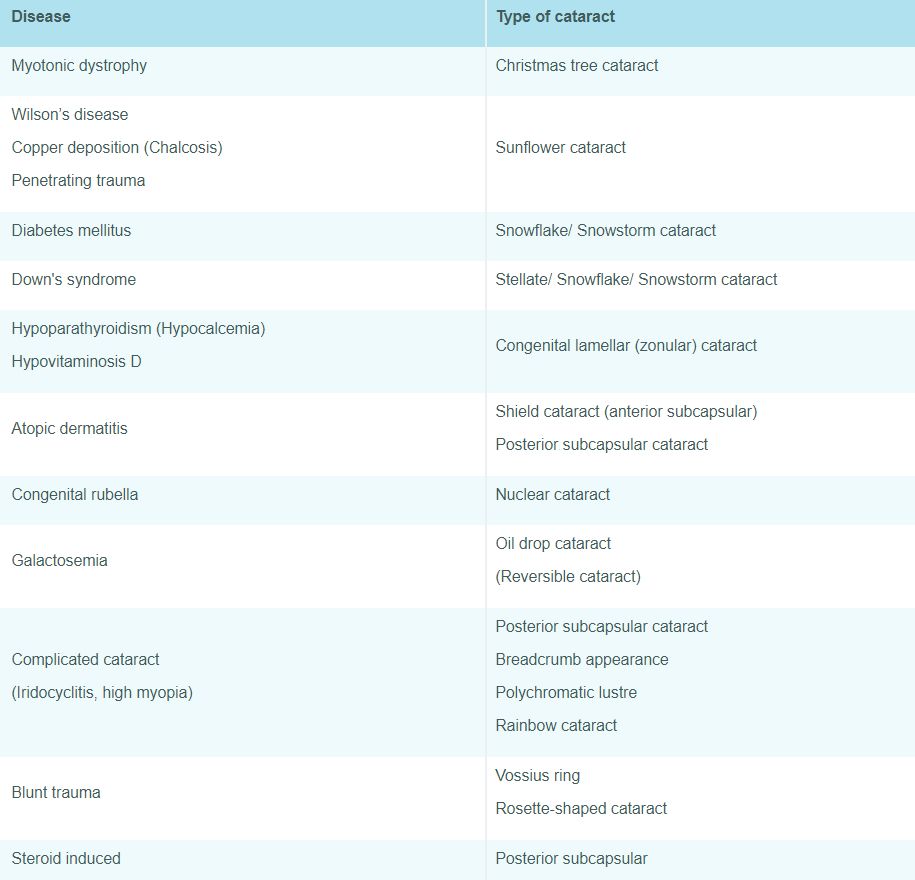
**Zonular (Lamellar) cataract** is the most common type of developmental cataract. It occurs due to a transient metabolic disturbance affecting the fibers being formed at a specific period. **Hypovitaminosis D** and the resulting **hypocalcemia** are the classic systemic triggers. When serum calcium levels drop, it disrupts the development of the lens fibers, leading to an area of opacification (a "zone") surrounded by clear lens matter. Characteristically, these cataracts show "riders"—linear opacities extending from the equator of the zone.
**Analysis of Incorrect Options:**
* **Blue-dot cataract (Punctate cataract):** These are the most common congenital cataracts, appearing as small, bluish, opaque dots. They are usually stationary, asymptomatic, and not specifically linked to Vitamin D deficiency.
* **Rosette cataract:** This is a classic sign of **mechanical ocular trauma** (concussive injury). The opacification follows the suture lines of the lens, resembling a flower or star.
* **Cupuliform cataract:** Also known as **Posterior Subcapsular Cataract (PSC)**, this is typically associated with aging, prolonged systemic or topical steroid use, or ionizing radiation.
**High-Yield Pearls for NEET-PG:**
* **Zonular Cataract:** Always look for a history of maternal malnutrition or infantile tetany/hypocalcemia. It is usually bilateral and affects the vision significantly.
* **Galactosemia:** Causes "Oil droplet" cataract.
* **Diabetes Mellitus:** Causes "Snowflake" cataract.
* **Myotonic Dystrophy:** Causes "Christmas tree" cataract.
* **Wilson’s Disease:** Causes "Sunflower" cataract (found in the anterior capsule).
Diseases of the Lens Indian Medical PG Question 2: What is the most common type of cataract observed in a newborn?
- A. Zonular cataract (Correct Answer)
- B. Morgagnian cataract
- C. Anterior polar cataract
- D. Posterior polar cataract
Diseases of the Lens Explanation: **Explanation:**
**Zonular (Lamellar) cataract** is the most common type of congenital cataract, accounting for approximately 50% of cases. It is characterized by opacification of a specific layer (lamella) of the lens fibers, usually surrounding a clear embryonic nucleus. This occurs due to a transient interference with lens development during fetal life. Clinically, it presents with "riders" (linear opacities extending from the equator of the cataract), which is a high-yield diagnostic feature.
**Analysis of Incorrect Options:**
* **Morgagnian cataract:** This is a stage of hypermature senile cataract where the cortex liquefies and the nucleus sinks to the bottom. It is an acquired condition of the elderly, not newborns.
* **Anterior polar cataract:** These are small, central opacities on the anterior lens capsule. While common, they are typically stationary, often unilateral, and less frequent than the zonular type.
* **Posterior polar cataract:** These occur at the posterior pole and are often associated with remnants of the hyaloid artery (Mittendorf dot). They are clinically significant due to the risk of posterior capsular rupture during surgery but are not the most common type.
**NEET-PG High-Yield Pearls:**
* **Most common cause of congenital cataract:** Idiopathic (followed by genetic/hereditary factors).
* **Most common infection causing congenital cataract:** Rubella (presents as "pearly white" opacity).
* **Galactosemia:** Associated with "Oil droplet" cataracts.
* **Diabetes Mellitus:** Associated with "Snowflake" cataracts.
* **Wilson’s Disease:** Associated with "Sunflower" cataracts.
Diseases of the Lens Indian Medical PG Question 3: Eye lens dislocation is seen in which of the following conditions?
- A. Marfan's syndrome and Homocystinuria
- B. Marfan's syndrome
- C. Marfan's syndrome and Homocystinuria (Correct Answer)
- D. Homocystinuria and Down's syndrome
Diseases of the Lens Explanation: **Explanation:**
Lens dislocation, or **Ectopia Lentis**, occurs due to the weakening or destruction of the ciliary zonules (suspensory ligaments) that hold the lens in place. This is a classic high-yield topic for NEET-PG, primarily associated with systemic connective tissue disorders.
**Why the correct answer is right:**
* **Marfan’s Syndrome:** This is the most common cause of heritable ectopia lentis. It is an autosomal dominant disorder caused by a mutation in the **FBN1 gene** (fibrillin-1). The lens typically dislocates **superotemporally** (Upward and Outward).
* **Homocystinuria:** This is an autosomal recessive metabolic disorder (cystathionine beta-synthase deficiency). It leads to brittle zonules due to cysteine deficiency. The lens typically dislocates **inferonasally** (Downward and Inward) and is more prone to total dislocation into the vitreous.
**Analysis of Incorrect Options:**
* **Option B:** While Marfan’s is a cause, it is incomplete as Homocystinuria is equally significant in clinical examinations.
* **Option D:** While Homocystinuria is correct, **Down’s syndrome** is not typically associated with lens dislocation; it is more commonly associated with Keratoconus, Brushfield spots, and congenital cataracts.
**Clinical Pearls for NEET-PG:**
1. **Direction Mnemonic:** **M**arfan = **M**ount (Upward); **H**omocystinuria = **H**ell (Downward).
2. **Accommodation:** In Marfan’s, zonules are stretched but intact, so some accommodation may remain. In Homocystinuria, zonules are absent/broken, leading to a complete loss of accommodation.
3. **Other causes:** Weill-Marchesani syndrome (dislocates inferiorly; associated with microspherophakia), Sulfite oxidase deficiency, and trauma (the most common overall cause).
Diseases of the Lens Indian Medical PG Question 4: A young patient presents with gradual blurring of vision in the left eye. Slit lamp examination reveals fine stellate keratatic precipitates and aqueous flare and a typical complicated posterior subcapsular cataract. No posterior synechiae were observed. What is the most likely diagnosis?
- A. Intermediate Uveitis (Pars planitis)
- B. Heerfordt's disease
- C. Heterochromic iridocyclitis of Fuch's (Correct Answer)
- D. Subacute Iridocyclitis
Diseases of the Lens Explanation: **Explanation:**
The clinical presentation points directly to **Fuchs’ Heterochromic Iridocyclitis (FHI)**. The hallmark of FHI is a chronic, low-grade, non-granulomatous uveitis characterized by a classic triad: **fine stellate keratatic precipitates (KPs)** distributed over the entire corneal endothelium, **aqueous flare/cells**, and the development of a **complicated posterior subcapsular cataract**.
A defining negative finding in FHI is the **absence of posterior synechiae**, despite the presence of chronic inflammation. This distinguishes it from most other forms of anterior uveitis. While heterochromia (iris color change) is a key sign, it may be subtle or absent in early stages or in dark-eyed individuals.
**Why other options are incorrect:**
* **Intermediate Uveitis (Pars planitis):** Characterized by "snowbanking" or "snowballs" in the vitreous and peripheral retina. While it causes complicated cataracts, it does not typically present with diffuse stellate KPs.
* **Heerfordt’s Disease:** A specific manifestation of Sarcoidosis (Uveoparotid fever) presenting with granulomatous uveitis (large mutton-fat KPs), parotid swelling, and facial nerve palsy. Posterior synechiae are common here.
* **Subacute Iridocyclitis:** Usually presents with circumcorneal congestion, pain, and a high tendency to form posterior synechiae.
**NEET-PG High-Yield Pearls:**
* **Amsler’s Sign:** Filiform hemorrhage triggered by paracentesis or minor trauma (due to fragile iris vessels) is a classic diagnostic feature of FHI.
* **Treatment:** Steroids are generally **not** effective or indicated for FHI; management focuses on treating the secondary cataract and glaucoma.
* **Triad of FHI:** Heterochromia, Cyclitis (KPs), and Cataract.
Diseases of the Lens Indian Medical PG Question 5: What is the most common type of cataract?
- A. Blue dot
- B. Zonular
- C. Cupuliform
- D. Cuneiform (Correct Answer)
Diseases of the Lens Explanation: **Explanation:**
The most common type of cataract overall is the **Senile (Age-related) Cataract**, which is broadly classified into two types: **Nuclear** and **Cortical**. Among the sub-types of cortical cataracts, the **Cuneiform cataract** is the most frequent clinical presentation.
**1. Why Cuneiform is Correct:**
Cuneiform cataracts are characterized by wedge-shaped opacities (spokes) that begin in the periphery of the lens cortex and extend toward the center. They are the most common morphological manifestation of senile cortical cataracts. Patients typically present with glare (due to light scattering) and peripheral field disturbances before central vision is significantly affected.
**2. Analysis of Incorrect Options:**
* **Blue dot (Punctate) Cataract:** This is the most common type of **congenital** cataract, but it is usually stationary, asymptomatic, and much less common than senile varieties.
* **Zonular (Lamellar) Cataract:** This is the most common type of congenital cataract **causing visual impairment**. It involves a specific shell or "zone" of the lens, typically due to a transient metabolic insult during development.
* **Cupuliform (Posterior Subcapsular) Cataract:** While this is a common type of senile cataract, it is less frequent than the cuneiform variety. However, it is clinically significant because it affects central vision early (causing "day blindness" or nyctalopia) as it lies right in the visual axis.
**Clinical Pearls for NEET-PG:**
* **Most common cause of cataract worldwide:** Aging (Senile).
* **Most common type of Congenital Cataract:** Blue dot (Punctate).
* **Cataract associated with Diabetes:** "Snowflake" cataract (though senile cataracts occur earlier in diabetics).
* **Cataract associated with Myotonic Dystrophy:** "Christmas tree" cataract.
* **Cataract associated with Wilson’s Disease:** "Sunflower" cataract.
More Diseases of the Lens Indian Medical PG questions available in the OnCourse app. Practice MCQs, flashcards, and get detailed explanations.