Immunology Indian Medical PG Practice Questions and MCQs
Practice Indian Medical PG questions for Immunology. These multiple choice questions (MCQs) cover important concepts and help you prepare for your exams.
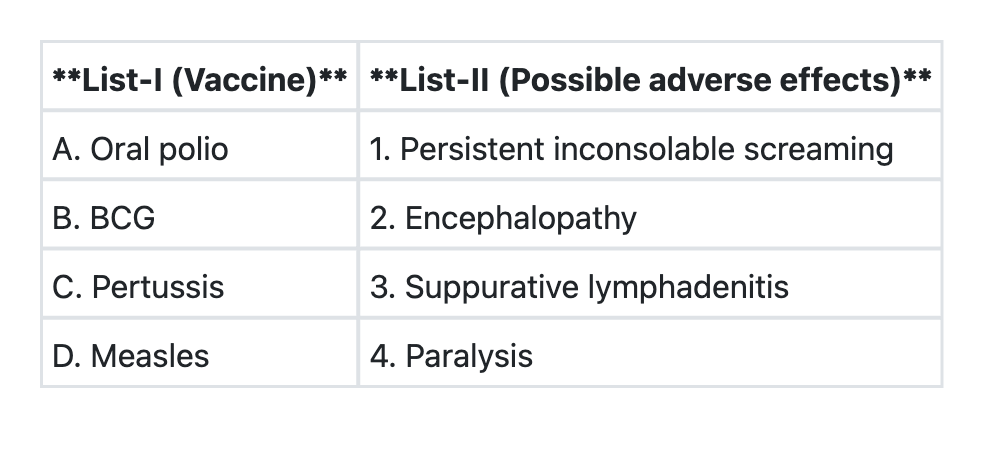
Immunology Indian Medical PG Question 1: Match List-I with List-II and select the correct answer using the code given below the Lists:
- A. A→4 B→3 C→1 D→2 (Correct Answer)
- B. A→3 B→4 C→1 D→2
- C. A→2 B→1 C→4 D→3
- D. A→1 B→2 C→3 D→4
Immunology Explanation: ***A→4 B→3 C→1 D→2***
- **Oral polio vaccine (OPV)** is a live attenuated vaccine, and a rare but serious adverse effect is vaccine-associated paralytic poliomyelitis (VAPP), which manifests as **paralysis**.
- **BCG vaccine** (Bacillus Calmette-Guérin) is used against tuberculosis. A known adverse effect, particularly in immunocompromised individuals, is **suppurative lymphadenitis**, where regional lymph nodes become inflamed and may form abscesses.
- **Pertussis vaccine** (whole-cell DTP) can cause reactions such as persistent inconsolable screaming, high fever, and, very rarely, encephalopathy. **Persistent inconsolable screaming** is a recognized adverse reaction to the pertussis component.
- **Measles vaccine** is a live attenuated vaccine. While generally safe, rare severe adverse effects include **encephalopathy** (or encephalitis).
*A→3 B→4 C→1 D→2*
- This option incorrectly associates oral polio vaccine with suppurative lymphadenitis and BCG with paralysis, contradicting established vaccine adverse effects.
- Oral polio has a risk of paralysis, not lymphadenitis, whereas BCG can cause lymphadenitis.
*A→2 B→1 C→4 D→3*
- This option incorrectly links oral polio to encephalopathy and BCG to persistent inconsolable screaming.
- Encephalopathy is associated with measles or pertussis, and persistent screaming with pertussis, not oral polio or BCG.
*A→1 B→2 C→3 D→4*
- This option incorrectly attributes persistent inconsolable screaming to oral polio and encephalopathy to BCG.
- Paralysis is a known complication of oral polio, and suppurative lymphadenitis is a key adverse effect of BCG.
Immunology Indian Medical PG Question 2: Which of the following is not a component of innate immunity?
- A. Epithelial barriers
- B. NK cells
- C. Dendritic cells
- D. Helper T lymphocytes (Correct Answer)
Immunology Explanation: ***Helper T lymphocyte***
- Helper T lymphocytes are a crucial part of **adaptive immunity** [4], facilitating responses against pathogens.
- They specifically activate B cells and cytotoxic T cells [2], unlike components of innate immunity, which respond nonspecifically.
*NK cells*
- Natural Killer (NK) cells are integral to **innate immunity** [1], targeting infected or tumor cells without prior sensitization.
- They play a role in the initial response to viral infections and can produce **cytokines** [2].
*Epithelial barriers*
- Epithelial barriers act as the first line of defense in **innate immunity** [1], preventing pathogen entry.
- They include physical and chemical barriers like skin and mucous membranes [3].
*Dendritic cells*
- Dendritic cells are key antigen-presenting cells involved in **innate immunity** [1] and link to adaptive immunity.
- They capture and present antigens [2], activating T cells to mount an immune response.
**References:**
[1] Kumar V, Abbas AK, et al.. Robbins and Cotran Pathologic Basis of Disease. 9th ed. Diseases of the Immune System, pp. 194-196.
[2] Kumar V, Abbas AK, et al.. Robbins and Cotran Pathologic Basis of Disease. 9th ed. Diseases of the Immune System, pp. 207-208.
[3] Cross SS. Underwood's Pathology: A Clinical Approach. 6th ed. (Basic Pathology) introduces the student to key general principles of pathology, both as a medical science and as a clinical activity with a vital role in patient care. Part 2 (Disease Mechanisms) provides fundamental knowledge about the cellular and molecular processes involved in diseases, providing the rationale for their treatment. Part 3 (Systematic Pathology) deals in detail with specific diseases, with emphasis on the clinically important aspects., pp. 152-153.
[4] Kumar V, Abbas AK, et al.. Robbins and Cotran Pathologic Basis of Disease. 9th ed. Diseases of the Immune System, pp. 196-198.
Immunology Indian Medical PG Question 3: Which of the following is a live attenuated vaccine?
- A. Salk Vaccine
- B. Yellow Fever Vaccine (Correct Answer)
- C. Hepatitis B vaccine
- D. Rabies Vaccine
Immunology Explanation: ***Yellow Fever Vaccine***
- The Yellow Fever vaccine is a **live attenuated vaccine**, meaning it contains a weakened form of the virus that stimulates a strong immune response without causing the disease.
- It is highly effective in providing long-lasting immunity against **yellow fever**, a viral hemorrhagic disease transmitted by mosquitoes.
*Salk Vaccine*
- The Salk vaccine is an **inactivated polio vaccine (IPV)**, meaning it contains killed poliovirus.
- It works by stimulating an immune response to the killed virus, but it does not replicate in the host.
*Rabies vaccine*
- The rabies vaccine is an **inactivated vaccine** prepared from killed rabies virus.
- It provides protection by inducing antibodies against the rabies virus glycoprotein.
*Hepatitis B vaccine*
- The Hepatitis B vaccine is a **recombinant vaccine**, meaning it is produced using genetic engineering techniques to synthesize hepatitis B surface antigen (HBsAg).
- It does not contain live or killed virus but rather a purified viral protein to stimulate immunity.
Immunology Indian Medical PG Question 4: During the EARLY phase of a primary immune response, which of the following best describes the relationship between peak IgM and IgG antibody levels?
- A. 50 times more
- B. 100 times more (Correct Answer)
- C. 25 times more
- D. 10 times more
Immunology Explanation: ***100 times more***
- In the **early phase of a primary immune response**, **IgM** is the first antibody produced and reaches peak levels when **IgG** levels are still very low.
- During this early period (approximately days 5-10), the **IgM concentration** can be significantly higher than IgG, with some references citing ratios up to 100-fold.
- **Important note:** As the primary response matures, **IgG levels rise and eventually exceed IgM levels** through class switching. This question specifically addresses the early peak comparison.
*50 times more*
- While IgM does predominate early in the primary response, the 50-fold ratio underestimates the typical difference during the **early peak phase** when IgG production has just begun.
- The most commonly cited ratio for early primary response is closer to 100-fold.
*25 times more*
- This ratio **underestimates** the relative abundance of **IgM** compared to **IgG** during the early peak of a primary immune response.
- **IgG** levels are typically very low or just beginning to rise in the early stages, while IgM has reached peak levels.
*10 times more*
- This significantly **underestimates** the difference in antibody levels during the early primary immune response.
- The rapid and robust initial production of **IgM** with delayed IgG production creates a much larger differential in the early phase.
**Clinical Note:** In a **secondary immune response**, the pattern reverses dramatically—IgG is produced rapidly and in much higher quantities than IgM (often 100-1000 times more) due to memory B cell activation.
Immunology Indian Medical PG Question 5: Assertion: VZV vaccine is live attenuated. Reason: It cannot be given to immunocompromised patients.
- A. Both true, reason doesn't explain assertion
- B. Assertion true, reason false
- C. Assertion false, reason true
- D. Both true, reason explains assertion (Correct Answer)
Immunology Explanation: ***Both true, reason explains assertion***
- The **VZV (varicella-zoster virus) vaccine** is indeed a **live attenuated vaccine** containing weakened virus - the assertion is **TRUE**
- It **cannot be given to immunocompromised patients** due to risk of vaccine-strain disease - the reason is **TRUE**
- The reason **directly explains the assertion**: BECAUSE the vaccine is live attenuated, it poses infection risk and therefore cannot be used in immunocompromised individuals
- The **causal relationship** is clear: live attenuated nature → contraindication in immunocompromised patients
*Both true, reason doesn't explain assertion*
- While both statements are factually true, this option would only be correct if the reason was unrelated to the assertion
- However, the reason **directly explains WHY** the live attenuated nature is clinically significant
- The contraindication is a **direct consequence** of the vaccine being live attenuated, so the reason does explain the assertion
*Assertion true, reason false*
- The assertion is true (VZV vaccine is live attenuated)
- However, the reason is also **TRUE** - live attenuated vaccines are indeed contraindicated in immunocompromised patients due to risk of disseminated vaccine-strain infection
- Since both statements are true, this option is incorrect
*Assertion false, reason true*
- The assertion is **TRUE**, not false - VZV vaccine (Varivax, Zostavax) is a **live attenuated vaccine** containing the Oka strain
- This option incorrectly claims the assertion is false
- Since the assertion is factually correct, this option cannot be right
More Immunology Indian Medical PG questions available in the OnCourse app. Practice MCQs, flashcards, and get detailed explanations.