Systemic Anatomy Indian Medical PG Practice Questions and MCQs
Practice Indian Medical PG questions for Systemic Anatomy. These multiple choice questions (MCQs) cover important concepts and help you prepare for your exams.
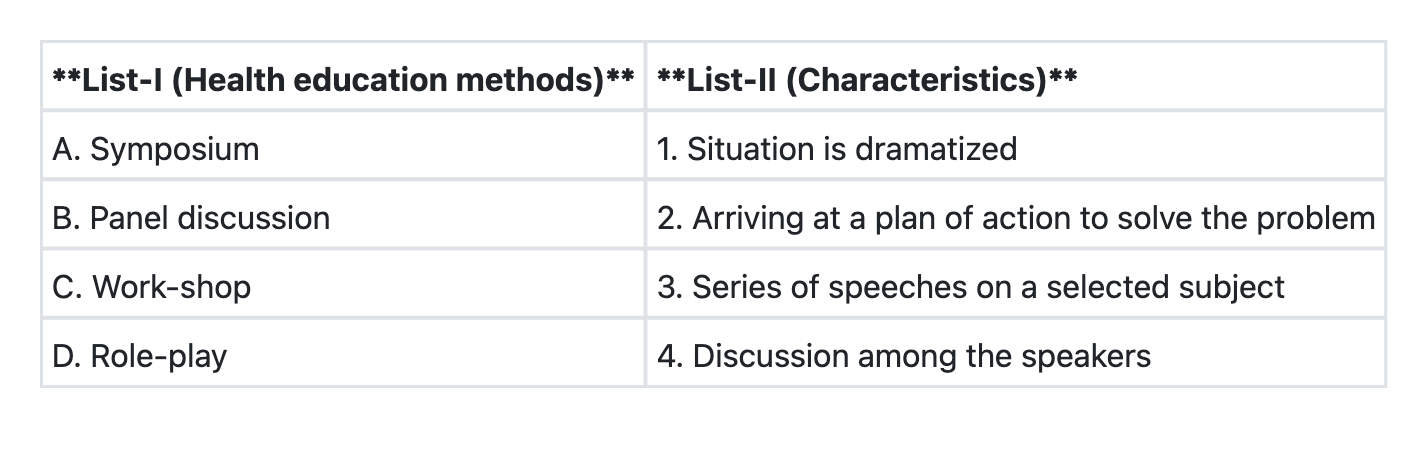
Systemic Anatomy Indian Medical PG Question 1: Match List-I with List-II and select the correct answer using the code given below the Lists:
- A. A→1 B→2 C→4 D→3
- B. A→3 B→2 C→4 D→1
- C. A→3 B→4 C→2 D→1 (Correct Answer)
- D. A→1 B→4 C→2 D→3
Systemic Anatomy Explanation: ***Correct Answer: A→3, B→4, C→2, D→1***
**Understanding Health Education Methods:**
**A. Symposium → 3. Series of speeches**
- A symposium is a formal meeting where multiple experts deliver **sequential speeches** on different aspects of a selected subject
- Each speaker presents their perspective, typically without much interaction between speakers during the presentation
**B. Panel Discussion → 4. Discussion among the speakers**
- A panel involves **interactive discussion among panelists** (experts) on a particular topic
- Characterized by dialogue and exchange of views between speakers, often followed by audience questions
**C. Workshop → 2. Arriving at a plan of action**
- A workshop is a **participatory, problem-solving session** designed to achieve practical outcomes
- Participants actively engage in exercises and activities to develop concrete action plans or solutions
**D. Role-play → 1. Dramatizing a situation**
- Role-play involves **acting out scenarios** to experience different perspectives
- Participants assume roles and dramatize situations to understand behaviors, emotions, and decision-making processes
*Key Differentiation:*
- Symposium = One-way presentations (speakers → audience)
- Panel = Two-way discussion (speakers ↔ speakers)
- Workshop = Participatory action planning
- Role-play = Experiential learning through dramatization
Systemic Anatomy Indian Medical PG Question 2: Which of the following is the platinum-based chemotherapeutic agent used as first-line treatment for ovarian carcinoma?
- A. Cyclophosphamide
- B. Methotrexate
- C. Cisplatin (Correct Answer)
- D. Dacarbazine
Systemic Anatomy Explanation: ***Cisplatin***
- **Cisplatin** is a platinum-based chemotherapy drug that forms **DNA cross-links**, inhibiting DNA synthesis and leading to the death of rapidly dividing cells, making it highly effective against **ovarian carcinoma**.
- It is a cornerstone of chemotherapy regimens for ovarian cancer, often used in combination with other agents such as paclitaxel.
*Methotrexate*
- **Methotrexate** is an **antimetabolite** that inhibits dihydrofolate reductase, thereby interfering with DNA synthesis.
- While it is used in various cancers like leukemia, lymphoma, and some solid tumors (e.g., breast cancer, gestational trophoblastic disease), it is **not a primary recommended drug for ovarian carcinoma**.
*Cyclophosphamide*
- **Cyclophosphamide** is an **alkylating agent** that causes DNA damage, leading to cell death.
- It is used in many cancers, including lymphoma, breast cancer, and some leukemias, but it is **not a first-line or primary agent for ovarian carcinoma** in contemporary treatment guidelines.
*Dacarbazine*
- **Dacarbazine** is an **alkylating agent** primarily used in the treatment of **malignant melanoma** and Hodgkin lymphoma.
- It is **not indicated for the treatment of ovarian carcinoma**.
Systemic Anatomy Indian Medical PG Question 3: A study was conducted to evaluate the diagnostic accuracy of ECG for detecting myocardial infarction. The results are shown in the 2x2 table below:
Myocardial Infarction
Present Absent Total
ECG Positive 45 8,000 8,045
ECG Negative 5 32,000 32,005
Total 50 40,000 40,050
Consider the following statements:
I. Sensitivity is 90%.
II. Specificity is 80%.
Which of the statements given above is/are correct?
- A. Both I and II (Correct Answer)
- B. Neither I nor II
- C. II only
- D. I only
Systemic Anatomy Explanation: **Both I and II**
- **Sensitivity** = True Positives / (True Positives + False Negatives) = 45 / (45 + 5) = 45/50 = **0.90 or 90%** ✓
- **Specificity** = True Negatives / (True Negatives + False Positives) = 32,000 / (32,000 + 8,000) = 32,000/40,000 = **0.80 or 80%** ✓
- Both calculations are correct based on the 2×2 contingency table
- **Sensitivity** measures the ability of the test to correctly identify those with disease (true positive rate)
- **Specificity** measures the ability of the test to correctly identify those without disease (true negative rate)
*I only*
- Incorrect because Statement II (Specificity = 80%) is also correct, not just Statement I
*II only*
- Incorrect because Statement I (Sensitivity = 90%) is also correct, not just Statement II
*Neither I nor II*
- Incorrect because both statements are mathematically correct based on the given data
Systemic Anatomy Indian Medical PG Question 4: The organ with maximum blood flow in milliliters per kilogram per minute during resting is:
- A. Kidneys (Correct Answer)
- B. Brain
- C. Lungs
- D. Liver
Systemic Anatomy Explanation: ***Kidneys***
- The kidneys receive a disproportionately large share of cardiac output, approximately **20-25%**, which is essential for their role in **filtering blood** and maintaining fluid and electrolyte balance.
- When adjusted for organ weight, the kidneys have the highest blood flow per unit mass due to their high metabolic demands for active transport and regulatory functions.
*Liver*
- The liver receives significant blood flow, but a substantial portion is **venous blood** from the portal system, which is lower in oxygen and nutrient content.
- While total blood flow to the liver is high, its actual arterial supply and overall perfusion density per kilogram is lower than that of the kidneys.
*Brain*
- The brain has high metabolic demands and receives a constant and significant blood supply, typically around **15% of cardiac output**, to ensure adequate oxygen and glucose delivery.
- However, when normalized per unit of tissue mass, its blood flow is less than that of the kidneys, which have specialized functions requiring extremely high perfusion.
*Lungs*
- The lungs receive the entire cardiac output through the **pulmonary circulation** for gas exchange, but this refers to the total volume of blood passing through, not the nutritive arterial supply to the lung tissue itself.
- The bronchial circulation, which supplies oxygenated blood to the lung tissue, is relatively small compared to other highly metabolic organs.
Systemic Anatomy Indian Medical PG Question 5: What is the primary function of the superior cervical ganglion?
- A. Is the largest cervical ganglion
- B. Supplies sympathetic fibers to the dilator pupillae muscle (Correct Answer)
- C. Deep petrosal nerve of pterygopalatine ganglion is derived from plexus around internal carotid artery
- D. Left superior cervical cardiac branch goes to deep cardiac plexus
Systemic Anatomy Explanation: Supplies sympathetic fibers to the dilator pupillae muscle
- The superior cervical ganglion is the primary source of postganglionic sympathetic fibers to the head and neck.
- One of its key functions is providing sympathetic innervation to the dilator pupillae muscle [1] via the long ciliary nerves, causing mydriasis (pupil dilation) [2].
- This represents a clear physiological function of the ganglion in autonomic control of the eye.
Is the largest cervical ganglion
- While the superior cervical ganglion is indeed the largest of the three cervical sympathetic ganglia, this is an anatomical characteristic, not a function.
- Size is a structural feature, not a physiological role.
Left superior cervical cardiac branch goes to deep cardiac plexus
- The superior cervical ganglion does contribute cardiac branches to the cardiac plexus for sympathetic innervation of the heart.
- However, this describes an anatomical pathway rather than the primary function itself, and specifying "left" and "deep cardiac plexus" makes it overly specific rather than addressing overall function.
Deep petrosal nerve of pterygopalatine ganglion is derived from plexus around internal carotid artery
- The superior cervical ganglion does send postganglionic fibers forming a plexus around the internal carotid artery, which contributes to the deep petrosal nerve.
- However, this is an anatomical derivation/pathway, not a functional description of what the ganglion does physiologically.
More Systemic Anatomy Indian Medical PG questions available in the OnCourse app. Practice MCQs, flashcards, and get detailed explanations.