Study designs: RCT, cohort, case-control, cross-sectional — comparison and biases
 Rezzy
RezzyAh, the bread and butter of biostatistics! Understanding these study designs is like learning the rules of the game before you start playing. It's high-yield for the USMLE and honestly, it makes reading any medical journal much less intimidating.
Let me find a good visual to help you see how these designs differ in their approach.
That diagram is a lifesaver for remembering the "direction" of each study.
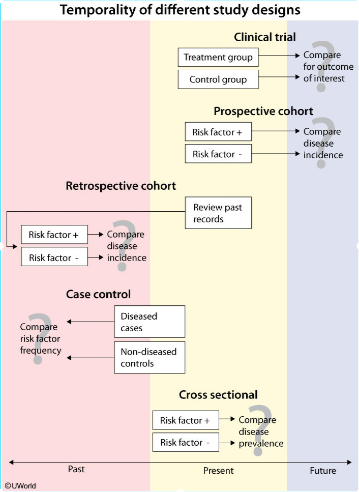
This visual shows how RCTs and Cohort studies look forward (prospective), while Case-Control studies look backward (retrospective), and Cross-Sectional studies take a snapshot of the present.
To make it even easier to compare them side-by-side, I've put together a table summarizing their key features, measures of association, and common pitfalls.
| Study Design | Key Feature | Measure | Main Biases |
|---|---|---|---|
| RCT | Randomly assigns exposure/treatment | Relative Risk (RR) | Selection bias (if not randomized), Attrition bias |
| Cohort | Follows a group based on exposure | Relative Risk (RR) | Selection bias, Attrition bias |
| Case-Control | Compares those with disease (cases) to those without (controls) | Odds Ratio (OR) | Recall bias, Selection bias |
| Cross-Sectional | Snapshot of prevalence at one point in time | Prevalence Odds Ratio | Selection bias, Temporal ambiguity |
The table gives you the high-level view, but let's dive into those biases because that's where the USMLE examiners love to hide the tricky questions!
Common Biases to Watch Out For:
- Selection Bias: This happens when the study population doesn't represent the target population. In Case-Control studies, if the controls aren't chosen from the same population as the cases, you've got a problem.
- Recall Bias: A classic in Case-Control studies. People with a disease (cases) are more likely to remember past exposures than those without (controls). "Did you eat sushi three years ago?" A case might say yes because they're searching for a cause, while a control might just forget.
- Attrition Bias: This is the bane of Cohort studies and RCTs. If people drop out of the study (lost to follow-up), and those who drop out are different from those who stay, your results are skewed.
- Confounding: When an outside factor is related to both the exposure and the outcome. For example, a study might find a link between coffee and lung cancer, but the real "confounder" is smoking (coffee drinkers might smoke more). RCTs are the best at minimizing this through randomization.
- Temporal Ambiguity: This is the "chicken or the egg" problem in Cross-Sectional studies. Since everything is measured at once, you can't always tell if the exposure caused the disease or if the disease led to the exposure.
I'll pull up some lessons that go even deeper into these concepts if you want to master the nuances.
📚 Study Design Lessons
Those lessons are perfect for getting into the nitty-gritty of each design. If you're feeling ready to test your knowledge, I can set up a quick quiz for you, or we can look at some flashcards to lock in those definitions. What sounds best?
Setting up chat...