Status epilepticus: definition, stepwise treatment and benzodiazepine protocol
 Rezzy
RezzyStatus epilepticus (SE) is a true medical emergency where every second counts for the brain. For your UKMLA AKT, the definition is key: it's traditionally defined as a seizure lasting more than 30 minutes, or repeated seizures without recovery of consciousness in between.
However, for clinical management, we use the 5-minute mark (T1) as the point to start emergency treatment, because seizures lasting this long are unlikely to stop spontaneously. Let me find a clear clinical algorithm to help you visualize the management steps.
That flowchart gives a great high-level view of the urgency involved. Let's look at the specific benzodiazepine protocol used in the UK, as this is a high-yield area for the AKT.
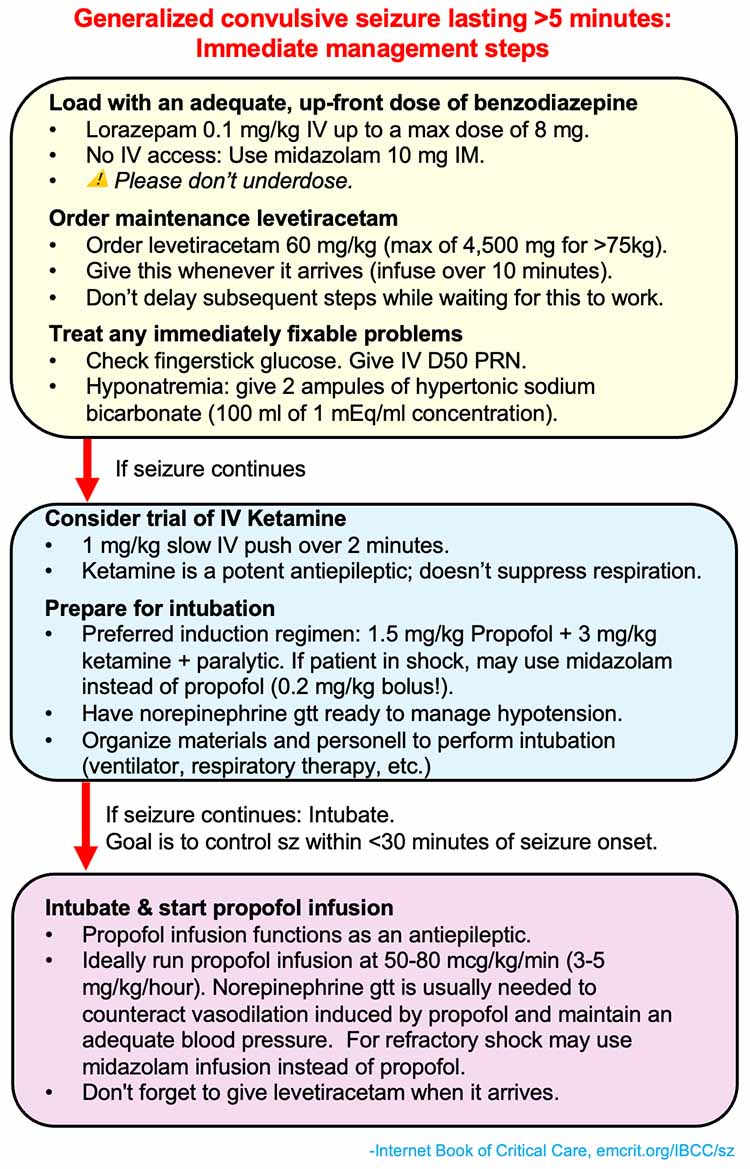
The management of Status Epilepticus is divided into stages based on the time elapsed since the seizure started. Here is the breakdown of the Benzodiazepine Protocol and the subsequent steps:
1. The Benzodiazepine Protocol (First-Line)
If the seizure lasts more than 5 minutes, you must intervene. The choice of drug depends on the setting and available access.
| Route | Drug & Dosage | Notes |
|---|---|---|
| Intravenous (IV) | Lorazepam 4mg | The gold standard. Can repeat once after 10-20 mins if needed. |
| Community / No IV | Buccal Midazolam 10mg | Often used by paramedics or in community settings. |
| Alternative | Rectal Diazepam 10mg | Used if midazolam is unavailable and there is no IV access. |
2. Stepwise Management Summary
- Stage 1 (0–5 mins): Pre-hospital/Initial
- Secure airway, give high-flow oxygen.
- Check blood glucose (if
< 4 mmol/L, giveIV Glucose 10%or20%+Pabrinexif alcohol/malnutrition suspected).
- Stage 2 (5–20 mins): Early Status
- Administer the Benzodiazepine protocol mentioned above.
- Stage 3 (20–40 mins): Established Status
- If seizures continue, move to second-line IV anti-epileptics (AEDs). Common choices include:
- Levetiracetam (increasingly preferred due to safety profile).
- Phenytoin (requires cardiac monitoring).
- Sodium Valproate.
- If seizures continue, move to second-line IV anti-epileptics (AEDs). Common choices include:
- Stage 4 (40+ mins): Refractory Status
- Transfer to ICU for general anesthesia (Intubation + Propofol, Midazolam, or Thiopental infusion).
==High-Yield Tip: Always remember to treat the underlying cause (e.g., electrolyte imbalance, infection, or drug withdrawal) while stopping the seizure! ==
I've pulled up some relevant lessons that go deeper into the pharmacology and long-term management of epilepsy for your revision.
📚 Epilepsy & SE Lessons
Those lessons are perfect for a deep dive into the "why" behind the drugs we use.
Since Status Epilepticus is such a high-stakes topic in the AKT, would you like to try a quick game to test your recall of the drug dosages and timings? Or maybe a few practice questions to see how this shows up in clinical scenarios?
Setting up chat...