Schizophrenia: Schneider's first-rank symptoms, antipsychotics and side effects
 Rezzy
RezzySchizophrenia is a heavy-hitter for the UKMLA AKT, and getting a solid grip on Schneider's symptoms and the nuances of antipsychotics is key. It's one of those topics where the side effects are just as likely to be tested as the diagnosis itself!
Let's start by looking at some high-yield lessons to give you a structured overview of the condition and its management.
📚 Schizophrenia & Antipsychotics Lessons
Schneider's First-Rank Symptoms (FRS)
These are the "classic" symptoms used to help diagnose schizophrenia, though they aren't pathognomonic (meaning they can occur in other psychoses too). A helpful way to remember them is the "ABCD" or grouping them into four categories:
- Auditory Hallucinations:
- Third-person voices: Voices talking about the patient.
- Running commentary: A voice describing the patient's actions as they happen.
- Thought echo (Gedankenlautwerden): Hearing one's own thoughts spoken aloud.
- Thought Disorders (Thought Alienation):
- Thought Withdrawal: Feeling like thoughts are being "taken out" of your head.
- Thought Insertion: Feeling like outside thoughts are being "put into" your head.
- Thought Broadcasting: Feeling like others can hear your thoughts.
- Passivity Phenomena (Delusions of Control):
- Feeling that your actions, impulses, or feelings are controlled by an external force ("Made" acts/feelings).
- Delusional Perception:
- A normal perception (e.g., seeing a red car) is suddenly given a bizarre, delusional meaning (e.g., "The red car means I am the King of Mars").
Antipsychotics & Side Effects
In the UK, Atypical (Second-Generation) Antipsychotics are usually first-line (except in emergencies or specific cases) because they generally have a lower risk of movement-related side effects.
1. Typical (First-Generation) - e.g., Haloperidol, Chlorpromazine
- Mechanism: Potent D2 receptor antagonists.
- Main Issue: Extrapyramidal Side Effects (EPSEs):
- Acute Dystonia: Sustained muscle contractions (e.g., torticollis, oculogyric crisis). Treat with Procyclidine.
- Akathisia: Intense inner restlessness.
- Parkinsonism: Tremor, rigidity, bradykinesia.
- Tardive Dyskinesia: Late-onset, often irreversible choreoathetoid movements (e.g., lip-smacking).
2. Atypical (Second-Generation) - e.g., Olanzapine, Risperidone, Quetiapine
- Mechanism: D2 and 5-HT2A receptor antagonism.
- Main Issue: Metabolic Syndrome:
- Significant weight gain, dyslipidaemia, and diabetes (especially Olanzapine and Clozapine).
- Risperidone is notorious for Hyperprolactinaemia (leading to galactorrhoea or sexual dysfunction).
3. Clozapine (The "Gold Standard" for Treatment-Resistant Schizophrenia)
Used after failing two other antipsychotics (one must be atypical).
- ==CRITICAL: Agranulocytosis==: Requires mandatory FBC monitoring (weekly initially).
- Other risks: Myocarditis, constipation (can be fatal!), and lowered seizure threshold.
I've put together a comparison table of these side effects to help you visualize which drug causes what.
This table is a goldmine for your AKT revision. It breaks down the relative risks of sedation, EPSEs (EPS), and weight gain for the most common antipsychotics.
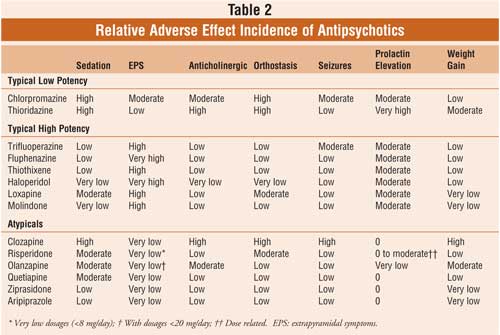
Notice how Haloperidol (High Potency Typical) has a very high risk of EPS, while Olanzapine and Clozapine (Atypicals) are much higher for weight gain.
Quick Management Tips for Side Effects:
- Acute Dystonia: Give an anticholinergic like Procyclidine (IM/IV in emergencies).
- Akathisia: Try a beta-blocker like Propranolol.
- Tardive Dyskinesia: Stop the current drug and consider switching to Clozapine (which has the lowest risk of TD).
- Neuroleptic Malignant Syndrome (NMS): The "deadly" side effect. Look for FEVER (Fever, Encephalopathy, Vital sign instability, Elevated CK, Rigidity). Stop the drug immediately!
Would you like to try a few practice questions on this to see how it's tested in the exam?
✍️ Schizophrenia & Antipsychotics Quiz
Tap to practice questions in the Oncourse app
I've set up a 10-question quiz for you to test your knowledge on these high-yield concepts. It focuses on the diagnosis and management of schizophrenia, as well as the side effects of antipsychotics.
Remember, for the AKT, the most important things to know are:
- Schneider's FRS (especially thought broadcasting and third-person voices).
- Atypical vs. Typical (metabolic vs. movement side effects).
- Clozapine (the "last resort" with mandatory FBC monitoring).
- NMS (the medical emergency you can't afford to miss).
Good luck with the quiz! Let me know if you want to dive deeper into any of these, or if you'd like to try a game to help memorize the drug classes.
Setting up chat...