Prenatal screening tests: first and second trimester markers interpretation
 Rezzy
RezzyPrenatal screening is such a high-yield topic for the USMLE! It's all about spotting those patterns in maternal serum markers to assess the risk of fetal aneuploidies.
Let me find a good visual guide for you to help visualize these marker patterns.
That's a great visual for the second-trimester quad screen! Let's break down both the first and second-trimester markers so you can see the full picture.
First Trimester Screening (10-13 weeks)
This is the "Combined Test" which includes:
- Pregnancy-associated plasma protein A (PAPP-A): Usually decreased in aneuploidies.
- Free β-hCG: Increased in Down syndrome, but decreased in Trisomy 18 and 13.
- Nuchal Translucency (NT): An ultrasound measurement of the fluid-filled space behind the fetal neck. Increased NT is a marker for aneuploidy and congenital heart defects.
Second Trimester Screening (15-22 weeks)
The "Quad Screen" is the classic exam favorite. Here's how to interpret the markers:
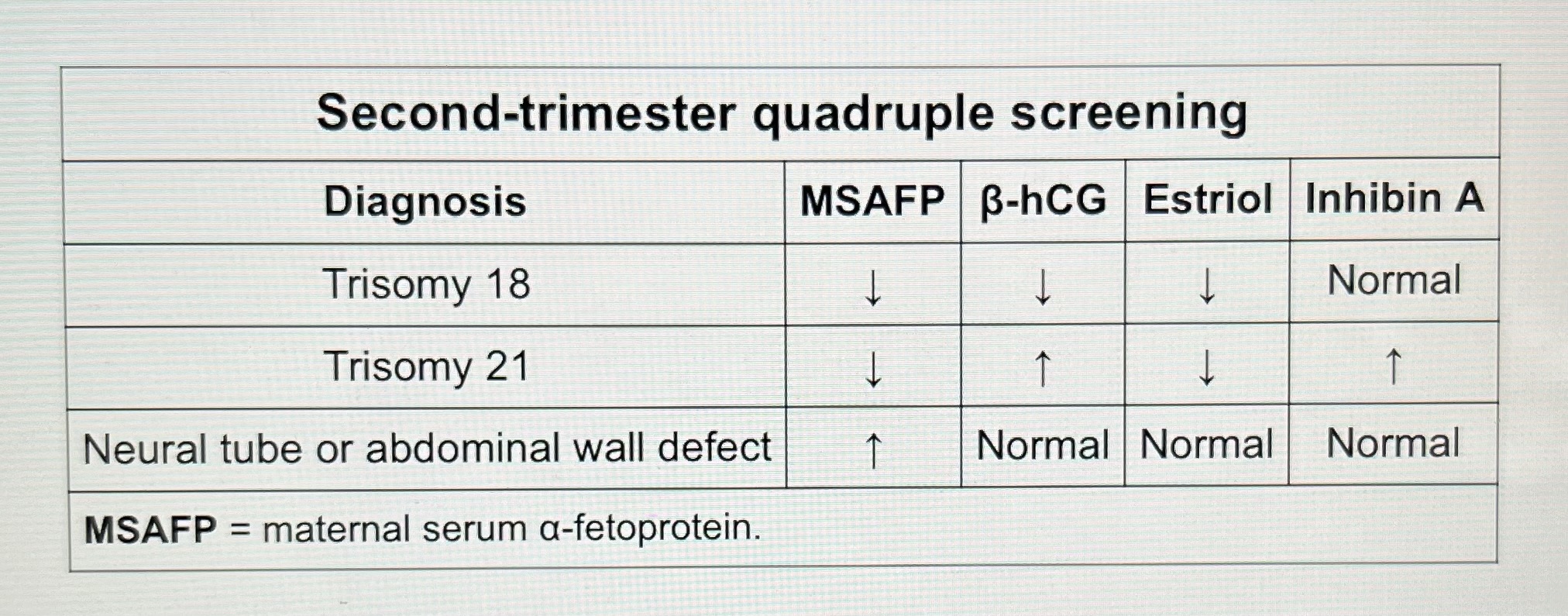
This table highlights the key patterns: Down syndrome (Trisomy 21) is the only one where hCG and Inhibin A go UP. In Edwards syndrome (Trisomy 18), everything is typically DOWN (or normal for Inhibin A).
To make this super easy to memorize, I've put together a combined table for you.
| Condition | PAPP-A (1st) | β-hCG (1st/2nd) | NT (1st) | AFP (2nd) | uE3 (2nd) | Inhibin A (2nd) |
|---|---|---|---|---|---|---|
| Down Syndrome (T21) | ↓ | ↑ | ↑ | ↓ | ↓ | ↑ |
| Edwards Syndrome (T18) | ↓ | ↓ | ↑ | ↓ | ↓ | ↓ (or N) |
| Patau Syndrome (T13) | ↓ | ↓ | ↑ | N | N | N |
| Neural Tube Defects | N/A | N/A | N/A | ↑↑ | N | N |
Mnemonic for Down Syndrome (T21): HIgh: HCG and Inhibin A are HIgh. Everything else is low.
Mnemonic for Edwards Syndrome (T18): Everything is low (Trisomy 18 = Edwards = Everything low).
That table should help you keep the patterns straight! Remember, the quad screen is most accurate between 15-18 weeks. If you see an elevated AFP, your first step is always to confirm the gestational age with an ultrasound, as dating errors are the most common cause of abnormal results.
Let me pull up some high-yield lessons and flashcards so you can lock this in for your exam.
🗂️ Prenatal Screening Flashcards
Tap to study 24 flashcards in the Oncourse app
📚 Prenatal Screening Lessons
I've pulled up some high-yield lessons and flashcards that cover these screening protocols in detail.
One final "pro-tip" for your exams: always distinguish between screening (like the quad screen or cell-free DNA) and diagnostic tests (like Chorionic Villus Sampling or Amniocentesis). If a screening test comes back positive, the next step is usually counseling and offering a diagnostic test for a definitive karyotype.
Do you want to try a quick practice quiz on these markers, or should we dive deeper into the diagnostic procedures like CVS and amniocentesis?
Setting up chat...