Pediatric infectious diseases: TORCH infections, rashes and vaccination schedule
 Rezzy
RezzyPediatrics infectious diseases are a huge part of the USMLE, and honestly, they're like a puzzle where the clues are often hidden in the timing of a rash or a specific prenatal exposure. Let's dive into the "sugar-coated" version of these high-yield topics!
1. TORCH Infections
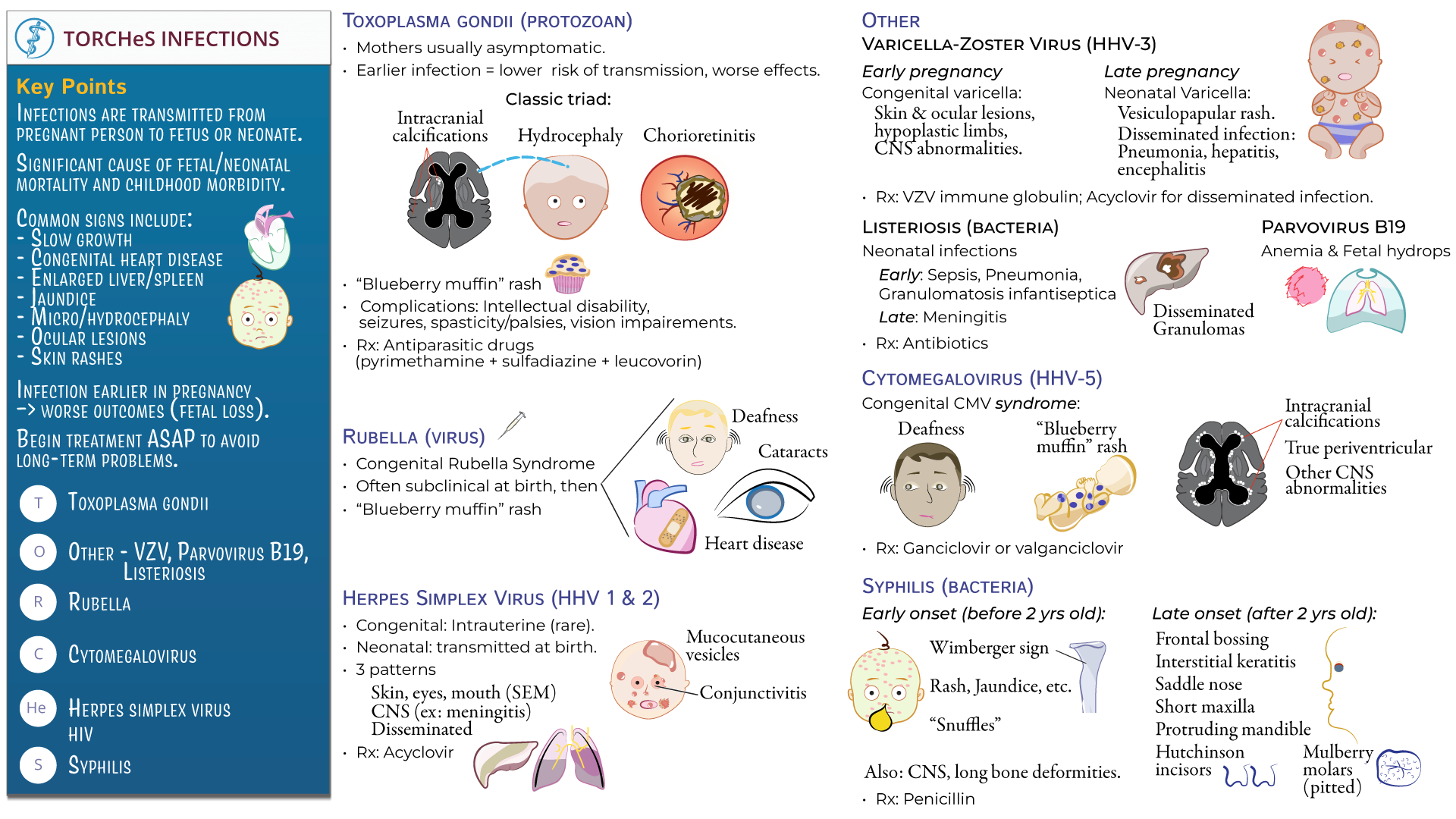
These are the infections that cross the placenta and can cause significant congenital issues. I've put together a comparison table to help you distinguish between them, as they often have overlapping features like hepatosplenomegaly and jaundice.
[tool call: show_markdown_to_user] Thinking Process:
- Topic: TORCH Infections comparison
- Content: Table with Pathogen, Classic Triad/Findings, and Unique Clues.
- Tool: show_markdown_to_user (contentType: 'table')
Next, I'll find a visual to help you visualize these findings.
[tool call: assetSearch] Thinking Process:
- Query: "congenital TORCH infections clinical features diagram"
- Tool: assetSearch
Then, I'll cover the pediatric rashes and the vaccination schedule.
| Pathogen | Classic Triad / Key Findings | Unique "Buzzword" Clues |
|---|---|---|
| Toxoplasmosis | Chorioretinitis, Hydrocephalus, Intracranial calcifications | Diffuse calcifications; exposure to cat feces/undercooked meat |
| Syphilis | Snuffles (rhinitis), Bone lesions, Palmar/plantar rash | Hutchinson teeth, Mulberry molars, Saber shins (late findings) |
| Rubella | PDA (or pulmonary artery stenosis), Cataracts, Deafness | "Blueberry muffin" rash (extramedullary hematopoiesis) |
| CMV | Periventricular calcifications, Microcephaly, Hearing loss | Most common congenital infection; Periventricular is key |
| HSV | Skin-eye-mouth vesicles, Encephalitis, Disseminated disease | Often acquired during delivery; temporal lobe involvement |
That diagram really helps tie the clinical features together! Notice how CMV and Toxoplasmosis both have intracranial calcifications, but the location (periventricular vs. diffuse) is the classic differentiator for exams.
[tool call: show_markdown_to_user] Thinking Process:
- Topic: TORCH Infections Visual
- Content: Image from assetSearch
- Tool: show_markdown_to_user (contentType: 'image')
2. Pediatric Rashes: The "Numbered" Diseases
When you're looking at pediatric rashes, the prodrome and the progression of the rash are your best friends.
- Measles (Rubeola): Look for the 4 C's (Cough, Coryza, Conjunctivitis, and Koplik spots). The rash starts at the head and moves down.
- Rubella (German Measles): Similar to measles but milder, with postauricular lymphadenopathy. The rash also moves head-to-toe but much faster (clears in 3 days).
- Roseola (HHV-6): The classic "high fever that breaks, then a rash appears" scenario. The rash starts on the trunk and spreads to the extremities.
- Erythema Infectiosum (Fifth Disease/Parvovirus B19): Look for the "slapped cheek" appearance followed by a reticular (lace-like) rash on the body.
- Varicella (Chickenpox): Lesions in different stages of evolution (macules, papules, vesicles, crusts) described as "dewdrops on a rose petal."
3. Vaccination Schedule (CDC High-Yield)
Memorizing the whole chart is tough, so focus on these milestones:
- Birth: Hep B (the only one at birth).
- 2, 4, 6 Months: "DR. HIP" (DTaP, Rotavirus, Hib, IPV, PCV13) + Hep B (usually at 2 and 6).
- 12-15 Months: "Very MAD HP" (VZV, MMR, Hepatitis A, DTaP, Hib, PCV13).
- 4-6 Years: "Very DIM" (VZV, DTaP, IPV, MMR).
I'll pull up some lessons and flashcards so you can lock these in!
[tool call: get_related_lessons_by_search_query] Thinking Process:
- Query: "pediatric infectious diseases rashes vaccines"
- Tool: get_related_lessons_by_search_query
[tool call: get_related_flashcards] Thinking Process:
- Search Queries: ["TORCH infections", "pediatric rashes", "vaccination schedule"]
- Tool: get_related_flashcards (in next step)
Wait, I should do one tool at a time. I'll start with the image display and then the lessons.
📚 Pediatric ID Lessons
Those lessons are perfect for a deep dive, especially the one on Common Childhood Exanthems—that's where the real "rash-matching" happens!
To help you lock in these specific findings and the vaccination milestones, I've pulled some high-yield flashcards for you.
[tool call: get_related_flashcards] Thinking Process:
- Search Queries: ["TORCH infections", "pediatric rashes", "vaccination schedule"]
- Tool: get_related_flashcards
After that, if you're feeling up for it, we could play a quick game of Synapses to see if we can group these rashes and infections by their classic clinical features. It's a great way to make sure you don't mix up your "blueberry muffins" with your "slapped cheeks"! Would you like to try that?
🗂️ Pediatric ID Flashcards
Tap to study 27 flashcards in the Oncourse app
Those flashcards are a great way to drill the "blueberry muffin" rash and the "slapped cheek" findings.
Since these pediatric rashes and TORCH infections can get a bit jumbled in your head, I've set up a Synapses game for you. It'll challenge you to group these clinical findings and pathogens correctly. Give it a shot!
[tool call: show_game] Thinking Process:
- Game Type: 'synapses'
- Prompt: "Group these pediatric infectious disease findings: TORCH infections (Toxoplasmosis, CMV, Rubella, Syphilis), Rashes (Measles, Roseola, Fifth Disease, Chickenpox), and their classic buzzwords (Koplik spots, Slapped cheek, Periventricular calcifications, Snuffles, Blueberry muffin, Dewdrops on a rose petal)."
- Tool: show_game
Let me know if you have any other questions about these topics! Happy studying!
Setting up chat...