Basic science in orthopaedics: bone healing, fracture classification and biomechanics
 Rezzy
RezzyOrthopaedics isn't just about hammers and nails; the basic science behind it is actually what makes those surgeries work! Let's dive into the "why" behind the "how" by looking at bone healing, classification, and biomechanics.
I'll start by pulling up some high-yield lessons that cover these fundamentals in detail.
📚 Orthopaedic Basic Science Lessons
1. Bone Healing: The Two Pathways
Bone is unique because it heals by forming new bone, not a scar! There are two main ways this happens depending on how stable the fracture is:
- Primary (Direct) Healing: Occurs with absolute stability (e.g., compression plating). There is no callus formation. Instead, "cutting cones" of osteoclasts cross the fracture line, followed by osteoblasts.
- Secondary (Indirect) Healing: Occurs with relative stability (e.g., casting, IM nailing). This is the most common type and involves callus formation.
Let's look at the differences more closely:
| Feature | Primary Healing | Secondary Healing |
|---|---|---|
| Stability Required | Absolute (No movement) | Relative (Micro-motion) |
| Callus Formation | Absent | Present |
| Mechanism | Haversian remodeling (Cutting cones) | Enchondral ossification |
| Clinical Example | Compression plating | Cast, IM Nail, External Fixator |
2. Stages of Secondary Bone Healing
Secondary healing is the "classic" way we think of bone repair. It happens in four overlapping stages:
- Inflammation & Hematoma (0-2 weeks): The fracture causes bleeding, forming a hematoma. This releases cytokines (like BMPs) that recruit mesenchymal stem cells.
- Soft Callus (2-3 weeks): Cartilage and fibrous tissue are formed. This bridges the gap but isn't strong enough for weight-bearing.
- Hard Callus (3-12 weeks): The soft callus is replaced by woven bone through enchondral ossification. This is when you see the "bony bridge" on X-rays.
- Remodeling (Months to Years): Woven bone is replaced by stronger lamellar bone (Wolff's Law: bone adapts to the loads placed on it).
3. Fracture Classification: The High-Yield Ones
Classifications help us decide on treatment and predict outcomes. Two you must know for your exams are:
-
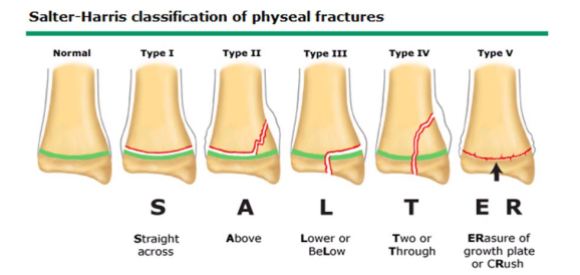
Salter-Harris Classification: For pediatric growth plate (physeal) injuries.
- Type I: Straight across (Physis only)
- Type II: Above (Physis + Metaphysis) - Most common!
- Type III: Lower (Physis + Epiphysis)
- Type IV: Through (Metaphysis + Physis + Epiphysis)
- Type V: ERasure (Crush injury to physis) - Worst prognosis.
-
Gustilo-Anderson Classification: For open fractures.
- Type I: Wound < 1 cm, clean.
- Type II: Wound 1-10 cm, moderate contamination.
- Type III: Wound > 10 cm or high-energy (e.g., farm injury, high-velocity gunshot).
- IIIA: Adequate soft tissue coverage.
- IIIB: Extensive soft tissue loss (needs flap).
- IIIC: Arterial injury requiring repair.
Let me find a diagram for the Salter-Harris classification to help you visualize it.
The Salter-Harris classification is high-yield for pediatric orthopaedics. Here's a visual to help you remember the types:
4. Biomechanics: The Physics of Bone
Biomechanics is all about how bone responds to forces. Here are the key terms you'll see in questions:
- Stress: The force applied per unit area ($\sigma = F/A$).
- Strain: The change in length relative to the original length ($\epsilon = \Delta L/L$).
- Young's Modulus (E): This is the stiffness of a material. It's the slope of the stress-strain curve.
- High E: Stiff material (e.g., Stainless steel, Cortical bone).
- Low E: Flexible material (e.g., Titanium, Cancellous bone).
- Stress Shielding: If you use a very stiff plate (like stainless steel) on a bone, the plate takes all the load, and the bone underneath becomes weak and osteoporotic because it's not being "stressed" (Wolff's Law).
Mnemonic: S-S-S Stress = Strength (Force) Strain = Stretch (Deformation) Stiffness = Slope (Young's Modulus)
This is a lot of info! Want to see how well you've locked in these concepts? I can set up a quick game to test your knowledge on these orthopaedic basics.
Setting up chat...