Odds ratio vs relative risk: when to use each and how to calculate
 Rezzy
RezzyAh, the classic biostatistics duo! Understanding the difference between Odds Ratio (OR) and Relative Risk (RR) is absolutely high-yield for the USMLE. It's one of those topics that seems tricky at first, but once you see the 2x2 table, it all clicks.
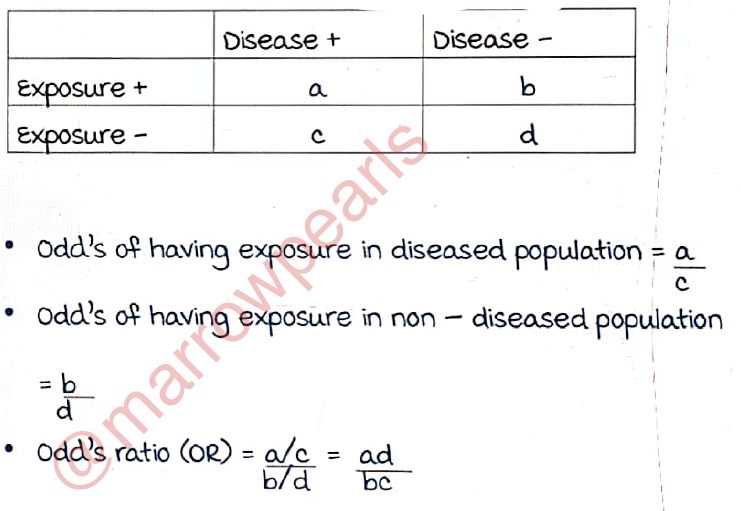
Let's start by looking at the standard 2x2 table that we use for these calculations.
That diagram is perfect for visualizing how we pull the numbers. Here is the breakdown of how we use that table to calculate both metrics:
1. Relative Risk (RR)
Relative Risk compares the incidence of a disease in an exposed group versus an unexposed group.
- Formula:
RR = [a / (a + b)] / [c / (c + d)] - When to use: Use this in Cohort studies. Since you are following people over time, you can actually calculate the "risk" (incidence) of developing the disease.
- Interpretation: "People with the exposure are X times as likely to develop the disease compared to those without the exposure."
2. Odds Ratio (OR)
The Odds Ratio compares the odds of exposure in those with the disease versus the odds of exposure in those without the disease.
- Formula:
OR = (a / c) / (b / d)which simplifies to(a * d) / (b * c)(the cross-product). - When to use: Use this in Case-Control studies. In these studies, you already know who has the disease, so you can't calculate incidence/risk—you can only look back at the "odds" of them having been exposed.
- Interpretation: "The odds of exposure among cases are X times the odds of exposure among controls."
The "Rare Disease Assumption"
This is a favorite for examiners! If a disease is very rare (usually <10% prevalence), the OR approximately equals the RR. This is because if the disease is rare, a and c are very small, making a + b almost equal to b and c + d almost equal to d.
I've put together a quick comparison table to help you keep these straight for your rounds or exams.
| Feature | Relative Risk (RR) | Odds Ratio (OR) |
|---|---|---|
| Study Type | Cohort Studies (Prospective) | Case-Control Studies (Retrospective) |
| Calculation | Risk in exposed / Risk in unexposed | Odds in diseased / Odds in non-diseased |
| Formula | [a/(a+b)] / [c/(c+d)] | (a/c) / (b/d) or ad/bc |
| Key Concept | Measures Incidence | Measures Association |
| Rare Disease | N/A | Approximates RR when disease is rare |
That table should be a handy reference for you! Biostatistics can feel a bit dry, but mastering these basics makes those exam questions much easier to tackle.
If you'd like to dive deeper into other study designs or statistical measures, I can pull up some relevant lessons for you.
📚 Biostatistics Lessons
Those lessons are excellent for reinforcing the nuances of study design and statistical measures.
If you're feeling confident with the theory, would you like to try a few practice questions or some flashcards to see how this shows up on the exam? Just let me know!
Setting up chat...