Liver cirrhosis: Child-Pugh score, complications and management
 Rezzy
RezzyAh, liver cirrhosis—the final common pathway of chronic liver insult. It's a massive topic for the UKMLA AKT, so let's break it down into manageable chunks, starting with how we actually grade the severity using the Child-Pugh score.
The Child-Pugh score is essential for predicting prognosis and determining the necessity of a liver transplant. It uses five clinical and biochemical markers. I've put together a table for you to help memorize the components and how they're scored.
| Feature | 1 Point | 2 Points | 3 Points |
|---|---|---|---|
| Encephalopathy | None | Grade 1-2 | Grade 3-4 |
| Ascites | None | Mild / Controlled | Moderate / Severe |
| Bilirubin (umol/L) | < 34 | 34 - 50 | > 50 |
| Albumin (g/L) | > 35 | 28 - 35 | < 28 |
| INR | < 1.7 | 1.7 - 2.3 | > 2.3 |
Interpretation:
- Class A (5-6 points): Well-compensated; 100% 1-year survival.
- Class B (7-9 points): Functional impairment; 80% 1-year survival.
- Class C (10-15 points): Decompensated; 45% 1-year survival.
Mnemonic: ABCDE Albumin, Bilirubin, Clotting (INR), Distension (Ascites), Encephalopathy.
Cirrhosis is essentially a state of portal hypertension and liver failure. The complications are often what we're actually managing in the hospital.
Key Complications & Management
- Portal Hypertension & Varices:
- Screening: All cirrhotic patients need an OGD to look for varices.
- Prophylaxis: Non-selective beta-blockers (like Propranolol) or endoscopic band ligation (EBL).
- Acute Bleed: This is a medical emergency! Management includes
Terlipressin, prophylactic antibiotics (e.g., Ceftriaxone), and urgent EBL.
- Ascites:
- Management: Reduced sodium intake and diuretics (usually Spironolactone is first-line, sometimes with Furosemide).
- Refractory: Large-volume paracentesis (LVP) with albumin cover.
- Spontaneous Bacterial Peritonitis (SBP):
- Diagnosis: Neutrophil count
> 250 cells/mm³in ascitic fluid. - Treatment: IV Cefotaxime.
- Prophylaxis: If ascitic protein is
< 15 g/L, patients usually need long-term oral Ciprofloxacin.
- Diagnosis: Neutrophil count
- Hepatic Encephalopathy:
- Management: Lactulose (aiming for 2-3 soft stools/day) to clear ammonia, and Rifaximin for secondary prophylaxis.
- Hepatocellular Carcinoma (HCC):
- Screening: Ultrasound and Alpha-fetoprotein (AFP) every 6 months.
I've found some excellent lessons and flashcards that cover these management protocols in more detail—perfect for your AKT revision.
🗂️ Cirrhosis Flashcards
Tap to study 35 flashcards in the Oncourse app
📚 Cirrhosis Lessons
Beyond the specific complications, don't forget the "general" management of cirrhosis, which is a favorite for AKT examiners:
- Nutrition: High-protein, high-calorie diet (cirrhosis is a catabolic state).
- Alcohol: Complete abstinence is mandatory.
- Vaccinations: Annual flu, one-off pneumococcal, and Hepatitis A & B if not already immune.
- Avoidance: NSAIDs (risk of renal failure/GI bleed), opiates (risk of encephalopathy), and hepatotoxic drugs.
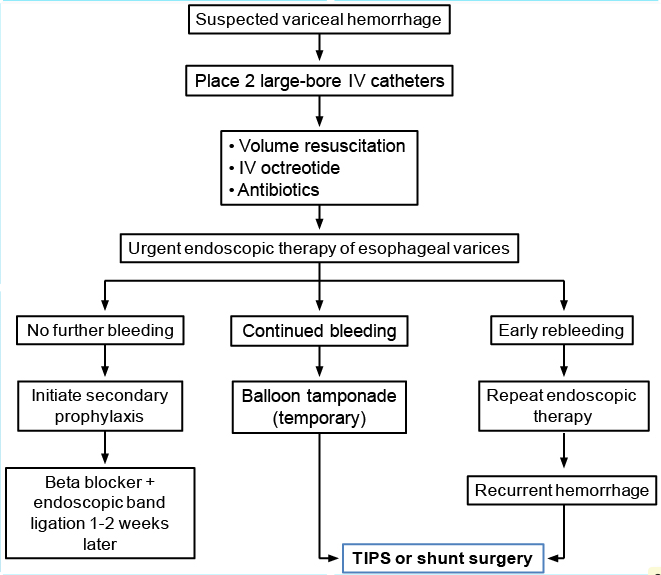
One of the most high-pressure scenarios you'll face in exams (and on the wards) is an acute variceal bleed. I'll pull up a clinical flowchart for you that outlines the immediate management steps.
This flowchart is a great summary of the acute management of variceal bleeding. It highlights the importance of early stabilization, pharmacological therapy (like octreotide or terlipressin), and the role of endoscopic intervention.
While Child-Pugh is great for prognosis, you'll also see the MELD score (Model for End-Stage Liver Disease) used clinically, especially for liver transplant prioritization. It uses Bilirubin, Creatinine, and INR to calculate a score from 6 to 40.
Cirrhosis is a huge topic, but if you've got the Child-Pugh components down and know the management of the "Big 3" (Varices, Ascites, and Encephalopathy), you're in a very strong position for the AKT.
Let me know if you want to dive deeper into any of these complications or if you're ready to try some practice questions!
Setting up chat...