Clinical forensic medicine: injury classification and medico-legal reports
 Rezzy
RezzyForensic medicine can feel a bit heavy with all the legal jargon, but it's actually super logical once you break it down! In clinical practice, your role is to accurately document what you see so the legal system can do its job.
Let's start with how we classify injuries and then look at how to structure those all-important medico-legal reports.
1. Classification of Injuries
In forensics, we generally divide mechanical injuries into two main categories based on the type of force applied:
A. Blunt Force Injuries
- Abrasions: Superficial injuries involving only the epidermis (e.g., grazes, pressure abrasions).
- Contusions (Bruises): Effusion of blood into tissues due to rupture of capillaries, without a break in the skin.
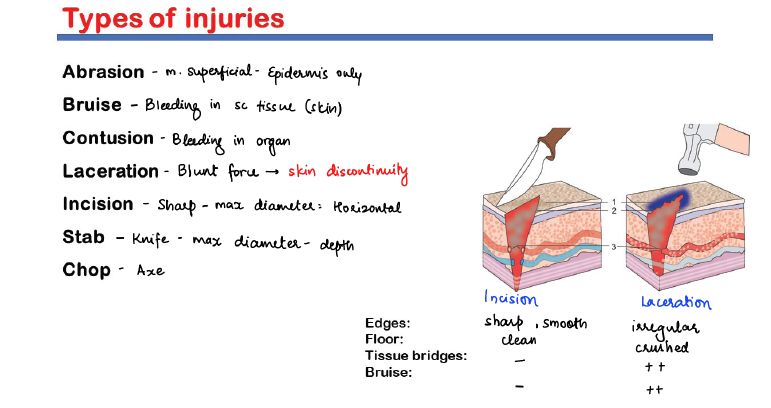
- Lacerations: Tears or splits in the skin/tissues caused by crushing or stretching (look for tissue bridging—this distinguishes them from incised wounds!).
B. Sharp Force Injuries
- Incised Wounds: Longer than they are deep, caused by sharp-edged weapons (clean-cut edges).
- Stab Wounds: Deeper than they are long, caused by pointed instruments.
- Chop Wounds: Caused by heavy, sharp-edged instruments (like an axe), often showing features of both blunt and sharp force.
2. Medico-Legal Reports (MLR)
An MLR is a legal document. If you didn't document it, in the eyes of the law, it didn't happen!
Pro-Tip for MLRs: Always use objective language. Instead of saying "the patient was beaten," write "multiple contusions noted over the back."
To help you visualize these injury types and how they differ, I'll pull up some high-yield diagrams and tables for you.
I've found a great visual that compares the morphology of these wounds. It’s particularly useful for distinguishing between a laceration (blunt force) and an incision (sharp force), which is a classic exam favorite.
When you're writing a medico-legal report, you need to follow a very specific algorithm to ensure nothing is missed. I'll put together a flowchart that outlines the standard procedure for documenting these injuries in a clinical setting.
This workflow is the standard approach you'll use in any clinical forensic setting. The key is to be as detailed as possible in the "Injury Specs" and "Topography" sections, as these are the most scrutinized in court.
To help you master these concepts for your exams, I've found some relevant lessons and flashcards that cover injury classification and medico-legal documentation in more detail.
📚 Forensic Medicine Lessons
Those lessons will give you a deep dive into the specifics of traumatology and the legal requirements for reporting.
To really lock in the differences between things like lacerations and incised wounds, I've also pulled some flashcards for a quick review.
🗂️ Injury Classification Flashcards
Tap to study 8 flashcards in the Oncourse app
Those flashcards should help you nail down the key differences between various wound types.
One last thing to remember for your exams: Tailing of the wound is a classic sign of an incised wound and tells you exactly which way the weapon was moving. It's these little details that make all the difference in a medico-legal report!
If you want to test your knowledge on a real-world scenario, I can set up a clinical case for you to work through. Ready to try a case?
Setting up chat...