Glycolysis: key enzymes, regulation and irreversible steps
 Rezzy
RezzyGlycolysis is the "bread and butter" of metabolic biochemistry, especially for the USMLE! It’s the process of breaking down one molecule of glucose into two molecules of pyruvate, netting 2 ATP and 2 NADH along the way.
The most important thing to remember is that while most steps are reversible, there are three irreversible "checkpoints" that keep the pathway moving forward. These are the steps where the body exerts the most control.
The Three Irreversible Steps
- Glucose → Glucose-6-Phosphate (G6P)
- Enzymes: Hexokinase (ubiquitous) or Glucokinase (liver/beta cells).
- Regulation: Hexokinase is inhibited by its product, G6P. Glucokinase has a high $K_m$ and is regulated by insulin.
- Fructose-6-Phosphate → Fructose-1,6-Bisphosphate
- Enzyme: Phosphofructokinase-1 (PFK-1).
- Importance: This is the rate-limiting step of glycolysis!
- Regulation: Stimulated by AMP and Fructose-2,6-bisphosphate; inhibited by ATP and Citrate.
- Phosphoenolpyruvate (PEP) → Pyruvate
- Enzyme: Pyruvate Kinase.
- Regulation: Stimulated by Fructose-1,6-bisphosphate (feed-forward regulation); inhibited by ATP, Alanine, and Glucagon (via phosphorylation in the liver).
I've put together a comparison table of these key regulatory enzymes to help you keep the activators and inhibitors straight.
| Enzyme | Step | Activators | Inhibitors |
|---|---|---|---|
| Hexokinase | Glucose → G6P | Insulin (indirectly) | Glucose-6-Phosphate |
| Glucokinase | Glucose → G6P | Insulin | Fructose-6-Phosphate |
| PFK-1 | F6P → F1,6-BP | AMP, F-2,6-BP | ATP, Citrate |
| Pyruvate Kinase | PEP → Pyruvate | F-1,6-BP (Feed-forward) | ATP, Alanine, Glucagon |
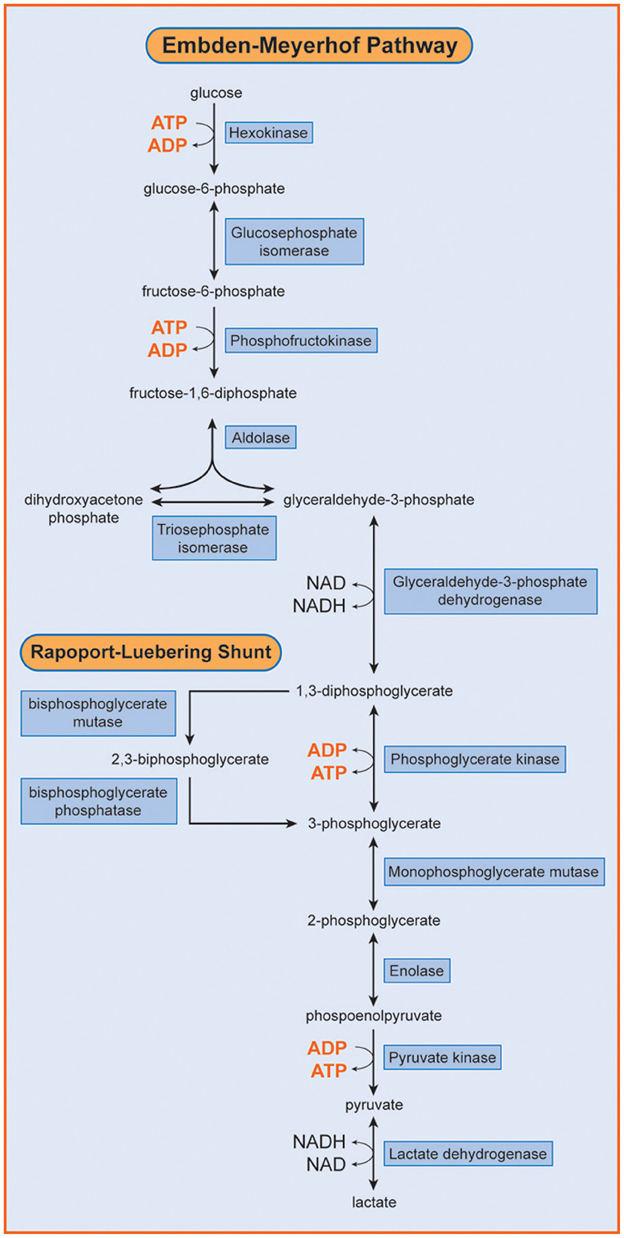
Seeing the pathway visually can really help lock in where these steps occur in the sequence. Let me find a clear diagram of the glycolysis pathway for you.
This diagram shows the full flow of glycolysis, including the ATP-consuming and ATP-producing phases. Notice how the irreversible steps we discussed are the primary control points.
To dive deeper into the hormonal regulation (like the PFK-2/FBPase-2 complex) or the clinical correlations like Pyruvate Kinase deficiency, check out these lessons.
📚 Glycolysis Lessons
Those lessons will give you a solid foundation for your exams. Let me know if you want to test your knowledge with some practice questions or if you'd like to dive into the specifics of the PFK-2/FBPase-2 "bifunctional enzyme" regulation!
Setting up chat...