ECG interpretation: systematic approach, common arrhythmias and STEMI patterns
 Rezzy
RezzyReading an ECG can feel like trying to decode a secret language at first, but once you have a solid system, it’s actually one of the most satisfying parts of clinical medicine! For the USMLE, they love testing your ability to spot patterns quickly.
The Systematic Approach (The "Steps" Method)
- Rate: Is it bradycardic (<60) or tachycardic (>100)? Use the "300-150-100-75-60-50" rule for regular rhythms.
- Rhythm: Is it regular or irregular? Look for P-waves before every QRS.
- Axis: Look at Leads I and aVF.
- Both positive = Normal.
- I positive, aVF negative = Left Axis Deviation (LAD).
- I negative, aVF positive = Right Axis Deviation (RAD).
- Intervals:
- PR Interval: Normal is
0.12 - 0.20s(3-5 small boxes). - QRS Complex: Normal is
< 0.12s(3 small boxes). - QT Interval: Usually corrected for rate (QTc).
- PR Interval: Normal is
- Segments & Waves: Look for ST-elevation/depression, T-wave inversions, and pathological Q-waves.
I'll pull up a visual guide to help you localize those STEMI patterns, as that's super high-yield for your exams.
This diagram is a lifesaver for localizing which coronary artery is blocked based on the ECG leads showing ST-elevation.
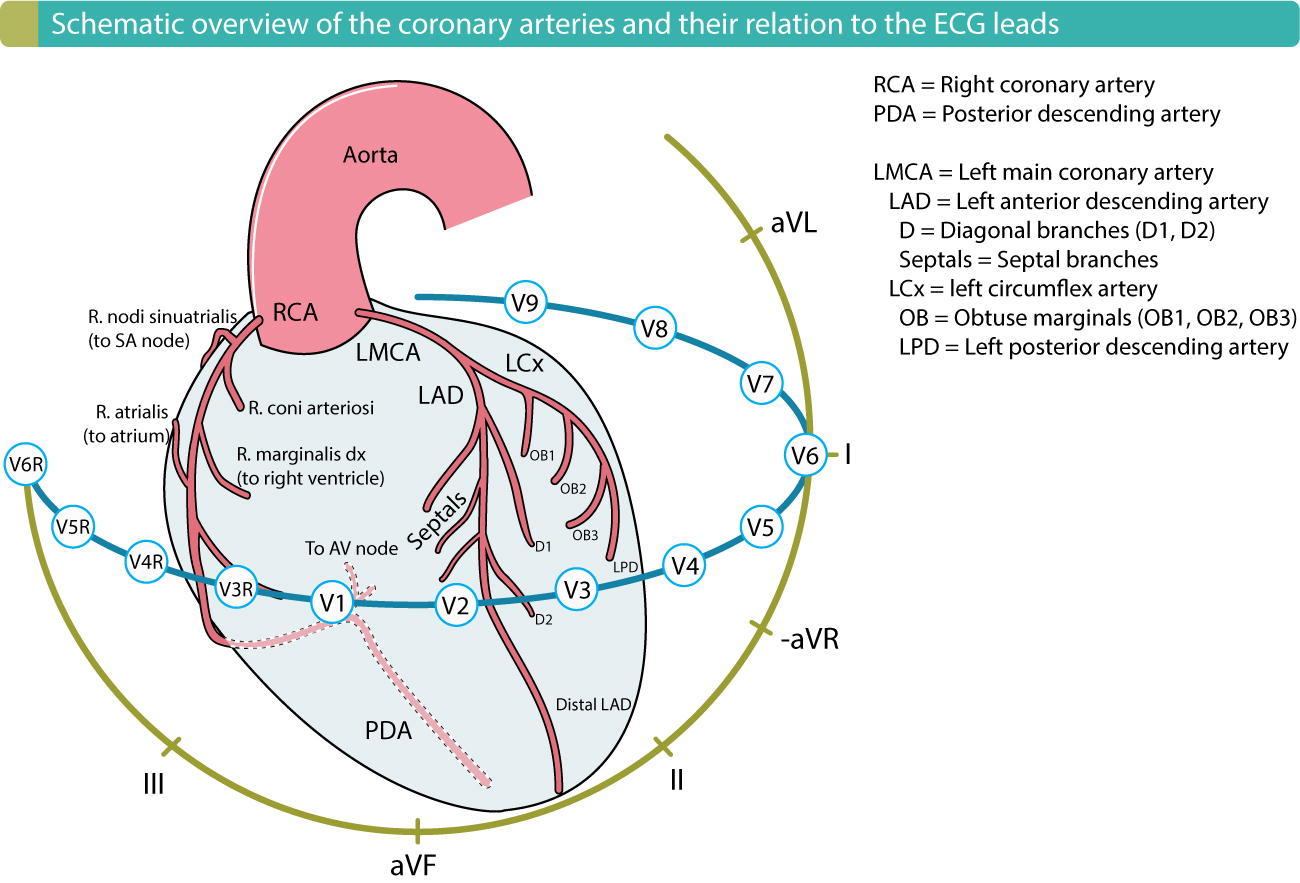
High-Yield STEMI Patterns
- Anterior (LAD): ST elevation in
V1-V4. If it's justV1-V2, think Septal. - Lateral (LCX or Diagonal of LAD): ST elevation in
I, aVL, V5, V6. - Inferior (RCA > LCX): ST elevation in
II, III, aVF. Look for reciprocal changes inI and aVL. - Posterior (RCA or LCX): Look for ST depression in
V1-V3with tall R waves (this is the "mirror image" of an anterior STEMI).
Common Arrhythmias to Spot
- Atrial Fibrillation (AFib): "Irregularly irregular" rhythm with no discernible P-waves.
- Supraventricular Tachycardia (SVT): Narrow QRS, regular, very fast (usually >150 bpm), and P-waves are often buried in the T-waves.
- Ventricular Tachycardia (VT): Wide QRS, regular, and fast. This is a medical emergency!
- First-Degree Heart Block: PR interval is consistently
> 0.20s(one big box).
I've gathered some lessons that break these down even further with more examples.
📚 ECG & Arrhythmia Lessons
Those lessons cover everything from basic recognition to management algorithms. To really lock in those patterns, let's try some flashcards!
🗂️ ECG & Arrhythmia Flashcards
Tap to study flashcards in the Oncourse app
It looks like my first flashcard search was a bit too specific. Let me try a broader search for you.
🗂️ ECG & Arrhythmia Flashcards
Tap to study 27 flashcards in the Oncourse app
That's a solid set of flashcards to get you started!
Remember, the key to mastering ECGs is repetition. Every time you see one, go through your systematic steps—Rate, Rhythm, Axis, Intervals, and Segments—even if the diagnosis seems obvious.
For the USMLE, keep these "must-knows" in mind:
- AFib = No P-waves, irregular rhythm.
- STEMI = Localize the leads to find the vessel (e.g.,
II, III, aVF= RCA). - Hyperkalemia = Peaked T-waves (often the first thing they test!).
Would you like to try a quick quiz to see how well you can identify these patterns under pressure?
Setting up chat...