DNA repair mechanisms and associated genetic disorders
 Rezzy
RezzyDNA repair is one of those high-yield topics that USMLE Step 1 absolutely loves. It's basically the cell's "spell-check" system, and when it fails, we see some very classic clinical presentations.
I'll start by finding a good summary diagram or table that links these repair pathways to their specific genetic disorders so you can visualize the connections.
That table is a goldmine for your Step 1 prep! It perfectly maps the molecular defect to the clinical syndrome.
To break it down simply, think of it like this:
- Nucleotide Excision Repair (NER): Think of this as the "bulky repair" crew. It fixes things like pyrimidine dimers caused by UV light. If this crew is on strike, you get Xeroderma Pigmentosum (extreme sun sensitivity and early skin cancers).
- Base Excision Repair (BER): This is the "single-base" specialist. It removes a single damaged base (like a cytosine that accidentally turned into a uracil).
- Mismatch Repair (MMR): This happens right after DNA replication to catch any "typos" the polymerase missed. A failure here leads to Lynch Syndrome (HNPCC).
- Double-Strand Break Repair: This is the heavy-duty stuff. Homologous Recombination is the high-fidelity version (defects in BRCA1/2), while Non-homologous End Joining (NHEJ) is the quick-and-dirty version (defects in Ataxia-telangiectasia).
Let me pull up that summary table for you to save.
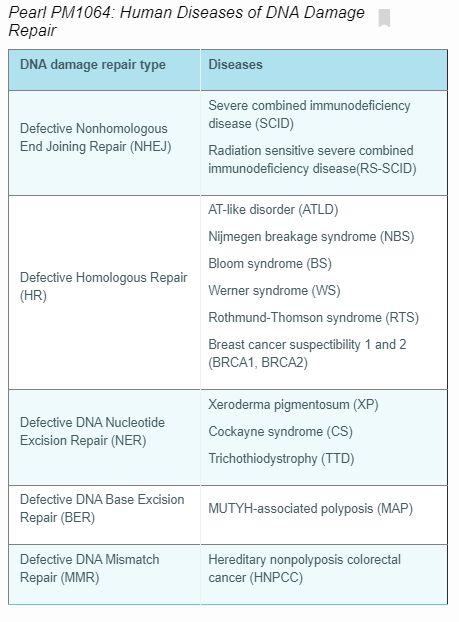
That table is a great reference for your Step 1 prep! It perfectly maps the molecular defect to the clinical syndrome.
To help you dive deeper into each of these mechanisms, I've found some high-yield lessons that break down the molecular steps and clinical features of these disorders.
📚 DNA Repair Lessons
Those lessons will give you a solid foundation on the molecular biology and the clinical syndromes.
To help you lock in these associations—like which repair mechanism is broken in Lynch Syndrome versus Xeroderma Pigmentosum—I've pulled some focused flashcards for you to review.
🗂️ DNA Repair Flashcards
Tap to study 8 flashcards in the Oncourse app
Those flashcards are perfect for quick review!
To wrap this up, here's a high-yield summary of the "Must-Knows" for your exam:
- Nucleotide Excision Repair (NER): Fixes bulky lesions (UV-induced pyrimidine dimers). Defective in Xeroderma Pigmentosum.
- Base Excision Repair (BER): Fixes single base damage (deamination, oxidation). Uses Glycosylase, AP-endonuclease, Lyase, Polymerase-β, and Ligase.
- Mismatch Repair (MMR): Fixes mismatched bases in the newly synthesized strand. Defective in Lynch Syndrome (HNPCC).
- Non-homologous End Joining (NHEJ): Fixes double-strand breaks without a template. Defective in Ataxia-telangiectasia and SCID.
- Homologous Recombination (HR): Fixes double-strand breaks using a sister chromatid. Defective in BRCA1/2 and Fanconi Anemia.
Pro-Tip: Remember the order of enzymes in BER: Glycosylase, AP-endonuclease, Lyase, Polymerase, Ligase ("GEL PLease").
Let me know if you want to dive deeper into any of these specific disorders or if you're ready to test your knowledge with a quick quiz!
Setting up chat...