Disaster management: triage systems, mass casualty and public health response
 Rezzy
RezzyDisaster management is one of those high-yield topics in Community Medicine and Surgery that really tests your ability to stay calm under pressure. When a mass casualty incident (MCI) hits, the goal shifts from "doing the best for one patient" to "doing the greatest good for the greatest number."
The heart of this is Triage, which comes from the French word trier (to sort). We use a color-coding system to prioritize patients based on their chance of survival and the urgency of their needs.
I've put together a quick reference table for the standard triage categories used worldwide.
| Color Tag | Category | Priority | Description | Examples |
|---|---|---|---|---|
| Red | Immediate | I | Life-threatening but treatable | Tension pneumothorax, airway obstruction, severe hemorrhage |
| Yellow | Delayed | II | Serious but not immediately life-threatening | Stable fractures, large wounds without major bleeding |
| Green | Minor | III | "Walking wounded"; minimal injuries | Minor cuts, abrasions, sprains |
| Black | Deceased/Expectant | 0 | Dead or injuries so severe they are unlikely to survive | Cardiac arrest, massive head trauma, 90% burns |
The START (Simple Triage and Rapid Treatment) algorithm is the gold standard for adult triage. It’s designed to be fast—taking less than 60 seconds per patient—by focusing on three key parameters: Respiration, Perfusion, and Mental Status (RPM).
Here is how the decision-making process flows on the field:
Beyond the immediate triage on the field, the broader public health response follows a specific cycle. It's not just about the "Response" phase; it's about everything that happens before and after.
- Mitigation: Reducing the risk (e.g., building earthquake-resistant hospitals).
- Preparedness: Planning and drills (e.g., mock disaster drills in your hospital).
- Response: The actual triage, treatment, and evacuation.
- Recovery: Restoring services and long-term rehabilitation.
In a Mass Casualty Incident (MCI), the "Golden Hour" is critical. The goal is to stabilize the Red patients and move them to definitive care as fast as possible.
Let me find a visual of a triage tag so you can see how we actually mark these patients in the field.
This is what a standard triage tag looks like in the field. Notice the perforated sections at the bottom—you simply tear off the colors until the patient's priority is at the bottom.
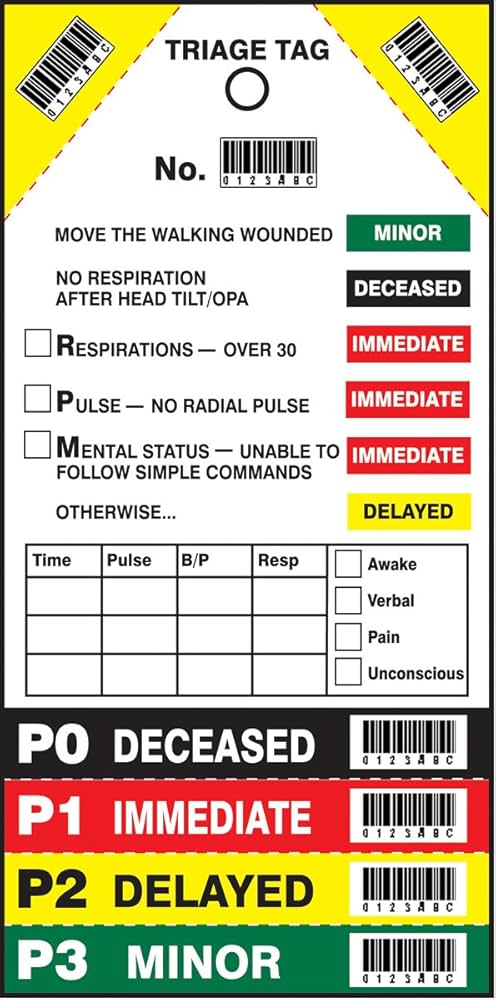
This triage tag is used for rapid documentation and prioritization. It includes the RPM criteria (Respirations, Pulse, Mental Status) to help you decide between Red, Yellow, Green, or Black tags.
To help you lock this in for your exams, I've pulled up some high-yield lessons and flashcards on disaster management and triage.
🗂️ Triage & Disaster Flashcards
Tap to study 6 flashcards in the Oncourse app
📚 Disaster Management Lessons
One final high-yield concept to remember is Reverse Triage. This happens at the hospital level during a disaster, where you discharge stable patients to make room for the incoming mass casualties. It’s the opposite of field triage, but it’s essential for increasing "surge capacity."
I've linked some lessons and flashcards above to help you master these protocols. If you're ready to test your knowledge, we could even jump into a quick game or a quiz on these concepts!
Setting up chat...