Dimorphic fungi: Histoplasma, Blastomyces, Coccidioides — comparison and treatment
 Rezzy
RezzyAh, the dimorphic fungi! These are absolute classics for the USMLE. They're like the "chameleons" of the fungal world—remember the rule: ==Mold in the Cold (20°C), Yeast in the Heat (37°C)==.
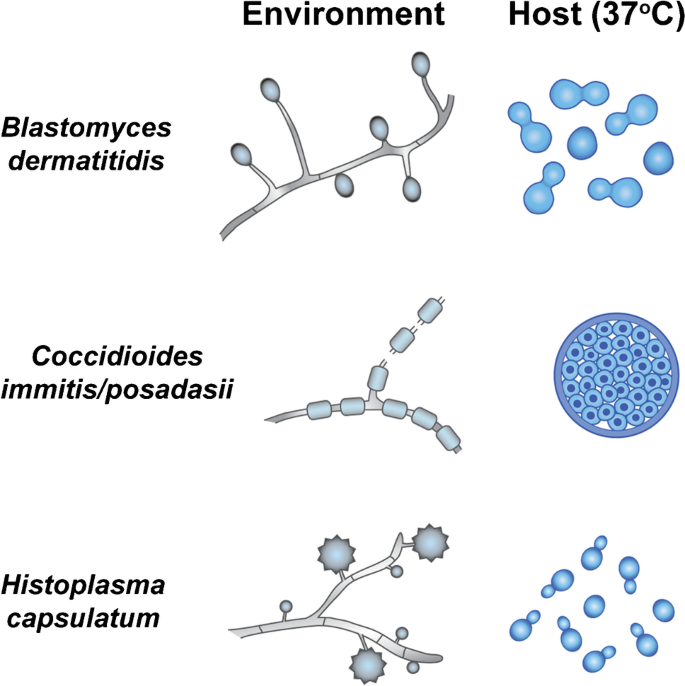
Let me pull up a visual comparison to help you distinguish their geographic locations and microscopic appearances, which are the most tested features.
This diagram is perfect for visualizing the "Mold vs. Yeast" transition. Pay close attention to the spherules of Coccidioides—that's a classic "gotcha" because it doesn't form a traditional yeast.
High-Yield Comparison Table
| Feature | Histoplasma | Blastomyces | Coccidioides |
|---|---|---|---|
| Geography | Mississippi & Ohio River Valleys | Central & Eastern US (Great Lakes) | Southwest US (California, Arizona) |
| Transmission | Bird/Bat droppings (caves, chicken coops) | Soil/Rotting wood | Dust (earthquakes, construction) |
| Microscopy (Yeast) | Small yeasts inside macrophages | Large, Broad-Based Budding yeast | Spherules filled with endospores |
| Key Clinical Sign | Palatal/tongue ulcers, splenomegaly | Inflammatory lung disease, skin/bone lesions | Erythema nodosum (Desert bumps), arthralgia |
When it comes to treatment, the strategy is generally consistent across all three:
- Mild to Moderate Disease: ==Itraconazole== is your first-line choice for localized or non-severe infections.
- Severe or Systemic Disease: ==Amphotericin B== is the heavy hitter used for disseminated disease or meningitis.
- Special Case: For Coccidioides meningitis, Fluconazole is often used because it has excellent CNS penetration.
Let me find some detailed lessons that dive deeper into the clinical presentations and management for each of these.
📚 Systemic Mycoses Lessons
Those lessons cover the clinical presentations and treatment protocols in detail. To help you lock in these differences—especially the "Broad-Based Budding" vs. "Spherules" distinction—let's pull up some flashcards for active recall.
🗂️ Dimorphic Fungi Flashcards
Tap to study 33 flashcards in the Oncourse app
Those flashcards are great for drilling the microscopic features. Before you dive into them, here are three quick mnemonics to keep the "Big Three" straight:
The Dimorphic Cheat Sheet:
- Histo Hides: Histoplasma is found inside macrophages (it's tiny!).
- Blasto Broad: Blastomyces has Broad-based budding (the yeast is the same size as an RBC).
- Cocci is a Circle: Coccidioides forms a large spherule (much larger than an RBC).
Good luck with the review! Let me know if you want to try a quick quiz or a game to test your knowledge on these.
Setting up chat...