Delusional disorder: types, differentiation from schizophrenia and treatment
 Rezzy
RezzyDelusional disorder is one of those psychiatry topics that really tests your ability to distinguish between subtle clinical presentations. It’s all about that one fixed, false belief without the "downward spiral" we see in other psychotic conditions.
Let me pull up some high-yield lessons to get us started on the specifics.
📚 Delusional Disorder Lessons
To help you visualize how this fits into the broader spectrum of psychosis, let me find a good comparison table or diagram that highlights the key differences.
This table is a goldmine for your exams—it breaks down the "psychosis timeline" and the key features that separate these disorders.
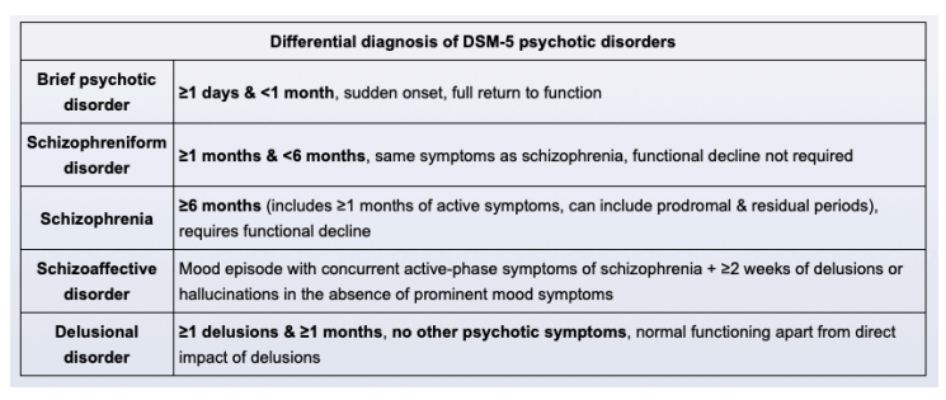
Delusional Disorder is characterized by one or more delusions lasting for $\ge$ 1 month. The key is that these patients are often high-functioning—they can hold down jobs and maintain relationships, as long as you don't touch on their specific "delusional topic."
1. Types of Delusional Disorder
The DSM-5 categorizes these based on the theme of the delusion:
- Persecutory (Most Common): The belief that they are being conspired against, cheated, spied on, followed, or harassed.
- Erotomanic: The belief that another person (usually of higher status or famous) is in love with them.
- Grandiose: Conviction of having some great (but unrecognized) talent or insight, or having made some important discovery.
- Jealous: The belief that their spouse or lover is unfaithful (often based on incorrect "evidence").
- Somatic: Delusions regarding bodily functions or sensations (e.g., believing they have a foul odor or a parasite infestation).
- Mixed/Unspecified: When no single theme predominates.
2. Differentiation from Schizophrenia
This is the most common "trick" on the USMLE. Here’s how you tell them apart:
| Feature | Delusional Disorder | Schizophrenia |
|---|---|---|
| Duration | $\ge$ 1 month | $\ge$ 6 months |
| Delusions | Usually "non-bizarre" (could happen) | Often "bizarre" (impossible) |
| Hallucinations | Absent or not prominent | Common (especially auditory) |
| Functioning | Preserved (except for the delusion) | Significantly impaired |
| Negative Symptoms | Absent | Present (flat affect, alogia, etc.) |
Key Exam Tip: If the patient is still working and "acting normal" except for one weird belief, think Delusional Disorder. If they are disorganized, hearing voices, and can't take care of themselves, think Schizophrenia.
3. Treatment
Treating Delusional Disorder is notoriously difficult because patients often lack insight—they don't believe they are ill.
- Therapeutic Alliance: This is the most important first step. You have to build trust without either "colluding" with the delusion or directly challenging it too early.
- Antipsychotics: ==First-line pharmacological treatment== (e.g., Risperidone, Aripiprazole). They are often less effective here than in schizophrenia but can help reduce the intensity of the delusion.
- Cognitive Behavioral Therapy (CBT): Used to help the patient develop coping strategies and reality-test their beliefs in a non-confrontational way.
Does that help clear up the differences for you? If you're feeling confident, we could try a quick practice case to see if you can spot the diagnosis!
Setting up chat...