Cystic fibrosis: genetics, sweat test, lung management and nutrition
 Rezzy
RezzyCystic Fibrosis (CF) is a classic "bread and butter" topic for the UKMLA AKT, so it's great we're diving into this. It’s a multi-system disorder, but the genetics and management are where the high-yield points usually hide for your exams!
1. Genetics: The "Delta F508" Story
CF is an autosomal recessive condition caused by a mutation in the CFTR gene located on chromosome 7.
- The Defect: It codes for a chloride channel. When it's broken, chloride can't move out of cells, so water doesn't follow. This results in thick, dehydrated secretions in the lungs, pancreas, and gut.
- Common Mutation: In the UK, the most common mutation is Delta F508.
2. The Sweat Test: Gold Standard
If you suspect CF (e.g., a child with recurrent chest infections or failure to thrive), the sweat test is your go-to diagnostic tool.
- Procedure: We use pilocarpine iontophoresis to stimulate sweat production.
- Diagnostic Criteria: A sweat chloride concentration > 60 mmol/L on two separate occasions is diagnostic.
- Note: Values between 30-59 mmol/L are "borderline" and usually require genetic testing.
I'll start by finding a helpful diagram that illustrates how these CFTR mutations affect different organ systems.
This diagram provides a great summary of how CF affects multiple organ systems, from the lungs to the digestive tract.
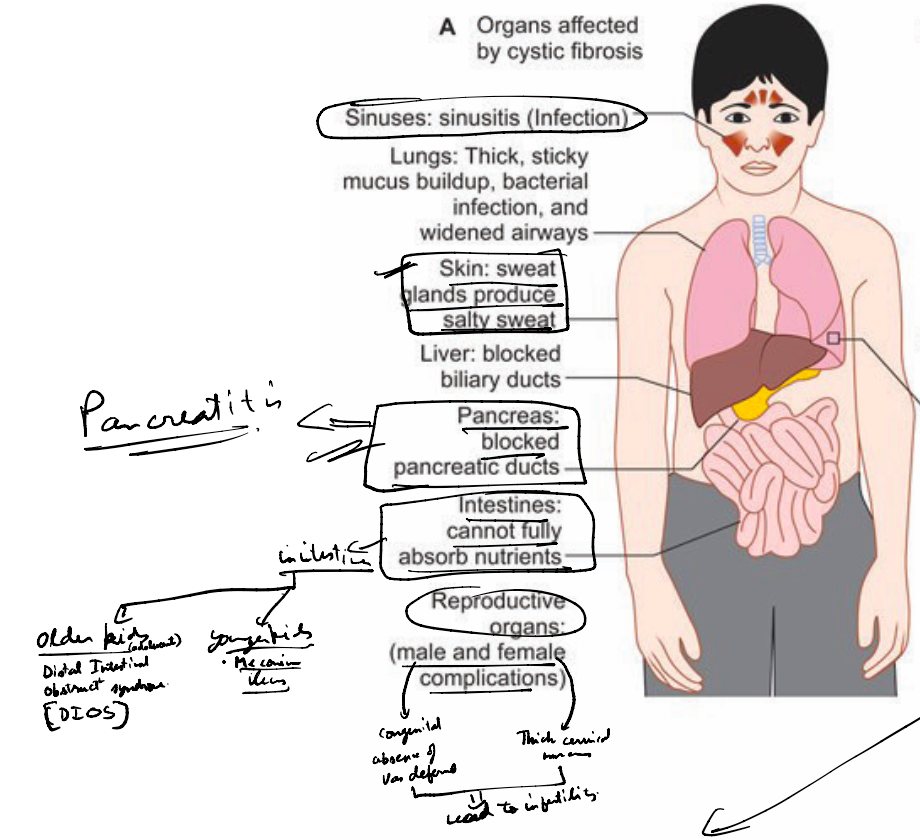
This illustration shows the multisystem effects of CF, including thick mucus in the lungs, blocked pancreatic ducts, and malabsorption in the intestines.
Managing CF is a lifelong commitment, focusing on keeping the lungs clear and the body well-nourished.
3. Lung Management: Clearing the Air
The goal is to prevent the "vicious cycle" of mucus plugging, infection, and inflammation.
- Chest Physiotherapy: Twice daily is the baseline to clear thick secretions.
- Mucolytics: Nebulised Dornase alfa (DNase) is high-yield—it breaks down the DNA from dead neutrophils in the mucus, making it less viscous.
- Antibiotics:
- Prophylactic flucloxacillin is often used in children.
- If Pseudomonas aeruginosa is detected, we use nebulised colistin or tobramycin.
- CFTR Modulators: These are the "miracle" drugs of the 2020s. Ivacaftor (Kalydeco) works for specific mutations, while the triple therapy Kaftrio (Ivacaftor/Tezacaftor/Elexacaftor) is now widely used in the UK for those with at least one Delta F508 mutation.
4. Nutrition: Feeding the Engine
Because the pancreatic ducts are blocked, patients suffer from pancreatic insufficiency and malabsorption.
- High-Calorie Diet: Patients often need 120-150% of the normal daily calorie and fat intake.
- PERT (Pancreatic Enzyme Replacement Therapy): Drugs like Creon must be taken with every meal and snack.
- Vitamin Supplementation: Since fat isn't absorbed well, patients need lifelong supplementation of fat-soluble vitamins: A, D, E, and K.
I'll pull up some specific lessons on CF management so you can dive deeper into the clinical guidelines.
📚 Cystic Fibrosis Lessons
I've pulled up some great lessons for you that cover everything from the pediatric presentation to the adult complications like bronchiectasis and pancreatic insufficiency.
To wrap this up, here is a quick summary table of the high-yield facts we've covered. This is perfect for a last-minute review before your AKT!
| Feature | Key High-Yield Fact |
|---|---|
| Genetics | Autosomal Recessive, CFTR gene, Chromosome 7, Delta F508 mutation |
| Diagnosis | Sweat Test (Chloride > 60 mmol/L), Newborn Screening (IRT) |
| Lungs | Chest Physio, Dornase alfa (DNase), Antibiotics (Pseudomonas coverage) |
| Nutrition | High-calorie/high-fat diet, PERT (Creon), ADEK vitamins |
| Modulators | Ivacaftor (Kalydeco), Triple therapy (Kaftrio) |
| Complications | Bronchiectasis, CF-Related Diabetes (CFRD), Infertility (CBAVD) |
I hope this helps you master Cystic Fibrosis for your exams! It's a complex topic, but focusing on these four pillars—genetics, diagnosis, lung care, and nutrition—will get you through most AKT questions. Let me know if you want to test your knowledge with a quick quiz or some flashcards!
Setting up chat...