Cross-sectional anatomy of the mediastinum and abdomen for USMLE
 Rezzy
RezzyCross-sectional anatomy is a USMLE Step 1 favorite because it bridges the gap between basic anatomy and clinical radiology. They love testing the "T4 level" for the thorax and the "L1 level" for the abdomen.
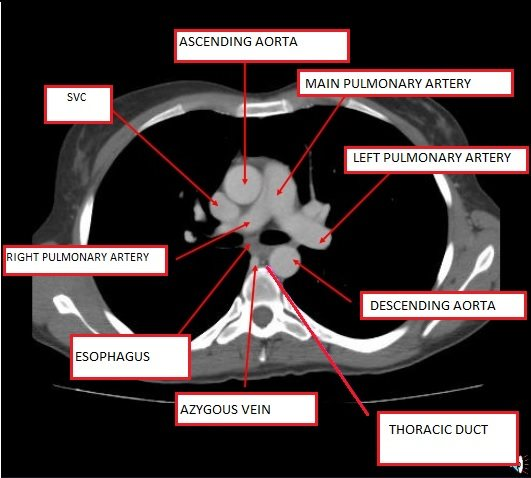
Let's start with the mediastinum, specifically at the level of the sternal angle (T4/T5), which is where all the action happens. I'll find a clear diagram for you to visualize these structures.
That's a perfect view of the "T4 level" structures. Notice how the arch of the aorta and the bifurcation of the trachea are the stars of the show here.
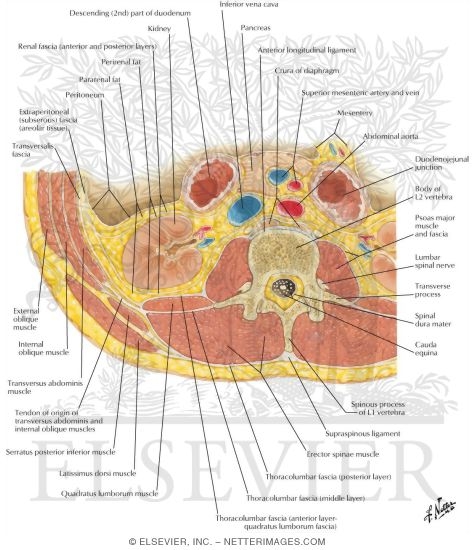
Moving down to the abdomen, the L1 level (Transpyloric Plane) is the one you'll see most often on exams. It's where you'll find the pancreas, the hila of the kidneys, and the origin of the Superior Mesenteric Artery (SMA).
Let me find a clear cross-section of the abdomen at this level for you.
This cross-section at the L1-L2 level is essential for understanding the retroperitoneal structures. Pay close attention to the relationship between the pancreas, the kidneys, and the major vessels like the aorta and IVC.
To really nail these for the USMLE, you'll want to review the specific structures at each vertebral level. I've pulled up some high-yield lessons that break down the mediastinum and abdominal anatomy in detail.
📚 Anatomy Lessons Search
Active recall is the best way to lock in these spatial relationships. I've found some flashcards that will test your ability to identify these structures on the fly.
🗂️ Anatomy Flashcards Search
Tap to study 17 flashcards in the Oncourse app
Those flashcards are gold for memorizing the specific structures at each level.
To wrap it up, here are the two "magic levels" you absolutely need to know for USMLE cross-sections:
- T4 Level (Sternal Angle): This is the "transition zone." You'll see the arch of the aorta, the bifurcation of the trachea, and the superior vena cava (SVC). It's also where the azygos vein drains into the SVC.
- L1 Level (Transpyloric Plane): This is the busiest plane in the abdomen. Look for the pylorus of the stomach, the neck/body of the pancreas, the hila of the kidneys, and the origin of the Superior Mesenteric Artery (SMA).
If you can identify these landmarks, you can usually orient yourself for any other structure nearby! Let me know if you want to dive deeper into any of these levels or try a quick quiz to test your knowledge.
Setting up chat...