Clinical manifestations of systemic diseases: multisystem approach for NEET-PG
 Rezzy
RezzySystemic diseases are a favorite for NEET-PG examiners because they test your ability to connect the dots across different organ systems. Instead of just memorizing a list, it's much more effective to look at how a single underlying pathology—like a connective tissue disorder or a metabolic derangement—manifests from head to toe.
Let's break down some of the heavy hitters you'll definitely see on the exam, focusing on the multisystem "red flags" that point you toward the right diagnosis.
1. Systemic Lupus Erythematosus (SLE)
SLE is the classic multisystem disease. Think of it as an "immune system gone rogue" attacking various tissues.
- Skin: Malar rash (spares nasolabial folds), discoid rash, photosensitivity.
- Joints: Non-erosive arthritis (usually involving two or more peripheral joints).
- Renal: Lupus nephritis (WHO classification is high-yield!). Look for proteinuria or red cell casts.
- Serosa: Pleuritis or pericarditis (chest pain that changes with position).
- Hematologic: Hemolytic anemia, leukopenia, or thrombocytopenia.
2. Sarcoidosis
This is the "great masquerader" characterized by non-caseating granulomas.
- Lungs: Bilateral hilar lymphadenopathy (Stage I) and interstitial lung disease.
- Eyes: Anterior uveitis (blurred vision, red eye).
- Skin: Erythema nodosum (painful shins) or Lupus pernio (violaceous rash on the face).
- Heart: Heart block or restrictive cardiomyopathy.
- Metabolic: Hypercalcemia (due to 1-alpha hydroxylase activity in macrophages).
3. Diabetes Mellitus (Chronic Complications)
You can't escape DM in NEET-PG. It affects almost everything via microvascular and macrovascular damage.
- Microvascular: Retinopathy (cotton wool spots), Nephropathy (Kimmelstiel-Wilson nodules), and Neuropathy (stocking-glove distribution).
- Macrovascular: Coronary artery disease, Stroke, and Peripheral vascular disease.
- Skin: Acanthosis nigricans (insulin resistance) or Necrobiosis lipoidica diabeticorum.
4. Amyloidosis
Think of this when you see a patient with "too many things going wrong" that don't seem to fit one category.
- Heart: Restrictive cardiomyopathy (thickened ventricles on Echo).
- Kidney: Nephrotic syndrome (massive proteinuria).
- GI/Tongue: Macroglossia (large tongue) and malabsorption.
- Nerves: Carpal tunnel syndrome or autonomic neuropathy.
To help you visualize these connections, I'll pull up some high-yield lessons and a comparison table for these multisystem manifestations.
Mnemonic: SOAP BRAIN MD (for SLE) Serositis, Oral ulcers, Arthritis, Photosensitivity, Blood disorders, Renal, ANA positive, Immunologic, Neurologic, Malar rash, Discoid rash.
Let's start by finding some detailed lessons on these systemic conditions.
📚 Systemic Disease Lessons
Those lessons cover the core systemic involvements. To make this even clearer for your revision, I've put together a comparison table of the most high-yield multisystem findings you're likely to encounter in a clinical vignette.
| Systemic Disease | Key Cardiac Finding | Key Renal Finding | Key Skin Finding | Other High-Yield Sign |
|---|---|---|---|---|
| SLE | Libman-Sacks Endocarditis | Lupus Nephritis (Wire-loop lesions) | Malar (Butterfly) Rash | Oral ulcers, Alopecia |
| Sarcoidosis | Heart Block / Arrhythmias | Hypercalciuria / Stones | Erythema Nodosum | Bilateral Hilar Lymphadenopathy |
| Amyloidosis | Restrictive Cardiomyopathy | Nephrotic Syndrome | Periorbital Ecchymosis | Macroglossia |
| Diabetes | Coronary Artery Disease | Kimmelstiel-Wilson Nodules | Acanthosis Nigricans | Stocking-glove Neuropathy |
| Scleroderma | Pulmonary Hypertension | Scleroderma Renal Crisis | Sclerodactyly / Raynaud's | CREST Syndrome features |
That table should be a great quick-reference for your revision. Since these diseases often have very specific visual clues—like the malar rash in SLE or the "panda sign" in sarcoidosis—it's super helpful to see them.
Let me find some high-yield images of these manifestations for you.
The image below shows some of the most characteristic skin findings in systemic diseases. Notice the Lupus Pernio in sarcoidosis—it's that violaceous, plaque-like rash on the nose that's a classic exam "buzzword."
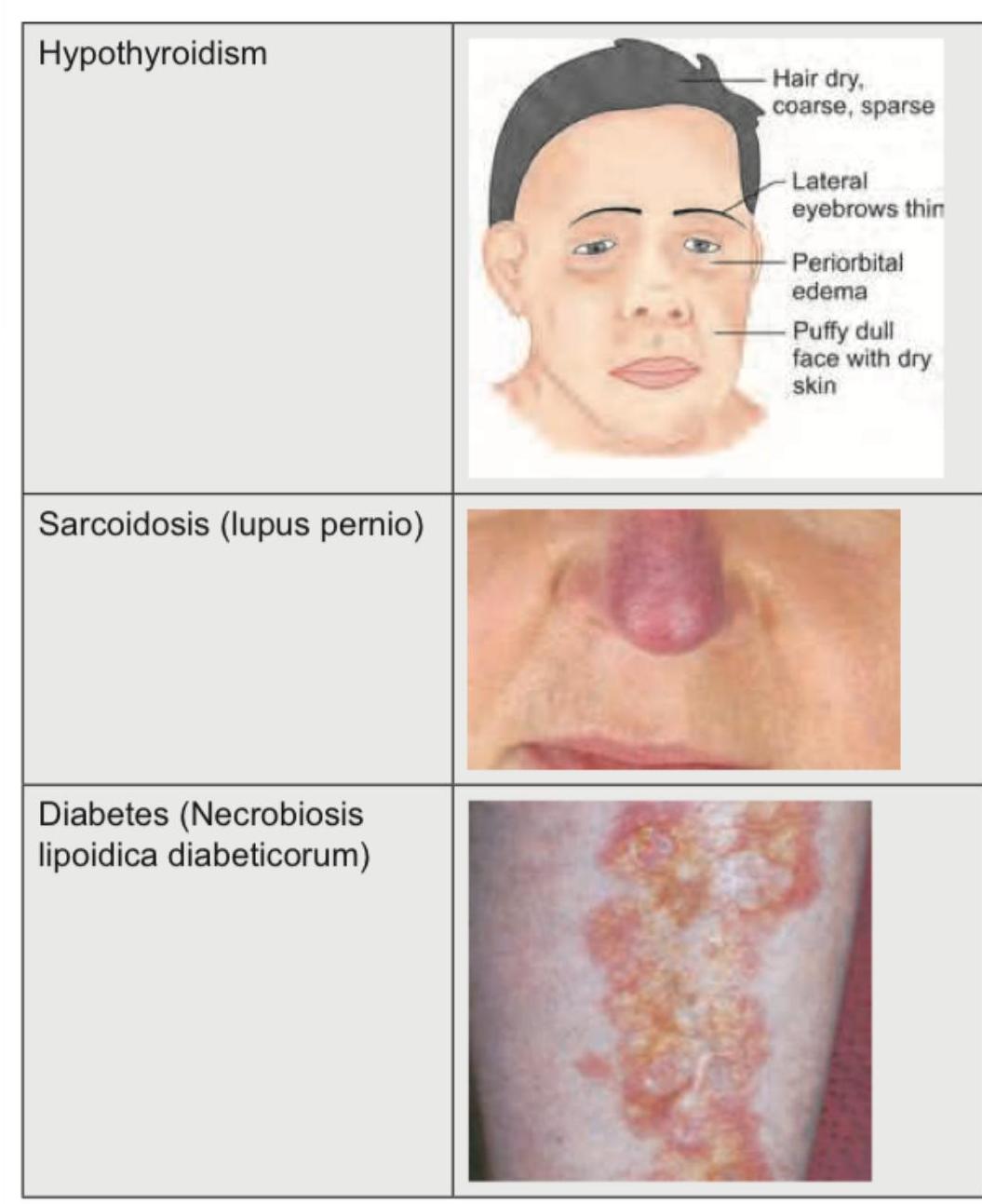
- Top Panel: Hypothyroidism (periorbital edema, sparse eyebrows).
- Middle Panel: Sarcoidosis (Lupus Pernio) showing violaceous plaques on the nose.
- Bottom Panel: Necrobiosis Lipoidica Diabeticorum (NLD) on the shin, often seen in diabetics.
To wrap this up, would you like to try a quick Synapses game to see if you can group these multisystem findings correctly, or should we jump into some Practice Questions?
Setting up chat...