Clinical anatomy: surface landmarks, common surgical approaches for NEET-PG
 Rezzy
RezzyClinical anatomy is where the textbook meets the operating table, and for NEET-PG, it's all about those high-yield "danger zones" and "safe entries." Understanding where to poke, prod, or cut based on surface landmarks is a favorite for examiners.
I'll start by pulling up some key lessons that cover these surgical approaches and anatomical landmarks in detail.
It looks like I need to be a bit more specific with my search to find the best resources for you. Clinical anatomy is often categorized by region, so let's look for lessons on surgical landmarks and common incisions.
📚 Surgical Anatomy Resources
Those lessons are a goldmine for the nitty-gritty details! To give you a quick "cheat sheet" for your revision, here are some of the most frequently tested landmarks and incisions:
High-Yield Surface Landmarks
- Sternal Angle (Angle of Louis): Located at the
T4/T5vertebral level. It's your landmark for the 2nd costal cartilage, the bifurcation of the trachea, and the beginning/end of the aortic arch. - Transpyloric Plane (L1): Passes through the pylorus of the stomach, the hila of the kidneys, the fundus of the gallbladder, and the origin of the Superior Mesenteric Artery (SMA).
- McBurney’s Point: Located 1/3rd of the way from the Right Anterior Superior Iliac Spine (ASIS) to the umbilicus. This is the surface projection of the base of the appendix.
- Mid-inguinal Point: Midway between the ASIS and the pubic symphysis. This is where you find the femoral artery pulse. (Don't confuse it with the midpoint of the inguinal ligament, which is midway between ASIS and the pubic tubercle—the landmark for the deep inguinal ring!)
Common Surgical Approaches
- Kocher’s Incision: A right subcostal incision used for open cholecystectomy or biliary tract surgery.
- Pfannenstiel Incision: A "bikini-line" transverse incision used for C-sections and pelvic surgeries.
- Gridiron (McBurney's) Incision: The classic muscle-splitting approach for an appendectomy.
- Median Sternotomy: The "vertical" midline chest incision used for most open-heart surgeries.
Let me find a diagram to help you visualize these abdominal landmarks and incisions, as they are very visual-heavy in exams.
This diagram is a great reference for the most common abdominal incisions you'll encounter in surgery and anatomy questions.
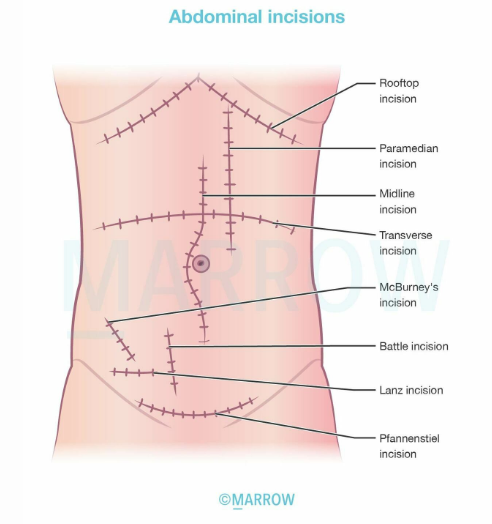
That diagram covers the "where" and "what" of abdominal access. To help you lock in these landmarks and surgical approaches for your exam, I've pulled some high-yield flashcards.
🗂️ Clinical Anatomy Flashcards
Tap to study 12 flashcards in the Oncourse app
Those flashcards cover some of the trickier "named" incisions and landmarks that often pop up in exams. To wrap this up, let's see how you handle some practice questions on these clinical anatomy concepts.
✍️ Clinical Anatomy Quiz
Tap to practice questions in the Oncourse app
That should give you a solid foundation for clinical anatomy and surgical approaches! We've covered the key landmarks like the Sternal Angle and McBurney's Point, visualized the major abdominal incisions, and set up some flashcards and a quiz to lock it all in.
Is there a specific region or a particular surgical approach you'd like to dive deeper into? I'm here to help!
Setting up chat...