Chronic kidney disease: eGFR staging, referral criteria and management
 Rezzy
RezzyCKD is a bread-and-butter topic for the UKMLA AKT, so getting these NICE guidelines down is essential! It's all about the "G" (eGFR) and the "A" (ACR) categories.
Let me grab some high-yield lessons to get us started on the right track.
📚 CKD High-Yield Lessons
Staging CKD is a two-dimensional process. We look at the eGFR (G stage) and the Albumin:Creatinine Ratio (ACR, A stage). Remember, you need two abnormal readings at least 3 months apart to confirm a diagnosis of CKD (unless it's obviously acute).
Here is the breakdown of the staging according to NICE guidelines:
| G Stage | eGFR (ml/min/1.73m²) | Description |
|---|---|---|
| G1 | ≥ 90 | Normal or high (only CKD if other evidence of kidney damage) |
| G2 | 60-89 | Mildly decreased (only CKD if other evidence of kidney damage) |
| G3a | 45-59 | Mildly to moderately decreased |
| G3b | 30-44 | Moderately to severely decreased |
| G4 | 15-29 | Severely decreased |
| G5 | < 15 | Kidney failure |
| A Stage | ACR (mg/mmol) | Description |
|---|---|---|
| A1 | < 3 | Normal to mildly increased |
| A2 | 3-30 | Moderately increased |
| A3 | > 30 | Severely increased |
When it comes to referral to a Nephrologist, NICE is quite specific. You should refer if:
- eGFR < 30 (Stage G4 or G5).
- ACR ≥ 70 mg/mmol (unless it's known diabetic nephropathy and already managed).
- ACR ≥ 30 mg/mmol PLUS hematuria.
- A sustained decrease in eGFR (e.g., >25% or >15 ml/min in 12 months).
- Uncontrolled hypertension despite 3+ drugs.
For management, the focus is on cardiovascular risk reduction and slowing progression:
- Blood Pressure: Target
< 140/90(or< 130/80if ACR ≥ 70). - ACEi or ARB: First-line if ACR ≥ 3 (with diabetes) or ACR ≥ 30 (without diabetes).
- SGLT2 Inhibitors: Now recommended for many CKD patients (e.g., Dapagliflozin) if they meet specific eGFR and ACR criteria.
- Statins: Atorvastatin 20mg is usually started for primary prevention of CVD in CKD.
Let me see if I can find a helpful diagram for the management pathway.
This diagram shows how we manage medications like ACE inhibitors and SGLT2 inhibitors as the eGFR declines. It's a key part of the "Guideline-Directed Medical Therapy" (GDMT) we use to protect the kidneys and the heart.
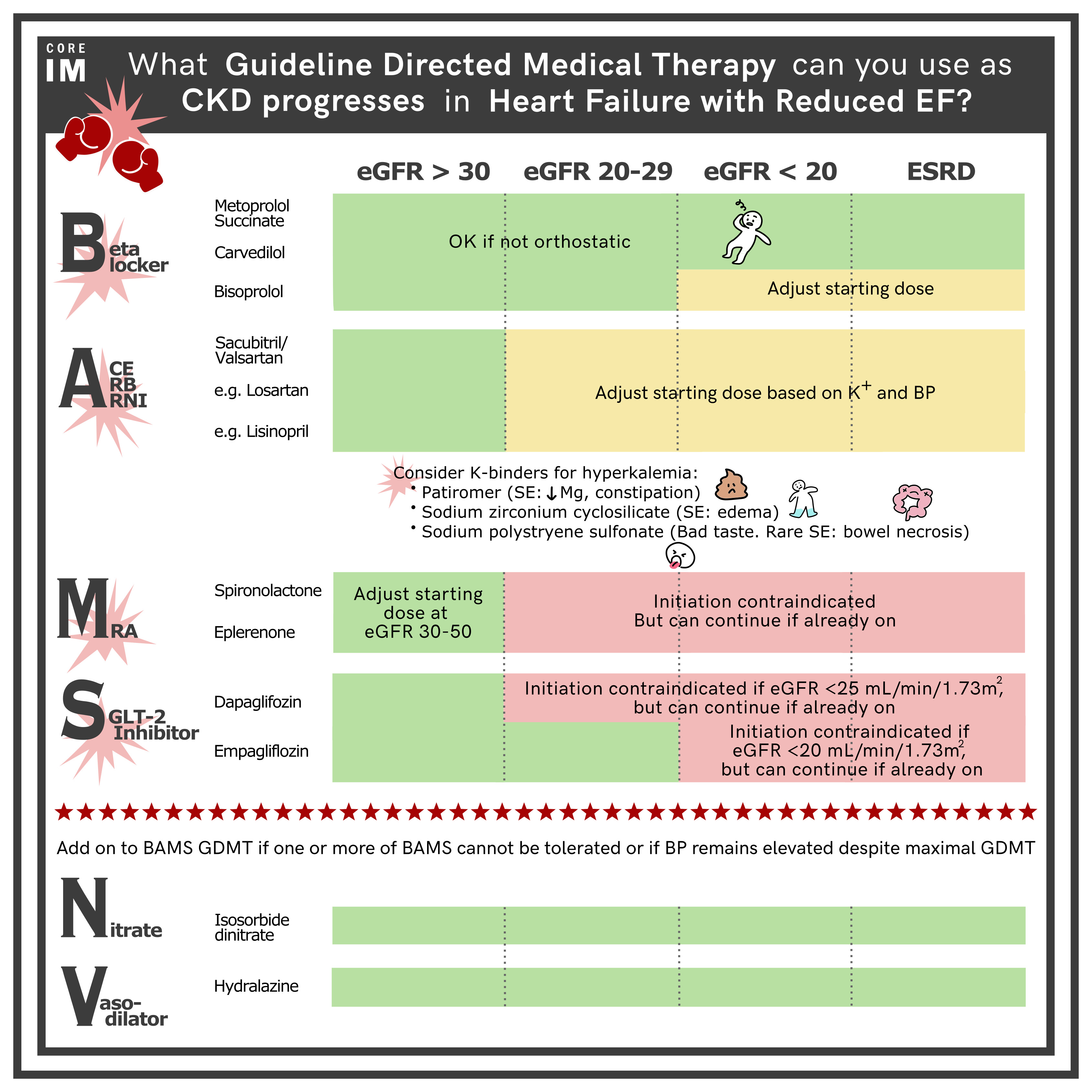
Note how SGLT2 inhibitors and ACEi/ARBs are titrated or monitored closely as the eGFR drops below 30.
Since CKD management and referral criteria are so common in the AKT, would you like to try a quick quiz to see if you've got these numbers memorized?
✍️ CKD High-Yield Quiz
Tap to practice questions in the Oncourse app
I've put together a 10-question quiz for you to test your knowledge of those eGFR and ACR thresholds. They're exactly the kind of numbers the AKT loves to test.
Let me know if you want to dive deeper into any of those management steps, like the specific criteria for starting Dapagliflozin or how to handle hyperkalaemia in CKD!
Setting up chat...