Child psychiatry: ADHD, autism spectrum disorder and learning disabilities
 Rezzy
RezzyChild psychiatry is such a high-yield area for NEET-PG and INI-CET, especially when it comes to neurodevelopmental disorders. These topics often overlap between Pediatrics and Psychiatry, so getting a solid grip on them is a double win for your prep!
Let me pull up some of the best lessons we have on ADHD, Autism, and Learning Disabilities to get you started.
📚 Child Psychiatry Lessons
It's really common to see these conditions presented as clinical vignettes in exams. For instance, you might get a case of a child who can't sit still in class (ADHD) versus one who has trouble with social cues and repetitive behaviors (ASD).
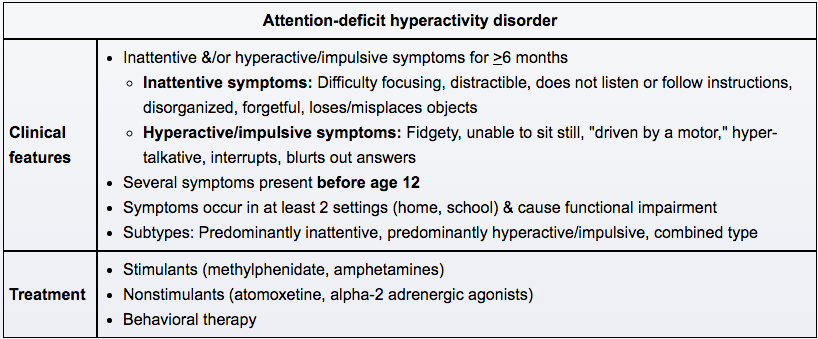
I'm going to grab a diagnostic comparison table for you to help keep these straight, and I'll also look for a visual aid on the core symptoms.
That image gives a great breakdown of the ADHD criteria—remember, symptoms must be present in two or more settings (like home and school) and start before age 12 for a diagnosis.
To help you differentiate these three big topics, I've put together a quick comparison table for you.
| Feature | ADHD | Autism Spectrum Disorder (ASD) | Learning Disabilities (LD) |
|---|---|---|---|
| Core Deficit | Attention, Impulse control, Hyperactivity | Social communication, Repetitive behaviors/interests | Specific academic skill (Reading, Writing, Math) |
| Onset | Before age 12 | Early developmental period (usually <3 years) | School-age (when academic demands increase) |
| Social Interaction | May be poor due to impulsivity/inattention | Fundamental lack of social-emotional reciprocity | Usually normal, unless secondary to frustration |
| Communication | Talkative, interrupts, shifts topics | Delayed speech, echolalia, literal interpretation | Specific to the disability (e.g., phonological awareness) |
| First-line Tx | Stimulants (Methylphenidate) + Behavioral therapy | Behavioral/Educational therapy (Applied Behavior Analysis) | Specialized educational interventions (IEP) |
That table should help you keep the core differences clear. Here are a few more high-yield "must-knows" for your exams:
ADHD (Attention-Deficit Hyperactivity Disorder)
- Diagnosis: Requires symptoms in two or more settings (e.g., home and school) for at least 6 months.
- Treatment:
- Stimulants (e.g., Methylphenidate) are first-line. Watch for side effects like appetite suppression and insomnia.
- Non-stimulants (e.g., Atomoxetine) are used if stimulants aren't tolerated or if there's a risk of substance abuse.
Autism Spectrum Disorder (ASD)
- Core Triad: Deficits in social communication, social interaction, and restricted/repetitive patterns of behavior.
- Early Signs: Lack of joint attention, poor eye contact, and delayed speech.
- Management: Early behavioral intervention (like ABA therapy) is key.
Learning Disabilities (Specific Learning Disorders)
- Dyslexia: Difficulty with word recognition and decoding (reading).
- Dyscalculia: Difficulty with number sense and math facts.
- Dysgraphia: Difficulty with spelling, grammar, and handwriting.
- Key Point: These are diagnosed when academic achievement is significantly below what's expected for the child's age and IQ.
Would you like to test your knowledge with a quick quiz on these topics, or should I pull up some flashcards for active recall?
Setting up chat...