Cellular physiology: membrane transport, action potential and cell signaling
 Rezzy
RezzyAh, diving into the fundamentals! Cellular physiology is basically the "operating system" of the human body. Understanding how cells move stuff, talk to each other, and fire off signals is high-yield for almost every system you'll study later.
I'll pull up some of our best lessons on these topics so you have a solid foundation to refer to.
📚 Cell Physiology Lessons
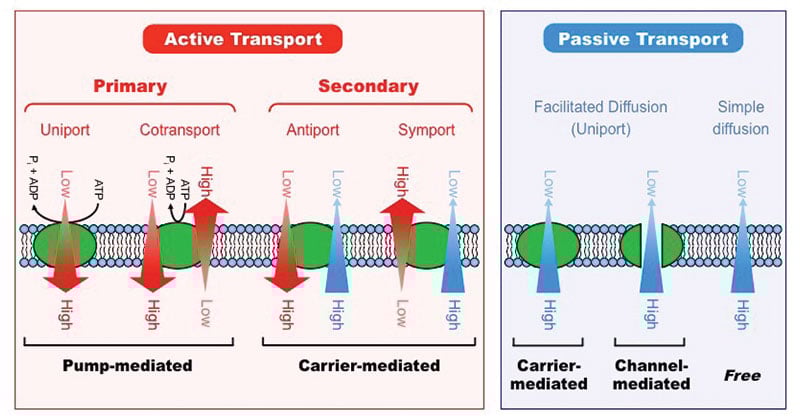
Let's start with Membrane Transport. Think of the cell membrane as a very picky bouncer at a club. It decides who gets in and who stays out based on size, charge, and concentration.
- Passive Transport: No energy (ATP) required. Molecules move down their concentration gradient.
- Simple Diffusion: Small, non-polar molecules (like $O_2$ or $CO_2$) just slip through the lipid bilayer.
- Facilitated Diffusion: Larger or polar molecules (like Glucose) need a "VIP pass" through a protein channel or carrier.
- Active Transport: Requires ATP because you're pushing molecules against the gradient (like salmon swimming upstream).
- Primary: Direct use of ATP (e.g., the famous $Na^+/K^+$ ATPase pump).
- Secondary: Uses the energy from an existing gradient (e.g., SGLT1 using the sodium gradient to pull in glucose).
I'll find a diagram to help you visualize these different transport mechanisms.
I've found a great diagram that breaks down these transport mechanisms. It's a classic exam favorite, so take a second to look at the difference between primary and secondary active transport.
Now, let's talk about the Action Potential. This is the electrical signal that allows your brain to tell your muscles to move. It's all about the rapid change in membrane potential.
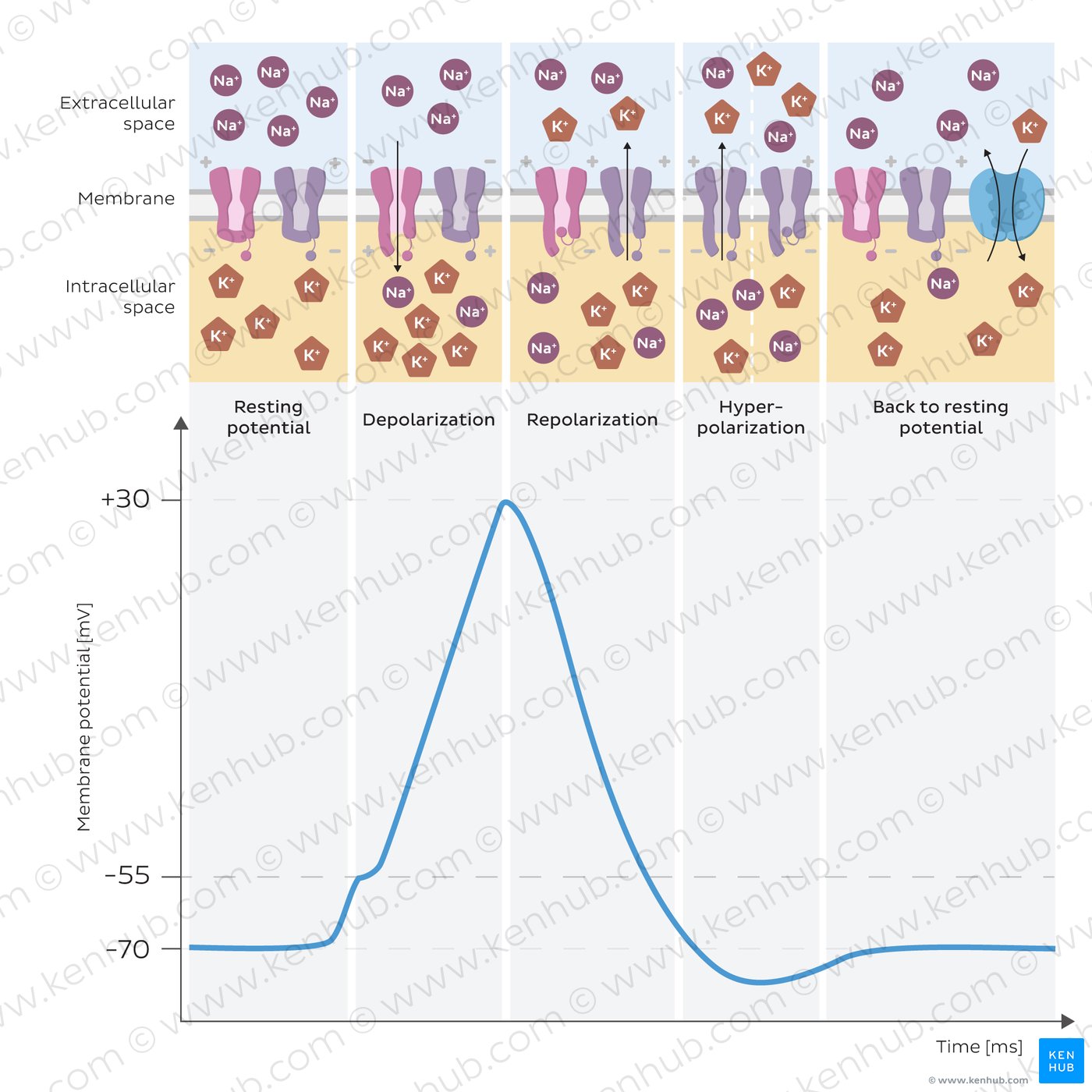
- Resting Membrane Potential (RMP): Usually around
-70 mV. The cell is "at rest," maintained by the $Na^+/K^+$ pump and $K^+$ leak channels. - Depolarization: A stimulus hits the threshold (around
-55 mV). Voltage-gated $Na^+$ channels open, and $Na^+$ rushes into the cell, making it more positive. - Repolarization: $Na^+$ channels close, and voltage-gated $K^+$ channels open. $K^+$ rushes out of the cell, bringing the potential back down.
- Hyperpolarization: $K^+$ channels stay open a bit too long, making the cell even more negative than the RMP. This is the Refractory Period, where it's harder to fire another signal.
I'll find a graph of the action potential to show you exactly how these phases look.
This graph shows exactly how the membrane potential changes over time. Notice the "all-or-none" principle: once you hit that threshold, the action potential will fire.
Finally, let's look at Cell Signaling. This is how cells communicate. It's like a game of telephone, but with molecules!
- Receptors:
- G-Protein Coupled Receptors (GPCRs): The most common. Think of them as the "middleman" that activates a second messenger.
- Ion Channel-Linked: The ligand binds, the channel opens, and ions flow in (like the Nicotinic Acetylcholine receptor).
- Enzyme-Linked: The receptor is an enzyme (like the Insulin receptor, which is a Tyrosine Kinase).
- Second Messengers: These are the "messengers" inside the cell that carry out the signal.
- cAMP: Activated by Adenylyl Cyclase.
- $IP_3$ and $DAG$: Activated by Phospholipase C (PLC).
- $Ca^{2+}$: Often released from the Sarcoplasmic Reticulum.
I'll find a diagram of the GPCR pathway, as it's the most common one you'll see in exams.
This diagram shows the classic GPCR pathway. It's a key concept for both Physiology and Pharmacology, so it's worth spending some time on.

That's a lot of information to take in! These three topics are the building blocks for almost everything else in physiology.
Would you like to test your knowledge with a quick quiz on these concepts, or should I pull up some flashcards to help you memorize the ion channel movements?
Setting up chat...