Cell injury and death: necrosis vs apoptosis with examples
 Rezzy
RezzyAh, the classic "messy vs. tidy" showdown of pathology! Understanding the difference between necrosis and apoptosis is like knowing the difference between a chaotic building demolition and a carefully planned deconstruction.
To get us started, I've put together a comparison table that breaks down the key morphological and biochemical differences you'll need to know for your exams.
| Feature | Necrosis | Apoptosis |
|---|---|---|
| Cell Size | Enlarged (swelling) | Reduced (shrinkage) |
| Nucleus | Pyknosis → karyorrhexis → karyolysis | Fragmentation into nucleosome-sized fragments |
| Plasma Membrane | Disrupted (leaky) | Intact; altered structure (lipid orientation) |
| Cellular Contents | Enzymatic digestion; may leak out | Intact; released in apoptotic bodies |
| Adjacent Inflammation | Frequent (the "messy" part) | No (the "tidy" part) |
| Physiologic or Pathologic | Invariably pathologic (culmination of irreversible cell injury) | Often physiologic; may be pathologic after some forms of cell injury |
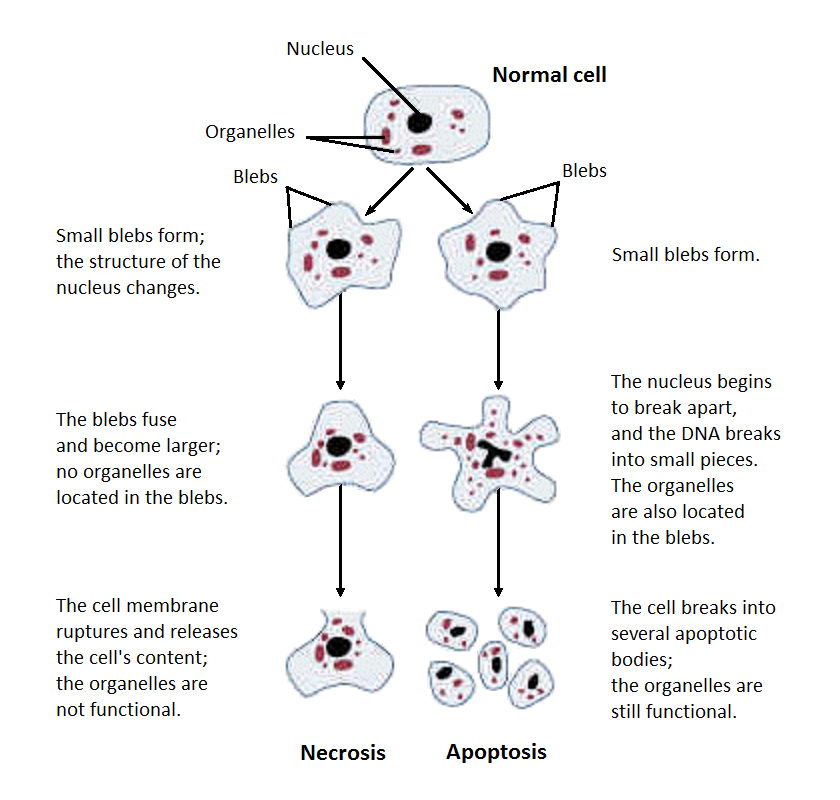
It's helpful to visualize how these processes actually look under the microscope. Let me find a diagram that illustrates these morphological changes for you.
Here is a visual breakdown of those morphological changes. Notice how necrosis leads to membrane rupture and a "messy" release of contents, while apoptosis neatly packages everything into apoptotic bodies.
To really lock this in, let's look at some high-yield examples you'll likely see on your exams.
Examples of Necrosis
Necrosis is almost always a pathologic process resulting from severe, irreversible injury.
- Coagulative Necrosis: The most common type, seen in ischemic infarction of most solid organs (heart, kidney, spleen), except the brain. The cell architecture is preserved for a few days.
- Liquefactive Necrosis: Seen in brain infarcts and bacterial/fungal abscesses. The tissue is literally digested into a liquid mass.
- Caseous Necrosis: The "cheese-like" appearance characteristic of Tuberculosis (TB) infections.
- Fat Necrosis: Occurs in acute pancreatitis (enzymatic) or trauma to fatty tissue like the breast.
- Fibrinoid Necrosis: Seen in immune-mediated vasculitis and malignant hypertension.
Examples of Apoptosis
Apoptosis can be either physiologic (normal part of life) or pathologic.
- Physiologic:
- Embryogenesis: The removal of "webbing" between fingers and toes.
- Hormone-dependent involution: The breakdown of the endometrium during the menstrual cycle.
- Immune system: Deletion of self-reactive lymphocytes to prevent autoimmunity.
- Pathologic:
- DNA Damage: If a cell's DNA is too damaged by radiation or chemotherapy to be repaired, it commits suicide via apoptosis.
- Viral Infections: Certain viruses (like Hepatitis) can trigger apoptosis in the host cell.
- Misfolded Proteins: Accumulation of "junk" proteins in diseases like Alzheimer’s or Parkinson’s triggers the apoptotic pathway.
Since these two can get a bit mixed up, would you like to try a quick game of Synapses to see if you can categorize different features and examples into the right "death" bucket?
Setting up chat...