Cardiovascular physiology: cardiac cycle, Starling law and blood pressure regulation
 Rezzy
RezzyAh, cardiovascular physiology! This is the bread and butter of medicine and a massive high-yield area for your exams. Understanding how the heart pumps and how the body keeps that pressure steady is key to grasping everything from heart failure to shock.
Let's start with the Cardiac Cycle. Think of it as a perfectly timed dance between electrical signals and mechanical actions. It’s divided into Systole (contraction/emptying) and Diastole (relaxation/filling). The most important thing to track here is the relationship between pressure and volume—especially when those heart sounds (S1 and S2) happen!
I'll pull up a diagram to help you visualize these pressure changes throughout the cycle.
That Wiggers diagram is the "gold standard" for understanding the cycle. Pay close attention to the Isovolumetric phases—that's when all valves are closed and pressure is changing rapidly without any change in volume.
Frank-Starling Law
Now, let's talk about the Frank-Starling Law. In simple terms: "The heart pumps what it gets." Physiologically, it states that the force of ventricular contraction is proportional to the initial length of the muscle fibers (Preload).
- More venous return $\rightarrow$ Increased End-Diastolic Volume (EDV) $\rightarrow$ Increased Stretch $\rightarrow$ Increased Stroke Volume.
- This ensures that the output of the left and right ventricles stays balanced!
Blood Pressure Regulation
Your body regulates BP through two main systems:
- Short-term (Neural): The Baroreceptor Reflex. High-pressure sensors in the carotid sinus and aortic arch detect changes and signal the medulla to adjust heart rate and vascular resistance within seconds.
- Long-term (Hormonal): The Renin-Angiotensin-Aldosterone System (RAAS). When BP drops, the kidneys release Renin, eventually leading to Angiotensin II (a potent vasoconstrictor) and Aldosterone (which saves salt and water).
I'm putting that diagram on a card for you to study, and I'll also find some lessons and flashcards to help you lock this in.
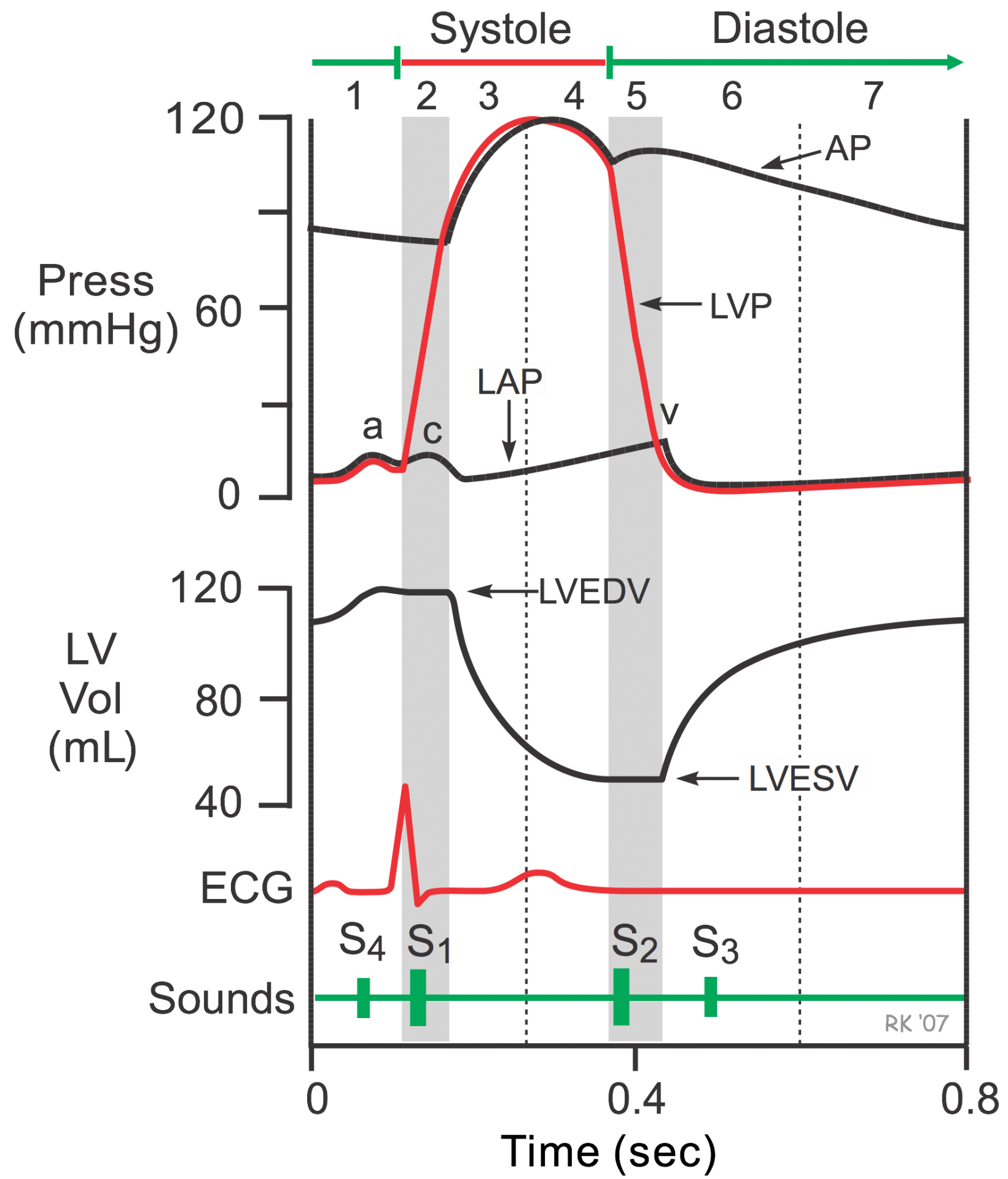
That diagram is a lifesaver for exams! Make sure you can identify where the Aortic Valve opens (when LV pressure exceeds Aortic pressure) and where it closes (the dicrotic notch).
Let me pull up some high-yield lessons and flashcards so you can test your knowledge on these concepts.
📚 Cardiovascular Physiology Lessons
Those lessons cover everything from the baroreceptor reflex to the RAAS pathway in detail. To really lock this in, let's look at some flashcards. They're great for testing your quick recall on things like "What happens to the stroke volume when preload increases?"
🗂️ Cardiovascular Physiology Flashcards
Tap to study 11 flashcards in the Oncourse app
Those flashcards are perfect for a quick review. One high-yield tip to remember: Diastole is the phase that gets shortened the most when your heart rate increases. This is why very high heart rates (like in SVT) can actually lead to decreased cardiac output—there's just not enough time for the heart to fill!
You've got the basics down:
- Cardiac Cycle: The mechanical and electrical coordination of the pump.
- Starling's Law: The "stretch and snap" mechanism that balances output.
- BP Regulation: The quick-acting baroreceptors and the long-term RAAS system.
If you want to dive deeper into any of these, like the specific waves of the atrial pressure curve (a, c, and v waves), just let me know! Happy studying!
Setting up chat...