Carbohydrate metabolism: glycolysis, gluconeogenesis and glycogen storage diseases
 Rezzy
RezzyBiochemistry can sometimes feel like an endless map of arrows and enzymes, but for NEET-PG and INI-CET, it’s all about the rate-limiting steps and the clinical "why." Carbohydrate metabolism is the backbone of it all.
1. Glycolysis: The Energy Starter
This happens in the cytosol of all cells. The big thing to remember is the rate-limiting enzyme: Phosphofructokinase-1 (PFK-1).
- High-Yield Fact:
==Arsenic poisoning inhibits Glyceraldehyde 3-phosphate dehydrogenase (G3PDH)==by competing with inorganic phosphate, leading to zero net ATP production! - Key Regulation: Insulin stimulates PFK-1 (via Fructose-2,6-bisphosphate), while Glucagon inhibits it.
2. Gluconeogenesis: The "Reverse" Gear
When you're fasting, your liver needs to make glucose from non-carb sources (like lactate, glycerol, and amino acids). It’s basically glycolysis in reverse, but it has to "bypass" three irreversible steps.
- The 4 Key Enzymes:
- Pyruvate carboxylase (requires Biotin)
- PEP carboxykinase (PEPCK)
- Fructose-1,6-bisphosphatase (The rate-limiting step!)
- Glucose-6-phosphatase (Missing in muscle, which is why muscle can't contribute to blood glucose).
Let me find a clear diagram that shows how these two pathways dance together.
That diagram really helps visualize how the body switches between burning and building glucose.
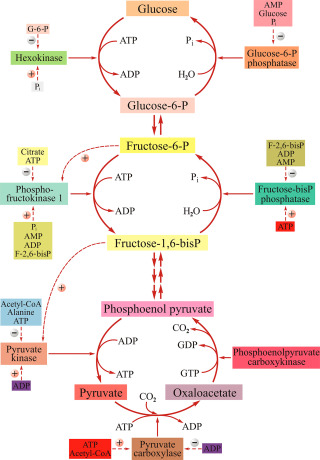
This diagram illustrates the integrated pathways of glycolysis and gluconeogenesis, highlighting the key enzymes and their allosteric regulators like ATP, AMP, and Fructose-2,6-bisphosphate.
Now, let's talk about Glycogen Storage Diseases (GSDs). These are a favorite for examiners because they combine biochemistry with clinical presentation. I've put together a high-yield comparison table for the most common types you'll see in your exams.
| Type | Name | Enzyme Deficiency | Key Clinical Features | High-Yield "Buzzwords" |
|---|---|---|---|---|
| I | Von Gierke | Glucose-6-phosphatase | Severe fasting hypoglycemia, hepatomegaly, doll-like face | High Lactate, Uric Acid, and Lipids |
| II | Pompe | $\alpha$-1,4-glucosidase (Acid maltase) | Cardiomegaly, hypertrophic cardiomyopathy, muscle weakness | "Pompe trashes the Pump (Heart)" |
| III | Cori | Debranching enzyme ($\alpha$-1,6-glucosidase) | Milder hypoglycemia, hepatomegaly | Normal blood lactate levels |
| V | McArdle | Skeletal muscle glycogen phosphorylase | Muscle cramps, myoglobinuria with strenuous exercise | "Second wind" phenomenon |
That table covers the most high-yield GSDs for your exams. Remember, Von Gierke (Type I) is the most severe because it blocks the final step of both glycogenolysis and gluconeogenesis, leading to profound hypoglycemia and lactic acidosis.
To help you master these pathways and their regulation, I've pulled up some detailed lessons from OnCourse.
📚 Carbohydrate Metabolism Lessons
Those lessons will give you a deep dive into the specific reactions and regulatory mechanisms.
One last high-yield tip for your exams: Type II GSD (Pompe) is the only one that is also a Lysosomal Storage Disease, which is why it affects the heart and muscles so severely.
If you're feeling confident with the theory, we could jump into some practice questions or flashcards to see how well you can spot these in a clinical scenario! Just let me know what you'd like to do next.
Setting up chat...