Bowel cancer screening: FIT test, colonoscopy and polyp surveillance
 Rezzy
RezzyBowel cancer screening is a massive topic for the UKMLA AKT, and the UK's approach has become much more streamlined recently with the switch to the FIT test. It's all about catching things early—either finding cancer when it's treatable or removing polyps before they even think about turning malignant.
The Faecal Immunochemical Test (FIT)
In England, the screening programme currently invites everyone aged 54 to 74 (transitioning down to age 50) to perform a FIT test every 2 years.
- How it works: It uses antibodies to specifically detect human haemoglobin in the stool.
- The "Magic Number": A result of ≥120 µg Hb/g is generally the threshold for a "positive" result in the screening programme, though this can vary slightly by region.
- Why it's better: Unlike the old Guaiac tests (gFOBT), patients only need to provide one sample, and there are no dietary restrictions (so they can keep eating their steak and broccoli!).
I'll pull up some high-yield lessons that break down these screening intervals and the specific criteria you'll need for the exam.
📚 Bowel Cancer Screening Lessons
Colonoscopy and Polyp Surveillance
If a screening FIT comes back positive, the next step is a colonoscopy. This is the "gold standard" for visualizing the entire colon and taking biopsies or performing polypectomies.
The surveillance of polyps after they've been removed is a favorite for examiners. The UK (BSG) guidelines were updated recently to reduce unnecessary procedures. Here is the current high-yield breakdown:
- High-Risk Criteria: You are considered high-risk if you have:
- 2 or more premalignant polyps (including at least one "advanced" polyp: ≥10mm in size or containing high-grade dysplasia) OR
- 5 or more premalignant polyps in total.
- Surveillance Interval: If you meet the high-risk criteria, you get a follow-up colonoscopy in 3 years.
- Low Risk: If you don't meet these criteria, you generally don't need surveillance and can just return to the normal 2-yearly FIT screening programme.
Rezzy's Tip: Don't confuse Screening FIT (for healthy people) with Symptomatic FIT (for patients with symptoms in GP). For symptomatic patients, the threshold for referral is much lower (usually
>10 µg Hb/g).
Let me find a visual to help you map out this pathway—it's much easier to remember when you see the flowchart.
While the general principles of screening are similar globally, remember that for the UKMLA AKT, the age range in England is currently 54 to 74 (moving towards 50).
Here's a visual overview of how the "2-step" process works:
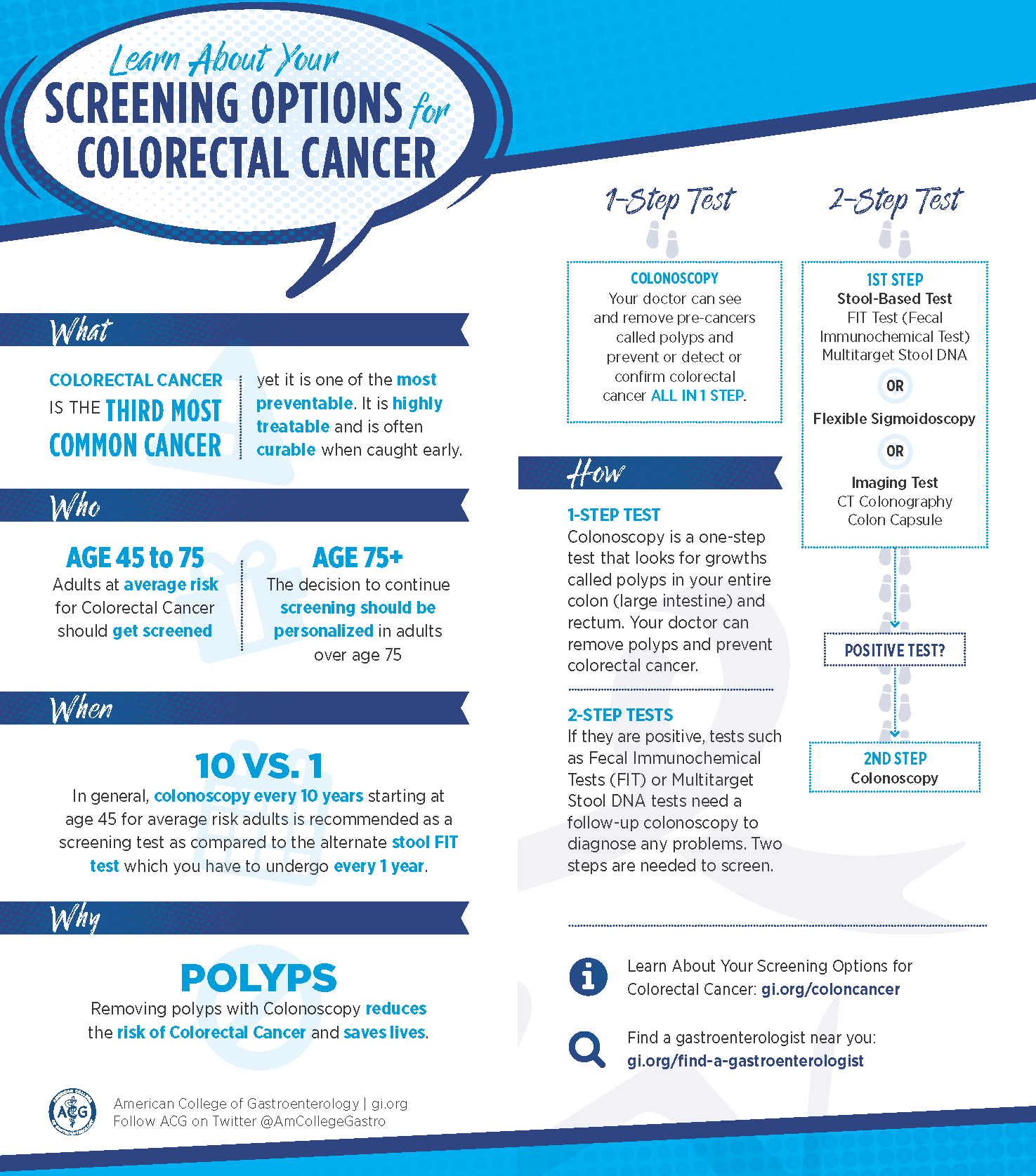
This diagram illustrates the "1-step" (direct colonoscopy) vs "2-step" (FIT followed by colonoscopy) approach. In the UK, we use the 2-step approach for population screening.
To make sure you don't get tripped up by the different FIT thresholds, I've put together a quick comparison table for you.
| Feature | Screening FIT (BCSP) | Symptomatic FIT (DG30) |
|---|---|---|
| Patient Group | Asymptomatic (Aged 54-74) | Symptomatic (Primary Care) |
| Frequency | Every 2 years | One-off (when symptoms occur) |
| Threshold | \u2265120 \u00b5g Hb/g (England) | \u226510 \u00b5g Hb/g |
| Next Step | Colonoscopy (Screening Centre) | 2WW Referral (Secondary Care) |
| Goal | Early detection/Prevention | Rule out cancer in symptomatic patients |
High-Risk Surveillance (Lynch & FAP)
Beyond the general population, you'll also need to know the surveillance for hereditary syndromes:
- Lynch Syndrome (HNPCC): Colonoscopy every 1-2 years starting from age 25.
- Familial Adenomatous Polyposis (FAP): Annual flexible sigmoidoscopy starting from age 12-15.
That's the core of bowel cancer screening for the AKT! Would you like to try a few practice questions to see how this shows up in the exam? I can pull up some high-yield questions for you.
✍️ Bowel Cancer Screening Quiz
Tap to practice questions in the Oncourse app
I've pulled up a quiz with 10 high-yield questions on bowel cancer screening and surveillance. It's a great way to lock in those FIT thresholds and surveillance intervals!
Let me know if you want to dive deeper into any of these, or if you're ready to move on to another topic!
Setting up chat...