Bone tumors: classification, features and high-yield comparisons
 Rezzy
RezzyBone tumors can be a bit of a maze because there are so many ways to categorize them—by age, location, or the type of matrix they produce. For your exams, the "where" and "who" (location and age) are often the biggest clues to the diagnosis!
Here is a quick breakdown of how we classify them based on the tissue they arise from:
1. Bone-Forming (Osteoid)
- Benign: Osteoid osteoma (classic nocturnal pain relieved by aspirin), Osteoblastoma.
- Malignant: Osteosarcoma (the most common primary malignant bone tumor in kids).
2. Cartilage-Forming (Chondroid)
- Benign: Osteochondrosis (Exostosis), Enchondroma, Chondroblastoma.
- Malignant: Chondrosarcoma.
3. Miscellaneous/Unknown Origin
- Giant Cell Tumor (GCT): Locally aggressive, "soap bubble" appearance.
- Ewing's Sarcoma: Highly malignant, small round blue cell tumor.
One of the highest-yield ways to differentiate these is by looking at which part of the bone they affect. Let me find a diagram that illustrates these common locations for you.
This diagram is a lifesaver for exams! Notice how GCT loves the epiphysis, while Osteosarcoma is a metaphyseal resident, and Ewing's prefers the diaphysis.
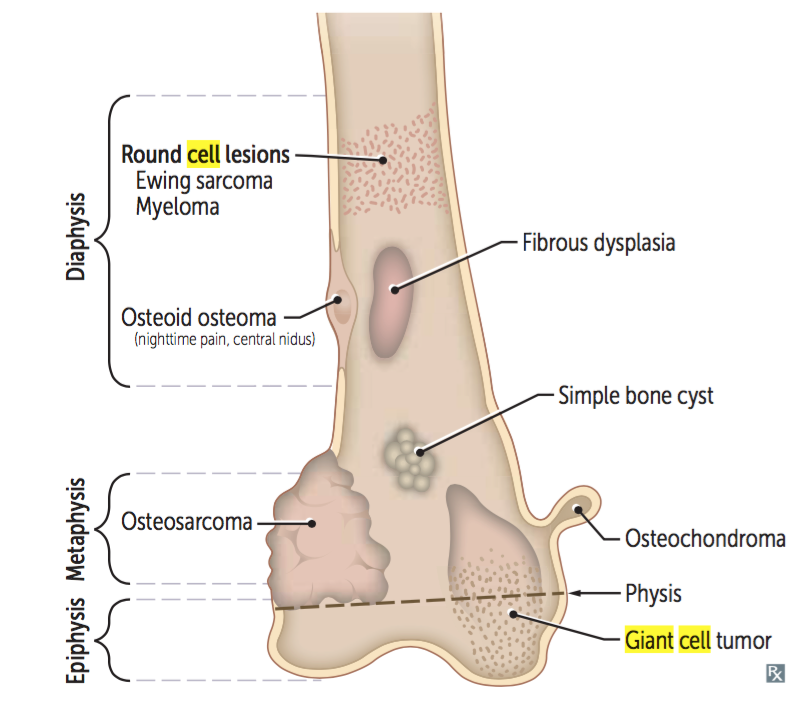
To make your revision easier, I've put together a comparison of the three most frequently tested bone tumors. Pay close attention to the X-ray findings and age groups—they are the most common "buzzwords" in question stems!
| Feature | Osteosarcoma | Ewing's Sarcoma | Giant Cell Tumor (GCT) |
|---|---|---|---|
| Age Group | 10-20 years (Bimodal) | 5-20 years | 20-40 years |
| Location | Metaphysis (Knee) | Diaphysis (Long bones) | Epiphysis (Knee) |
| X-ray Finding | Sunburst, Codman's triangle | Onion-skin appearance | Soap bubble appearance |
| Cell Origin | Osteoblasts | Neuroectodermal (t:11,22) | Osteoclasts (mononuclear) |
| Key Fact | Most common primary malignant | Small round blue cells | Locally aggressive, benign |
| Treatment | Surgery + Chemotherapy | Chemotherapy + Surgery/RT | Curettage + Bone grafting |
That table covers the bulk of what you'll see in exams! To really lock this in, I've pulled some detailed lessons and flashcards for you to review.
📚 Bone Tumor Lessons
Those lessons will give you the deep dive you need. To help you memorize the key "buzzwords" and associations, I've also pulled some high-yield flashcards for you.
🗂️ Bone Tumor Flashcards
Tap to study 33 flashcards in the Oncourse app
I hope this helps you master bone tumors! It's a high-yield topic, but once you get the hang of the age-location-X-ray triad, you'll be able to spot these diagnoses in seconds.
If you're feeling confident, we could try a quick Clinical Rounds case to see how you'd handle a patient presentation, or I can find some PYQs for you to practice. What sounds good?
Setting up chat...