Blood and immunity physiology: hematopoiesis, coagulation cascade and blood groups
 Rezzy
RezzyAh, diving into the "river of life," are we? Blood physiology is absolutely foundational for your PG prep—it's the kind of topic that shows up everywhere from basic physiology to clinical medicine and pathology.
Let's start with the "blood factory" itself: Hematopoiesis.
1. Hematopoiesis: The Origin Story
Hematopoiesis is the process by which all blood cells are formed. It's a highly regulated system that starts with a single hero: the Pluripotent Stem Cell.
- Site of Production:
- Fetus: It starts in the yolk sac (3rd week), moves to the liver and spleen (2nd trimester), and finally settles in the bone marrow (3rd trimester).
- Adults: Primarily in the red bone marrow of flat bones (sternum, ribs, pelvis) and the proximal ends of the humerus and femur.
- The Lineages:
- Myeloid Lineage: Gives rise to RBCs, platelets, granulocytes (neutrophils, eosinophils, basophils), and monocytes.
- Lymphoid Lineage: Gives rise to B-cells, T-cells, and Natural Killer (NK) cells.
Since the coagulation cascade is notoriously tricky to visualize without a map, let me find a clear diagram for you to follow along with.
I've found a perfect map of the coagulation cascade for you. It breaks down how those Roman numerals actually work together to stop a bleed.
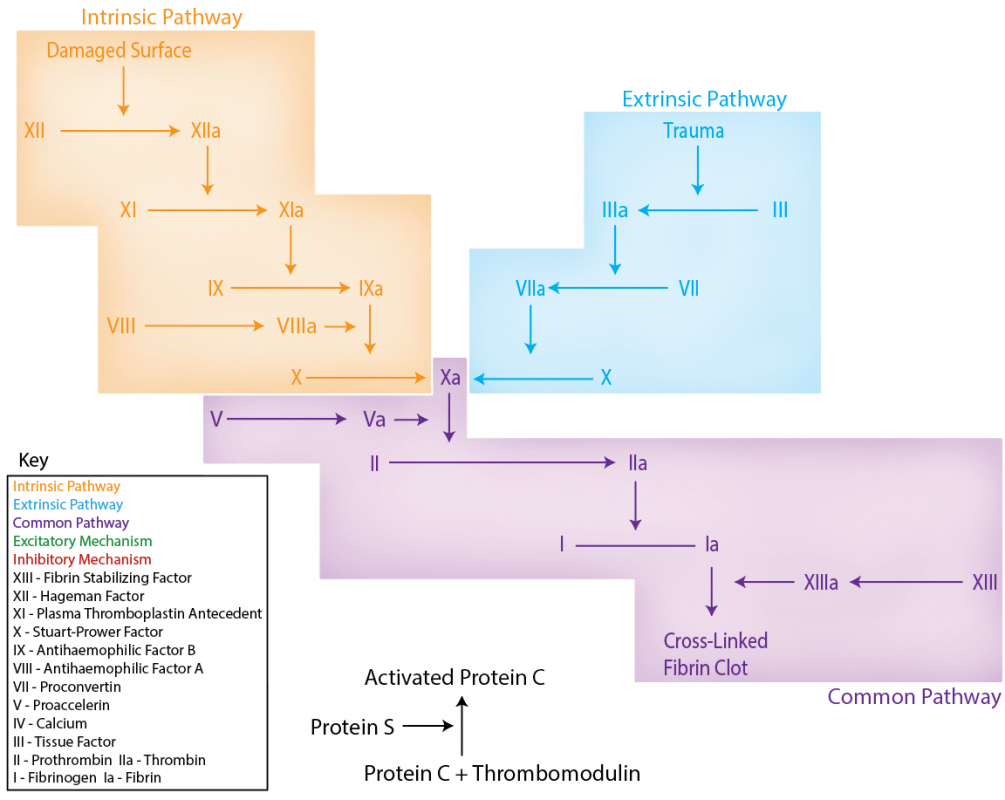
As you can see in the diagram, the cascade is like a series of falling dominoes that eventually leads to a stable fibrin clot.
2. The Coagulation Cascade: A Quick Breakdown
- Extrinsic Pathway (The "Fast" Lane): Triggered by Tissue Factor (Factor III) when there's trauma. It's short and sweet: Factor VII activates Factor X.
- Prothrombin Time (PT) measures this pathway.
- Intrinsic Pathway (The "Surface" Lane): Triggered by contact with a damaged surface (collagen). It involves Factors XII, XI, IX, and VIII.
- Activated Partial Thromboplastin Time (aPTT) measures this pathway.
- Common Pathway: Where they both meet! Factors X and V convert Prothrombin (II) to Thrombin, which then converts Fibrinogen (I) to Fibrin.
- ==Factor XIII== is the "glue" that cross-links the fibrin to make it strong.
3. Blood Groups: The ABO and Rh Systems
This is all about the antigens on the surface of your RBCs and the antibodies in your plasma.
- ABO System:
- Group A: A-antigen on RBC, anti-B antibody in plasma.
- Group B: B-antigen on RBC, anti-A antibody in plasma.
- Group AB: Both A and B antigens, no antibodies (Universal Recipient).
- Group O: No antigens, both anti-A and anti-B antibodies (Universal Donor).
- Rh System: The "D-antigen." If you have it, you're Rh positive. If not, you're Rh negative. This is critical in pregnancy (think Erythroblastosis Fetalis).
To help you lock this in for your exams, I'll pull up some high-yield lessons that cover these in more detail.
📚 Blood Physiology Lessons
Those lessons are gold for your revision!
Since the coagulation factors and blood groups can be a bit of a memory puzzle, would you like to try a quick game to see how well you've got them down? We could do a Synapses game to group the clotting factors by their pathways, or a Probe game to guess some high-yield terms.
What do you think? Or is there a specific part of this "blood saga" you'd like to dive deeper into?
Setting up chat...