Blistering diseases: pemphigus vulgaris, bullous pemphigoid, dermatitis herpetiformis
 Rezzy
RezzyBlistering diseases can be a real headache to keep straight, but they are super high-yield for exams! The big three you mentioned—Pemphigus Vulgaris, Bullous Pemphigoid, and Dermatitis Herpetiformis—each have very distinct "personalities" when you look at where the blisters form and what's causing the immune system to attack.
To help you see the big picture, I've put together a comparison table that breaks down the key differences you'll need to know.
| Feature | Pemphigus Vulgaris (PV) | Bullous Pemphigoid (BP) | Dermatitis Herpetiformis (DH) |
|---|---|---|---|
| Target Antigen | Desmoglein 1 & 3 (Desmosomes) | BP180 & BP230 (Hemidesmosomes) | Epidermal Transglutaminase |
| Blister Level | Intraepidermal (Suprabasal) | Subepidermal | Subepidermal (Dermal papillae) |
| Clinical Look | Flaccid bullae, painful, oral involvement common | Tense bullae, itchy, oral involvement rare | Pruritic papulovesicles (elbows/knees) |
| Nikolsky Sign | Positive (+) | Negative (-) | Negative (-) |
| IF Pattern | "Fishnet" (IgG/C3) | Linear (IgG/C3 at BMZ) | Granular IgA (Dermal papillae) |
| Association | Potentially fatal if untreated | Usually elderly patients | Celiac Disease (Gluten sensitivity) |
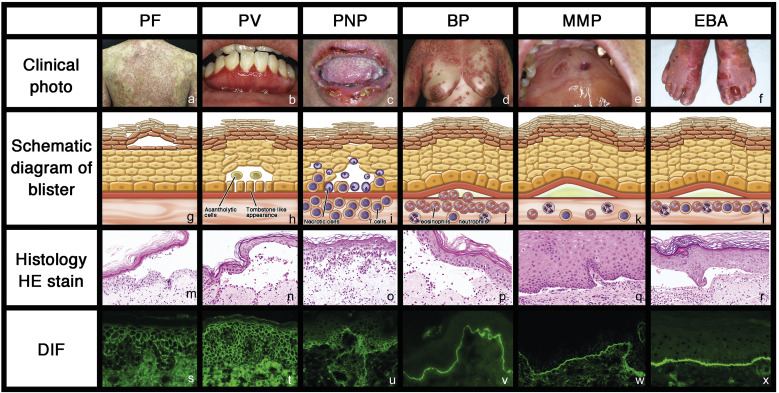
Visualizing these is half the battle. In Pemphigus Vulgaris, you'll often hear about the "row of tombstones" appearance on histology because the basal layer stays attached to the basement membrane while the layers above pull apart. In Bullous Pemphigoid, the whole epidermis lifts off, creating that tense bulla.
Let me find some diagrams to help you visualize these layers and the immunofluorescence patterns.
This diagram is perfect for seeing the "tombstone" cells in PV versus the clean subepidermal split in BP.
To really master these, I've pulled up some detailed lessons that go into the pathophysiology and management of each condition.
📚 Blistering Disease Lessons
Those lessons cover everything from the initial presentation to the long-term management with steroids and immunosuppressants.
Since these three diseases are so easy to mix up, would you like to try a quick Synapses game? It's a great way to test if you can correctly group the antigens, IF patterns, and clinical features for each one!
Setting up chat...