Bioterrorism agents: anthrax, smallpox, botulism — clinical features and response
 Rezzy
RezzyBioterrorism is one of those heavy topics that feels like it's straight out of a thriller movie, but for exams like NEET-PG or INI-CET, it's actually a high-yield area of public health and microbiology. These agents are categorized by the CDC based on how easily they spread and the severity of the illness they cause.
Let me pull up some relevant lessons on these Category A agents so you have the full details at your fingertips.
📚 Bioterrorism Lessons
1. Anthrax (Bacillus anthracis)
Anthrax is the classic "Category A" agent. It's highly stable in spore form, making it easy to aerosolize.
Clinical Features:
- Inhalational (Woolsorter’s Disease): This is the most likely route in a bioterror attack. It starts with flu-like symptoms but rapidly progresses to severe respiratory distress. A key exam finding is ==widened mediastinum== on chest X-ray due to hemorrhagic mediastinitis.
- Cutaneous: Most common natural form. Look for a painless skin papule that develops into a vesicle and then a characteristic painless black eschar surrounded by significant edema.
- Gastrointestinal: Rare, caused by ingesting contaminated meat.
Response & Management:
- Treatment: A combination of antibiotics (usually
CiprofloxacinorDoxycyclineplus a protein synthesis inhibitor likeClindamycinorLinezolid) and antitoxins (e.g., Raxibacumab). - Post-Exposure Prophylaxis (PEP): If someone is exposed to spores, they need 60 days of antibiotics because spores can remain dormant in the lungs for a long time.
Let's look at what that classic cutaneous eschar looks like.
That image shows the classic black eschar of cutaneous anthrax. It's typically painless, which is a key diagnostic clue!

2. Smallpox (Variola virus)
Smallpox was eradicated in 1980, but it remains a top bioterrorism concern because most of the world's population now has little to no immunity.
Clinical Features:
- Incubation: 7–19 days (not contagious during this time).
- Prodrome: High fever, severe headache, and backache.
- Rash: Starts in the mouth (enanthem) and then moves to the face and extremities (centrifugal distribution).
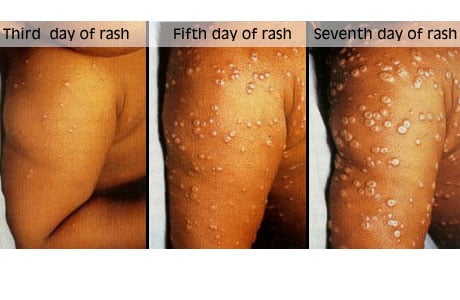
- Key Exam Fact: All lesions on a specific body part are in the ==same stage of development== (unlike chickenpox, where you see "crops" of lesions in different stages).
Response & Management:
- Vaccination: If given within 4 days of exposure, it can prevent or significantly lessen the disease.
- Isolation: Strict respiratory and contact precautions are mandatory.
- Treatment: Supportive care and antivirals like Tecovirimat (TPOXX).
Let's look at the characteristic "same stage" rash of smallpox.
That image shows the progressive nature of the smallpox rash. Notice how the lesions are in the same stage of development on a specific day—that's a classic exam differentiator from chickenpox!
3. Botulism (Clostridium botulinum toxin)
Botulism is caused by the most potent toxin known to man. In a bioterrorism scenario, it would likely be aerosolized or used to contaminate food/water.
Clinical Features:
- The "4 D's": ==Diplopia== (double vision), ==Dysarthria== (slurred speech), ==Dysphagia== (difficulty swallowing), and ==Dysphonia== (hoarseness).
- Paralysis: Characterized by descending, symmetric, flaccid paralysis. It starts with the cranial nerves and moves down to the respiratory muscles and limbs.
- Key Exam Fact: Patients are afebrile and have a normal mental status (they are awake and alert but paralyzed).
Response & Management:
- Antitoxin: Administer Heptavalent Botulism Antitoxin (HBAT) as soon as possible. It doesn't reverse existing paralysis but prevents further damage.
- Supportive Care: The most critical part of management is often mechanical ventilation if the respiratory muscles are affected.
Let's look at a quick comparison table to help you keep these straight for your exams.
| Feature | Anthrax (B. anthracis) | Smallpox (Variola virus) | Botulism (C. botulinum toxin) |
|---|---|---|---|
| Agent Type | Bacterium (Spore-forming) | Virus | Toxin |
| Key Clinical Sign | Widened mediastinum (Inhalational) | Centrifugal rash (Same stage) | Descending flaccid paralysis |
| Fever | Present | Present (High) | Absent |
| Mental Status | May be altered (if severe) | May be altered | Normal |
| Treatment | Ciprofloxacin + Antitoxin | Tecovirimat + Supportive | Antitoxin (HBAT) + Ventilation |
| Prophylaxis | 60 days of antibiotics | Vaccination (within 4 days) | None (Supportive monitoring) |
That table should help you quickly differentiate these three in a clinical vignette! Remember, the normal mental status in botulism is a classic "gotcha" on exams—the patient is fully awake but can't move or speak.
Since these are high-yield topics for your upcoming exams, would you like to try a quick quiz or some flashcards to lock in these features?
Setting up chat...