Biochemical techniques: PCR, ELISA, Western blot and electrophoresis explained
 Rezzy
RezzyAh, the "Big Four" of the lab! These techniques are the bread and butter of biochemistry and molecular biology, and they show up constantly in exams. Think of them as the detective tools we use to find specific DNA, proteins, or antibodies.
Let's break them down one by one so you can keep them straight.
1. Polymerase Chain Reaction (PCR)
PCR is essentially a "molecular photocopier." It takes a tiny, specific segment of DNA and amplifies it millions of times so we have enough to study.
- The Ingredients: DNA template, primers (the "start" markers), nucleotides (the building blocks), and Taq polymerase (the heat-stable enzyme).
- The Steps:
- Denaturation (~95°C): Heat separates the double-stranded DNA.
- Annealing (~55°C): Primers bind to the target sequence.
- Extension (~72°C): Taq polymerase builds the new DNA strands.
- Clinical Use: Detecting viral loads (like HIV or COVID-19) and genetic testing.
2. ELISA (Enzyme-Linked Immunosorbent Assay)
If PCR is for DNA, ELISA is usually for detecting antigens or antibodies. It relies on the high specificity of antibody-antigen binding.
- How it works: We use an antibody "tagged" with an enzyme. When a substrate is added, the enzyme converts it into a color change. The more intense the color, the more of the substance is present.
- Types:
- Direct: Detects antigen.
- Indirect: Detects antibodies (classic for HIV screening).
- Sandwich: Antigen is "sandwiched" between two antibodies (highly sensitive).
- Clinical Use: Screening for infections, hormones (like hCG in pregnancy tests), and cytokines.
3. Western Blot
Think of Western Blot as the more specific, "confirmatory" version of protein detection. While ELISA tells you if a protein is there, Western Blot tells you its size and presence.
- The Process:
- Proteins are separated by size via electrophoresis.
- They are transferred to a membrane (blotted).
- Labeled antibodies are added to identify the specific protein.
- Mnemonic: SNoW DRoP
- Southern = DNA
- Northern = RNA
- Western = Protein
- Clinical Use: Confirming a positive ELISA (e.g., for HIV or Lyme disease).
4. Electrophoresis
This is the foundational technique used to separate molecules (DNA, RNA, or proteins) based on size and charge.
- How it works: Molecules are placed in a gel (agarose for DNA, polyacrylamide for proteins) and an electric current is applied.
- The Movement: Since DNA is negatively charged (thanks to the phosphate backbone), it migrates toward the positive anode.
- Size Matters: Smaller fragments move faster and further through the gel "mesh" than larger ones.
I've got a great comparison table that summarizes these techniques and a few others you might see. Let me pull that up for you!
| Technique | Target Molecule | Key Principle | Common Clinical Use |
|---|---|---|---|
| PCR | DNA | Thermal cycling & amplification | Viral load, Genetic testing |
| ELISA | Antigen/Antibody | Enzyme-linked color change | HIV screening, Hormones |
| Western Blot | Protein | Size separation + Antibody binding | Confirming HIV/Lyme disease |
| Southern Blot | DNA | Size separation + Probe binding | Detecting gene mutations |
| Northern Blot | RNA | Size separation + Probe binding | Studying gene expression |
| Electrophoresis | DNA/Protein | Migration in electric field | DNA profiling, Hemoglobinopathy |
That table should help you keep the "Blots" and the "ELISAs" straight!
Since these are high-yield topics for exams like NEET-PG or INI-CET, it's really helpful to see how they look in practice—especially the PCR cycles and the ELISA "sandwich."
Let me find some diagrams for you to visualize these processes better.
That diagram really helps visualize the exponential nature of PCR—how one strand becomes two, then four, and so on.
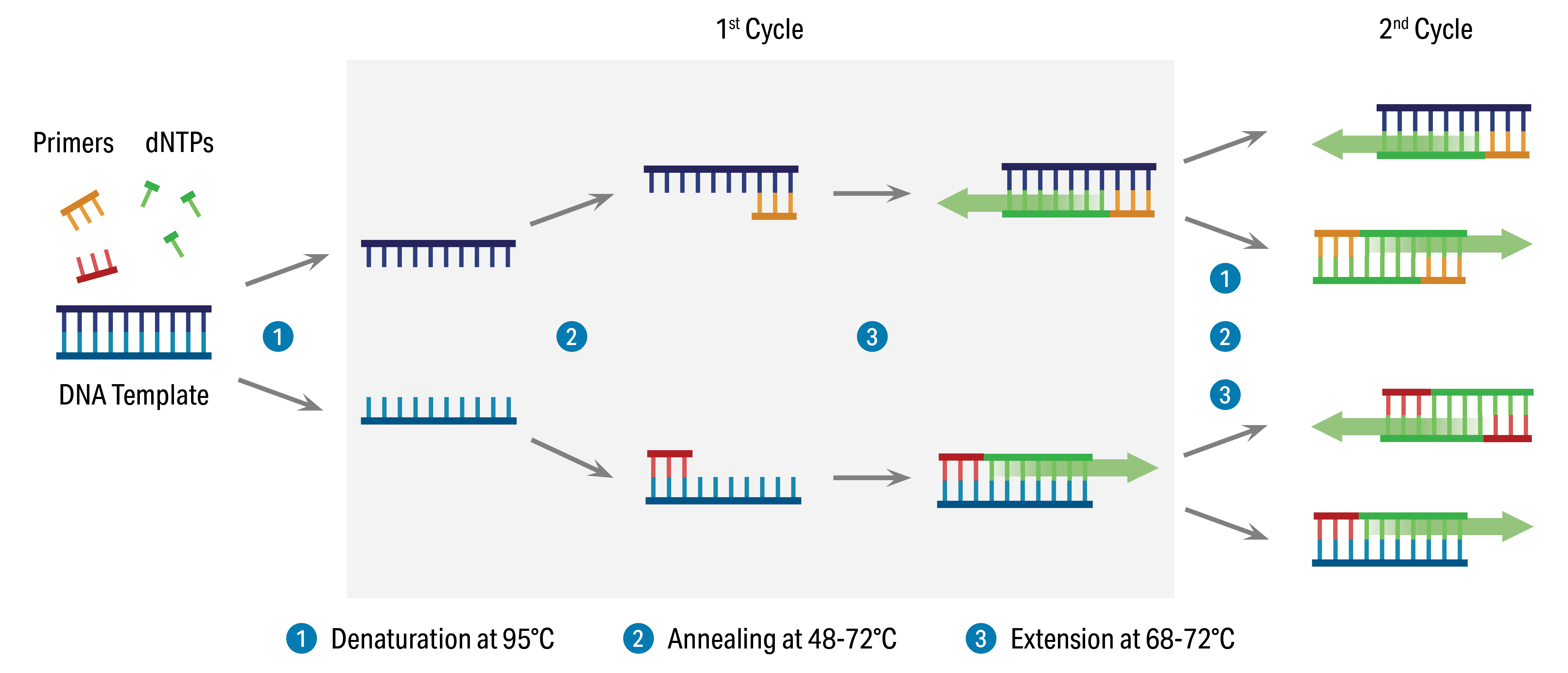
This PCR diagram shows the three critical temperature-dependent steps: Denaturation (95°C) to separate strands, Annealing (48-72°C) for primer binding, and Extension (68-72°C) for DNA synthesis.
Since these techniques are so central to biochemistry and microbiology, would you like to try a few practice questions to see how they're tested, or maybe some flashcards to lock in the "SNoW DRoP" mnemonics?
Setting up chat...