Asphyxial deaths: types, autopsy findings and medicolegal importance
 Rezzy
RezzyHey! Forensic Medicine (FMT) is one of those subjects where a few key concepts can get you a lot of marks. Asphyxial deaths are a classic example—they're high-yield and show up in almost every NEET-PG or INI-CET paper.
Let's start by looking at how we classify these deaths and some of the hallmark signs you'd look for during an autopsy. I'll pull up a visual to help you distinguish between the different mechanisms.
Asphyxia literally means "pulselessness," but in forensics, it refers to a state where the body's tissues are deprived of oxygen. The classic triad you'll see in almost all asphyxial deaths includes cyanosis, petechial hemorrhages (Tardieu spots), and post-mortem fluidity of blood.
Types of Asphyxial Deaths
- Mechanical Asphyxia:
- Hanging: Suspension of the body by a ligature around the neck.
- Strangulation: Compression of the neck by a ligature (Ligature Strangulation) or hands (Manual Strangulation/Throttling).
- Suffocation: Includes Smothering (closing nose/mouth), Choking (obstruction of air passages), and Gagging.
- Traumatic Asphyxia: External pressure on the chest/abdomen (e.g., in a stampede).
- Drowning: Asphyxia due to submersion in liquid.
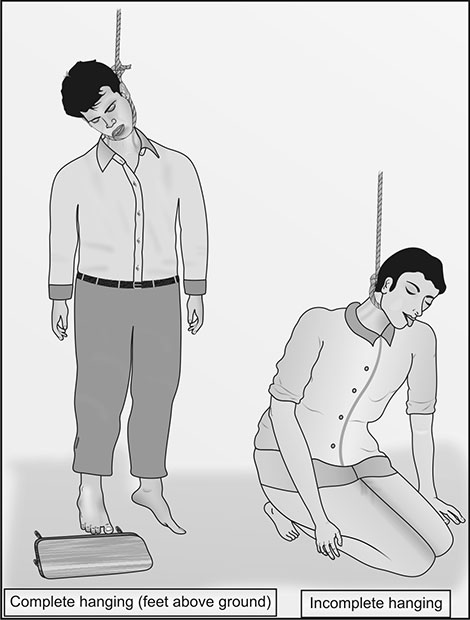 This diagram illustrates the difference between complete suspension (feet off the ground) and incomplete suspension (feet/knees touching the ground). Both can be fatal!
The most common exam question involves differentiating Hanging from Ligature Strangulation. Let's look at that comparison:
| Feature | Hanging | Ligature Strangulation |
|---|---|---|
| Nature | Usually Suicidal | Usually Homicidal |
| Ligature Mark | Oblique, non-continuous, high in the neck | Horizontal, continuous, low in the neck |
| Groove | Deepest opposite the knot | Uniform depth all around |
| Abrasions/Bruises | Rare | Common (struggle marks) |
| Hyoid Bone Fracture | Common in elderly (Direct/Indirect) | Rare (unless manual) |
| Saliva Dribbling | ==Sure sign of Ante-mortem hanging== | Absent |
| Face | Pale (usually) | Congested and Cyanosed |
Autopsy Findings
When you're performing an autopsy on an asphyxial death case, you'll look for these classic signs:
External Findings:
- Cyanosis: Bluish discoloration of the face, lips, and fingernails due to deoxygenated hemoglobin.
- Petechial Hemorrhages (Tardieu Spots): Small, pin-point hemorrhages on the conjunctiva, face, and under the skin. These occur due to the rupture of small capillaries from increased venous pressure.
- Post-mortem Lividity: In hanging, you'll see ==Glove and Stocking distribution== of lividity in the hands and feet.
Internal Findings:
- Congestion of Organs: The brain, lungs, and abdominal organs will be heavy and filled with blood.
- Fluid Blood: Blood remains fluid because of the release of fibrinolysins.
- Sub-pleural/Sub-pericardial Petechiae: These are the internal version of Tardieu spots, often seen on the surface of the lungs and heart.
Medicolegal Importance
The primary goal of the forensic expert is to determine the manner of death:
- Suicide: Hanging is the most common suicidal method.
- Homicide: Strangulation (especially manual) and smothering are almost always homicidal.
- Accident: Rare, but can occur in "auto-erotic asphyxia" or accidental choking.
==The Golden Rule==: Saliva dribbling from the angle of the mouth is a sure sign of ante-mortem hanging. If it's absent, you must suspect that the body was hanged after death to simulate suicide!
I've found some great lessons and flashcards to help you lock in these concepts for your exams.
📚 Asphyxia Lessons
Great! Those lessons will give you a deeper dive into the specifics of each type of asphyxia. To make sure you remember the key differences for your exam, let's pull up some flashcards.
🗂️ Asphyxia Flashcards
Tap to study 18 flashcards in the Oncourse app
Those flashcards are perfect for quick recall, especially the one about Glove and Stocking hypostasis—that's a classic exam favorite!
Remember, the key to mastering Asphyxia in Forensic Medicine is being able to differentiate between the suicidal and homicidal features. If you can spot the difference between a horizontal ligature mark and an oblique one, you're already halfway there.
Let me know if you want to dive deeper into any specific type, like drowning or the different types of strangulation!
Setting up chat...