Arthroscopy: indications, techniques and common procedures
 Rezzy
RezzyArthroscopy is basically the "keyhole surgery" of the orthopedic world, and it's a super high-yield topic for exams like NEET-PG and INI-CET. It allows surgeons to visualize, diagnose, and treat joint problems through tiny incisions.
Let me find a good diagram to show you how the typical setup looks, especially for the knee, which is the most common joint scoped.
That diagram shows the classic "triad" of arthroscopy: the light source, the camera (arthroscope), and the irrigation system (usually Normal Saline or Ringer's Lactate to distend the joint and clear out debris).
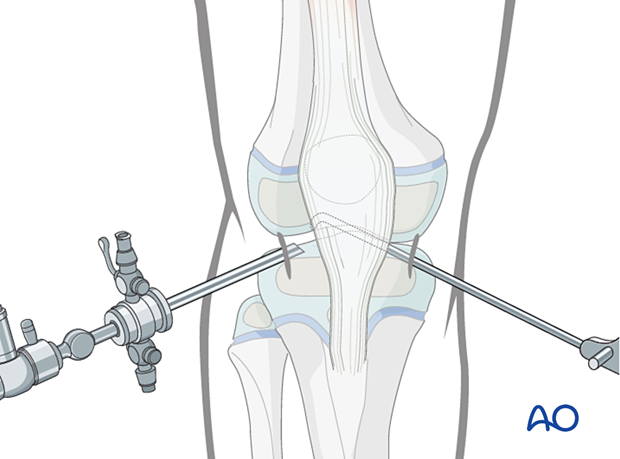
This illustration shows the anterolateral portal (for the camera) and the anteromedial portal (for instruments) in a standard knee arthroscopy.
Arthroscopy has revolutionized orthopedics by reducing recovery time and scarring. Here's a quick breakdown of the high-yield points:
1. Indications
- Diagnostic: When MRI is inconclusive for persistent joint pain or for taking a synovial biopsy.
- Therapeutic (Most Common):
- Knee: Meniscal tears (repair or meniscectomy), ACL/PCL reconstruction, removal of loose bodies (often called "joint mice").
- Shoulder: Recurrent dislocation (Bankart repair), rotator cuff tears, subacromial decompression.
- Others: Synovectomy in Rheumatoid Arthritis, septic arthritis drainage, and ankle/wrist impingement.
2. Techniques
- Portals: Small 5-10mm incisions. In the knee, the Anterolateral portal is the "viewing portal" (camera), and the Anteromedial portal is the "working portal" (instruments).
- Distension: The joint is distended with fluid (Normal Saline or RL) to create space and wash out blood/debris.
- Triangulation: This is the key surgical skill—bringing the scope and the instrument together at the same target point within the joint.
3. Common Procedures
- Meniscectomy/Repair: Trimming or suturing a torn meniscus.
- ACL Reconstruction: Replacing a torn ligament with a graft (like the bone-patellar tendon-bone or hamstring graft).
- Bankart Repair: Re-attaching the labrum to the glenoid in the shoulder.
Let me pull up some detailed lessons on these procedures to help you dive deeper.
📚 Arthroscopy Lessons
Those lessons cover the core surgical basics and sports medicine injuries where arthroscopy is most commonly used. To help you lock in the key facts for your exams, I'll pull up some high-yield flashcards on arthroscopic procedures.
🗂️ Arthroscopy Flashcards
Tap to study 10 flashcards in the Oncourse app
Those flashcards highlight a really important point for exams: Arthroscopy is the gold standard for diagnosing and treating meniscal and ligamentous injuries of the knee.
One last thing to keep in mind are the potential complications, though they are rare:
- Infection (Septic arthritis)
- Hemarthrosis (Bleeding into the joint)
- DVT (Deep Vein Thrombosis, especially in knee procedures)
- Instrument breakage (A classic "oops" moment in the OR!)
If you want to test your knowledge on these clinical scenarios, I can set up a quick quiz for you!
Setting up chat...