Anesthesia and perioperative medicine: ASA classification, preop assessment
 Rezzy
RezzyAnesthesia and perioperative medicine are all about "risk stratification"—basically, we're trying to predict how well a patient will handle the stress of surgery and anesthesia. The cornerstone of this is the ASA Physical Status Classification System, which helps us communicate a patient's overall health status quickly.
I've put together a table of the ASA classes for you, as this is super high-yield for exams and daily clinical practice.
| ASA Class | Definition | Examples |
|---|---|---|
| ASA I | A normal healthy patient | Non-smoking, no or minimal alcohol use |
| ASA II | A patient with mild systemic disease | Well-controlled DM/HTN, mild obesity (BMI 30-40), social smoker |
| ASA III | A patient with severe systemic disease | Poorly controlled DM/HTN, COPD, morbid obesity (BMI >40), active hepatitis, pacemaker |
| ASA IV | A patient with severe systemic disease that is a constant threat to life | Recent (<3 months) MI, CVA, TIA, or CAD/stents, ongoing cardiac ischemia or severe valve dysfunction |
| ASA V | A moribund patient who is not expected to survive without the operation | Ruptured abdominal/thoracic aneurysm, massive trauma, intracranial bleed with mass effect |
| ASA VI | A declared brain-dead patient whose organs are being removed for donor purposes | |
| 'E' Suffix | Added to any class to indicate an emergency surgery | e.g., ASA IIE |
Beyond the ASA score, the Preoperative Assessment involves a deep dive into the patient's history and a focused physical exam. We're looking for things like exercise tolerance (METs), cardiac risk factors, and most importantly, the Airway Assessment.
The Mallampati Score is our go-to for predicting how difficult an intubation might be. Let me find a diagram of that for you.
The Mallampati Classification is a quick way to assess the visibility of oropharyngeal structures, which correlates with the difficulty of intubation.
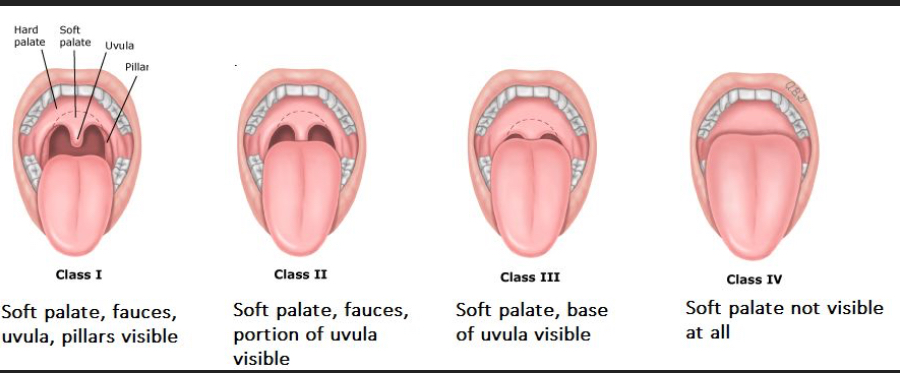
Class I and II are generally considered "easy" airways, while Class III and IV suggest a potentially difficult intubation.
Another critical part of the preop assessment is the NPO (Nothing by Mouth) Guidelines to prevent aspiration:
- 2 hours: Clear liquids (water, fruit juice without pulp, carbonated beverages, tea/coffee without milk)
- 4 hours: Breast milk
- 6 hours: Infant formula, non-human milk, light meal (toast and clear liquids)
- 8 hours: Fatty foods, fried foods, or meat
To help you lock this in, I'll pull up some relevant lessons and flashcards for your review!
📚 Anesthesia Preop Lessons
Those lessons cover the core concepts of preoperative risk assessment and the ASA classification in detail. To help you memorize the key facts, I've also pulled some flashcards for you.
🗂️ Anesthesia Preop Flashcards
Tap to study 26 flashcards in the Oncourse app
Those flashcards are great for testing your recall on specific ASA scenarios and airway assessment.
Remember, the goal of the preoperative assessment isn't just to "clear" the patient for surgery, but to optimize their condition and create a safe anesthetic plan. If you have any more questions about specific risk factors or want to dive deeper into anesthetic agents, just let me know!
Setting up chat...