Ambulatory anesthesia: patient selection, techniques and discharge criteria
 Rezzy
RezzyAmbulatory anesthesia is all about efficiency and safety—getting patients back to their own beds as quickly as possible! It's a high-yield topic for exams because it involves a lot of clinical judgment regarding who is "fit" for day-care surgery.
Let's start by looking at some key lessons that cover the fundamentals of patient selection and management.
📚 Ambulatory Anesthesia Basics
Patient selection is the first hurdle. Generally, we look for ASA I or II patients, though stable ASA III can be considered if their condition is well-managed. We also have to think about "social" criteria—like having a responsible adult to take them home and stay with them for 24 hours.
For techniques, Total Intravenous Anesthesia (TIVA) with Propofol is a favorite because it significantly reduces Post-Operative Nausea and Vomiting (PONV), which is the #1 reason for delayed discharge. Regional anesthesia is also great for "opioid-sparing" analgesia. Let me find a visual to help you see how we approach these cases.
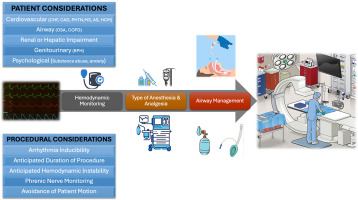
This diagram highlights the critical patient and procedural considerations we weigh before deciding on the type of anesthesia and airway management, which is the core of ambulatory selection.
Once the surgery is done, we can't just send them home the moment they open their eyes. We need objective criteria to ensure they're stable. The Post-Anesthetic Discharge Scoring System (PADSS) is the gold standard here. A score of ≥ 9 is usually required for discharge.
I've put together a table of the PADSS criteria for you to review.
| Criteria | Score 2 | Score 1 | Score 0 |
|---|---|---|---|
| Vital Signs | Within 20% of preoperative value | 20–40% of preoperative value | > 40% of preoperative value |
| Activity/Ambulation | Steady gait / No dizziness | With assistance | Unable / Dizziness |
| Nausea/Vomiting | Minimal / None | Moderate (treated with meds) | Severe (persistent) |
| Pain | Minimal / None | Moderate (controlled) | Severe (uncontrolled) |
| Surgical Bleeding | Minimal / None | Moderate | Severe |
Note: A total score of 9 or 10 is required for discharge to home with a responsible adult.
Ambulatory anesthesia is a high-yield topic for exams like NEET-PG and INI-CET because it tests your clinical judgment on patient safety.
To recap:
- Selection: Focus on ASA I & II (stable III) and ensure they have a responsible adult for the first 24 hours.
- Techniques: TIVA is the gold standard for reducing PONV, and Regional blocks are superstars for "opioid-sparing" pain control.
- Discharge: The PADSS score (as shown in the table) is your objective guide—aim for a score of 9 or 10 before they head home.
Would you like to test your knowledge on these criteria with a quick quiz?
✍️ Ambulatory Anesthesia Quiz
Tap to practice questions in the Oncourse app
I've generated a 10-question quiz for you to test your knowledge on ambulatory anesthesia—it's a great way to lock in those PADSS criteria and selection rules.
Let me know if you want to dive deeper into any of these techniques or if you're ready for another topic! Good luck with your prep!
Setting up chat...