Acid-base physiology: buffers, compensation and ABG interpretation
 Rezzy
RezzyAcid-base physiology is one of those topics that feels like a puzzle at first, but once you get the hang of the ABG interpretation steps, it's a guaranteed score in your exams. It's all about how the body maintains that tight pH range of 7.35 to 7.45.
Let's start by pulling up some high-yield lessons that break down the core concepts for your NEET-PG/INI-CET prep.
📚 Acid-Base Lessons
The body's first line of defense is the bicarbonate buffer system, which works in tandem with the lungs (fast response) and kidneys (slow but steady).
When the pH shifts, the lungs adjust $CO_2$ levels within minutes, while the kidneys take 2-3 days to fully adjust $HCO_3^-$ levels. I'll find a good diagnostic flowchart to help you visualize the interpretation process.
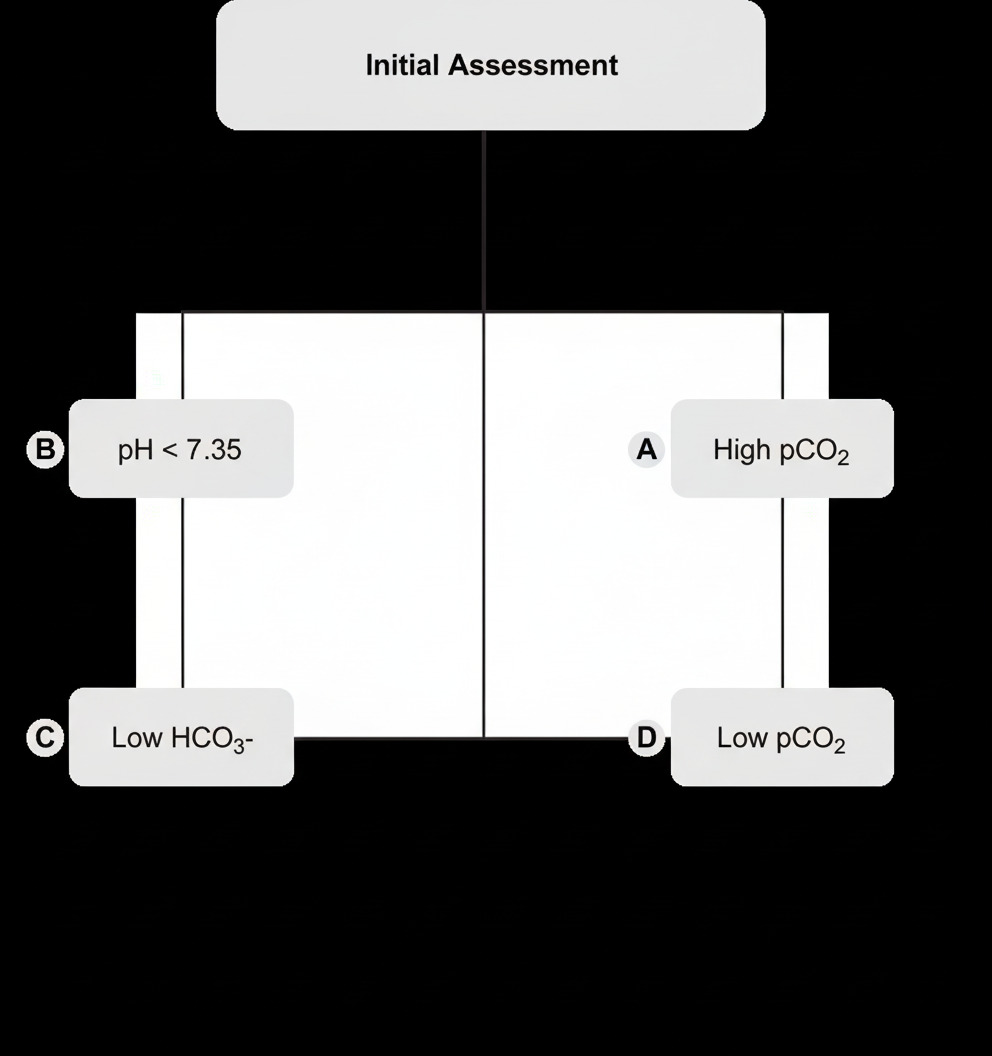
This flowchart demonstrates the initial assessment for evaluating acid-base balance, starting with pH and then looking at $pCO_2$ and $HCO_3^-$ to determine the primary disorder.
To master ABG interpretation, you need to know the normal values and the compensation rules. Here's a quick reference table for your revision:
| Parameter | Normal Range |
|---|---|
| pH | 7.35 - 7.45 |
| $pCO_2$ | 35 - 45 mmHg |
| $HCO_3^-$ | 22 - 26 mEq/L |
| Anion Gap | 8 - 12 mEq/L |
Compensation Rules (High-Yield!)
| Disorder | Primary Change | Compensatory Response | Formula/Rule |
|---|---|---|---|
| Metabolic Acidosis | $\downarrow HCO_3^-$ | $\downarrow pCO_2$ | ==Winters' Formula==: Expected $pCO_2 = (1.5 \times HCO_3^-) + 8 \pm 2$ |
| Metabolic Alkalosis | $\uparrow HCO_3^-$ | $\uparrow pCO_2$ | $pCO_2$ increases by 0.7 for every 1 mEq/L increase in $HCO_3^-$ |
| Respiratory Acidosis | $\uparrow pCO_2$ | $\uparrow HCO_3^-$ | Acute: 1 mEq/L $HCO_3^-$ per 10 mmHg $pCO_2$ Chronic: 3.5 mEq/L $HCO_3^-$ per 10 mmHg $pCO_2$ |
| Respiratory Alkalosis | $\downarrow pCO_2$ | $\downarrow HCO_3^-$ | Acute: 2 mEq/L $HCO_3^-$ per 10 mmHg $pCO_2$ Chronic: 5 mEq/L $HCO_3^-$ per 10 mmHg $pCO_2$ |
When you're dealing with metabolic acidosis, calculating the Anion Gap (AG) is the next crucial step. It helps you narrow down the cause.
Mnemonic: MUDPILES (High Anion Gap Metabolic Acidosis) Methanol, Uremia, DKA, Paraldehyde/Propylene glycol, Iron/INH, Lactic acidosis, Ethylene glycol, Salicylates.
To really lock this in, flashcards are the way to go. Here are some focused sets for your revision.
🗂️ Acid-Base Flashcards
Tap to study 9 flashcards in the Oncourse app
You've got the theory down! Acid-base balance is all about practice. To make sure these concepts stick, would you like to try a quick game?
I can set up a Synapses game to help you categorize different clinical scenarios into their respective acid-base disorders, or a Probe game to test your recall of the key formulas. Which one sounds like a good challenge?
Setting up chat...