

Hematopoiesis Basics - Blood Cell Genesis
Formation of all blood cellular components. Essential for life.
- Significance: Continuous, regulated production of blood cells.
- Sites of Hematopoiesis:
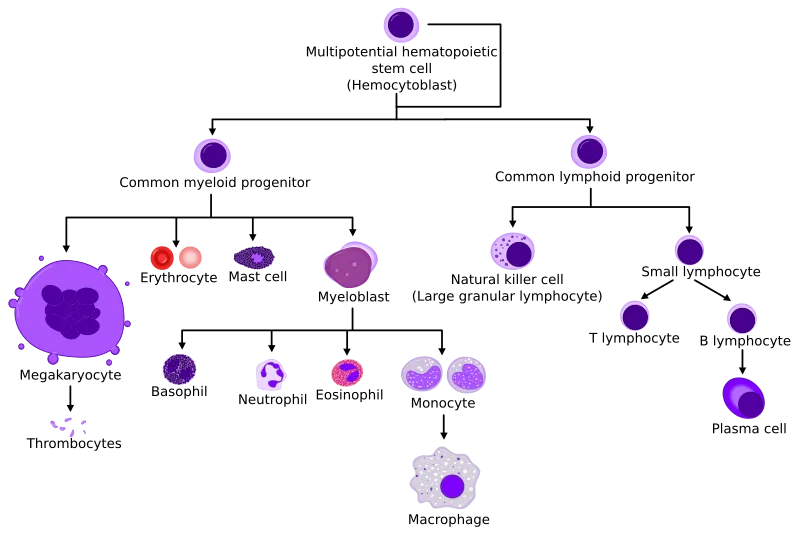
Age Site(s) Fetal Yolk Sac (from 3rd wk), Liver, Spleen, Bone Marrow (📌 Young Liver Synthesizes Blood) Child All bones (red marrow) Adult Axial skeleton (vertebrae, sternum, ribs, pelvis), proximal ends of long bones - Hematopoietic Stem Cells (HSCs):
- Origin of all blood cells.
- Markers: CD34+, CD38-, Lin- (Lineage negative).
- Key Properties: Pluripotency (can differentiate into all blood cell types), Self-renewal.
- Major Lineages:
- Myeloid: Erythrocytes, granulocytes (neutrophils, eosinophils, basophils), monocytes, megakaryocytes (platelets).
- Lymphoid: B-lymphocytes, T-lymphocytes, Natural Killer (NK) cells.
⭐ Yolk sac is the first site of hematopoiesis in fetal life, starting around the 3rd week of gestation.
Erythropoiesis - Red Cell Rally
Erythropoiesis: Formation of red blood cells (RBCs).
- Stages: 📌 Mnemonic: 'Profoundly Basophilic Policemen Oughtta Arrest Reds'
- Proerythroblast
- Basophilic erythroblast
⭐ The presence of a nucleus in circulating red blood cells (normoblastemia) in adults is abnormal and indicates severe bone marrow stress or extramedullary hematopoiesis.
- Polychromatophilic erythroblast
- Orthochromatophilic erythroblast (normoblast): Nucleus extruded.
- Reticulocyte: Anucleated, residual RNA. Normal: 0.5-2.5% (marrow activity).
- Erythrocyte: Mature RBC.
- Key changes: Cell size ↓, Hb ↑, nuclear extrusion.

- Regulation by Erythropoietin (EPO):
- Source: Kidney (peritubular cells), Fetal liver.
- Stimulus: Hypoxia (via HIF-1α).
- Nutritional Factors:
- Iron: Hb synthesis.
- Vitamin B12 & Folic Acid: DNA synthesis (maturation).
Leukopoiesis - White Knight Formation
Leukopoiesis is the formation of white blood cells (WBCs) or leukocytes, crucial for immunity.
- Granulopoiesis (Neutrophils, Eosinophils, Basophils):
- Stages: Myeloblast → Promyelocyte → Myelocyte → Metamyelocyte → Band form → Segmented cell.
- 📌 Mnemonic: 'My Promising Myelody Met A Band Segment'.
- Monocytopoiesis:
- Stages: Monoblast → Promonocyte → Monocyte (circulates) → Macrophage (in tissues).
- Lymphopoiesis:
- Stages: Lymphoblast → Prolymphocyte → Lymphocyte (T cells, B cells, NK cells).
Key Regulators:
| Factor | Primary Target/Function |
|---|---|
| G-CSF | Stimulates neutrophil production |
| GM-CSF | Stimulates granulocyte & monocyte production |
| M-CSF | Stimulates monocyte/macrophage production |
| IL-2 | T-cell proliferation, NK cell activation |
| IL-7 | T and B cell development/survival |
Thrombopoiesis - Platelet Power-Up
Formation of platelets (thrombocytes) from megakaryocytes. Normal platelet count: 1.5-4.5 lakhs/µL (or 150,000-450,000/µL).
-
Megakaryocytopoiesis Stages:
- Megakaryoblast → Promegakaryocyte → Megakaryocyte.
- Megakaryocyte: Large cell (50-100 µm) with multilobed nucleus; undergoes endomitosis (DNA replication without cytokinesis).
- Platelet shedding/demarcation: Cytoplasmic fragments of megakaryocytes form platelets.
-
Platelet Structure (Brief):
- Granules:
- Alpha (α): Contain fibrinogen, von Willebrand Factor (vWF), Platelet Factor 4 (PF4).
- Dense (δ) / Delta: Contain ADP, ATP, Ca²⁺, serotonin.
- Membrane systems: Open canalicular system (OCS) for substance release.
- Granules:
-
Regulation:
- Thrombopoietin (TPO): Primary regulator.
- Source: Mainly liver, also kidney & bone marrow stroma.
- Action: Stimulates megakaryocyte proliferation, differentiation, and maturation.
⭐ TPO levels are inversely correlated with the platelet mass; thus, in conditions like idiopathic thrombocytopenic purpura (ITP) with increased platelet destruction, TPO levels are typically high.
- Other factors: Interleukin (IL)-3, IL-6, IL-11 (stimulate megakaryopoiesis).
- Thrombopoietin (TPO): Primary regulator.
High‑Yield Points - ⚡ Biggest Takeaways
- Primary hematopoiesis sites transition: Yolk sac → Fetal liver/spleen → Adult red bone marrow (axial skeleton).
- Hematopoietic Stem Cells (HSCs) are CD34+ and pluripotent.
- Erythropoietin (EPO): Mainly from kidney (adults), stimulates erythropoiesis.
- Thrombopoietin (TPO): From liver/kidney, stimulates platelet production.
- Key cytokines: G-CSF (neutrophils), GM-CSF (granulocytes/macrophages), IL-7 (lymphoid precursors).
- Extramedullary hematopoiesis: Hematopoiesis outside marrow, typically in liver/spleen, during certain diseases.
- Myeloid maturation sequence is crucial for identifying leukemias and understanding myeloproliferative disorders.
Continue reading on Oncourse
Sign up for free to access the full lesson, plus unlimited questions, flashcards, AI-powered notes, and more.
CONTINUE READING — FREEor get the app
