
Primary vs. secondary intention — MCQs

A 55-year-old African American female presents to her breast surgeon for a six-month follow-up visit after undergoing a modified radical mastectomy for invasive ductal carcinoma of the left breast. She reports that she feels well and her pain has been well controlled with ibuprofen. However, she is frustrated that her incisional scar is much larger than she expected. She denies any pain or pruritus associated with the scar. Her past medical history is notable for systemic lupus erythematosus and multiple dermatofibromas on her lower extremities. She has had no other surgeries. She currently takes hydroxychloroquine. On examination, a raised hyperpigmented rubbery scar is noted at the inferior border of the left breast. It appears to have extended beyond the boundaries of the initial incision. Left arm range of motion is limited due to pain at the incisional site. Abnormal deposition of which of the following molecules is most likely responsible for the appearance of this patient’s scar?
An investigator is studying muscle contraction in tissue obtained from the thigh muscle of an experimental animal. After injection of radiolabeled ATP, the tissue is stimulated with electrical impulses. Radioassay of these muscle cells is most likely to show greatest activity in which of the following structures?
A 14-year-old girl is brought to the physician after she accidentally cut her right forearm earlier that morning while working with her mother's embroidery scissors. She has no history of serious illness. The mother says she went to elementary and middle school abroad and is not sure if she received all of her childhood vaccinations. She appears healthy. Her temperature is 37°C (98.6 °F), pulse 90/min, and blood pressure is 102/68 mm Hg. Examination shows a clean 2-cm laceration on her right forearm with surrounding edema. There is no erythema or discharge. The wound is irrigated with water and washed with soap. Which of the following is the most appropriate next step in management?
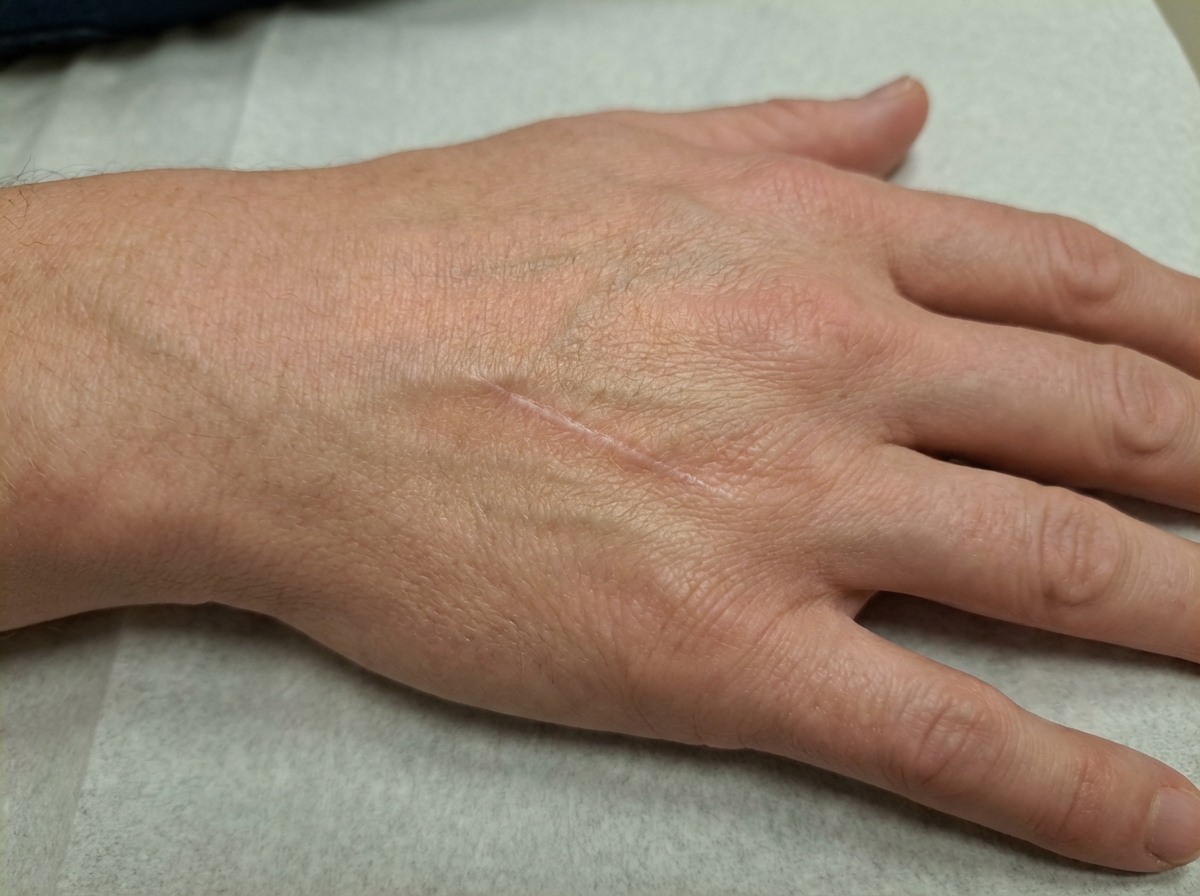
A 16-year-old boy presents to the emergency department after a skateboarding accident. He fell on a broken bottle and received a 4 cm wound on the dorsal aspect of his left hand. His vitals are stable and he was evaluated by the surgeon on call who determined that suturing was not required. After several weeks the wound has almost completely healed (see image). Which of the following is the correct description of this patient's wound before healing?
A 60-year-old male presents with fatigue, dyspnea on exertion, and lower extremity edema. Physical examination reveals an elevated jugular venous pressure and an S3 heart sound. Which of the following medications is most likely to improve this patient's symptoms?
A 38-year-old, working, first-time mother brings her 9-month-old male infant to the pediatrician for "wounds that simply won't heal" and bleeding gums. She exclaims, "I have been extra careful with him making sure to not let him get dirty, I boil his baby formula for 15 minutes each morning before I leave for work to give to the caregiver, and he has gotten all of his vaccinations." This infant is deficient in a molecule that is also an essential co-factor for which of the following reactions?
A 28-year-old male presents to his primary care physician with complaints of intermittent abdominal pain and alternating bouts of constipation and diarrhea. His medical chart is not significant for any past medical problems or prior surgeries. He is not prescribed any current medications. Which of the following questions would be the most useful next question in eliciting further history from this patient?
A 35-year-old man is brought to the emergency department 40 minutes after spilling hot oil over himself in a kitchen accident. Examination shows multiple tense blisters over the abdomen, anterior chest, and right upper extremity. On deroofing the blisters, the skin over the right upper extremity is tender, pink, and blanches with pressure. The skin over the abdomen and anterior chest is tender, mottled, and does not blanch with pressure. The left thigh shows erythema only, is tender, and shows quick capillary refill after blanching with pressure. Which of the following most closely approximates the body surface area affected by 2nd-degree burns in this patient?
A 31 year-old-man presents to an urgent care clinic with symptoms of lower abdominal pain, bloating, bloody diarrhea, and fullness, all of which have become more frequent over the last 3 months. Rectal examination reveals a small amount of bright red blood. His vital signs include: temperature 36.7°C (98.0°F), blood pressure 126/74 mm Hg, heart rate 74/min, and respiratory rate 14/min. Colonoscopy is performed, showing extensive mucosal erythema, induration, and pseudopolyps extending from the rectum to the splenic flexure. Given the following options, what is the most appropriate treatment to induce remission in this patient?
A 45-year-old woman presents to the emergency department with sudden-onset tearing chest pain radiating to her back. She has a history of hypertension and is a current smoker. Blood pressure is 178/96 mmHg in the right arm and 142/80 mmHg in the left arm. Heart rate is 96 bpm. She is diaphoretic but alert and oriented. Chest radiograph shows a widened mediastinum. CT chest with IV contrast demonstrates a Stanford Type A aortic dissection with an intimal flap involving the ascending aorta. After initiating IV beta-blockade for immediate heart rate and blood pressure control, which of the following is the most appropriate next step in definitive management?
Want unlimited practice?
Get full access to all questions, explanations, and performance tracking.
Scan to download app