
Diabetic wounds — MCQs

A 30-year-old man presents to his primary care physician for pain in his left ankle. The patient states that he was at karate practice when he suddenly felt severe pain in his ankle forcing him to stop. The patient has a past medical history notable for type I diabetes and is currently being treated for an episode of acute bacterial sinusitis with moxifloxacin. The patient recently had to have his insulin dose increased secondary to poorly controlled blood glucose levels. Otherwise, the patient takes ibuprofen for headaches and loratadine for seasonal allergies. Physical exam reveals a young healthy man in no acute distress. Pain is elicited over the Achilles tendon with dorsiflexion of the left foot. Pain is also elicited with plantar flexion of the left foot against resistance. Which of the following is the best next step in management?
A 45-year-old male presents to his primary care physician complaining of drainage from his left great toe. He has had an ulcer on his left great toe for over eight months. He noticed increasing drainage from the ulcer over the past week. His past medical history is notable for diabetes mellitus on insulin complicated by peripheral neuropathy and retinopathy. His most recent hemoglobin A1c was 9.4%. He has a 25 pack-year smoking history. He has multiple sexual partners and does not use condoms. His temperature is 100.8°F (38.2°C), blood pressure is 150/70 mmHg, pulse is 100/min, and respirations are 18/min. Physical examination reveals a 1 cm ulcer on the plantar aspect of the left great toe surrounded by an edematous and erythematous ring. Exposed bone can be palpated with a probe. There are multiple small cuts and bruises on both feet. A bone biopsy reveals abundant gram-negative rods that do not ferment lactose. The pathogen most likely responsible for this patient’s current condition is also strongly associated with which of the following conditions?
A 57-year-old man presents to his primary care provider with progressive right foot swelling, redness, and malaise. He reports seeing a blister on his forefoot several months ago after he started using new work boots. He has dressed the affected area daily with bandages; however, healing has not occurred. He has a history of type 2 diabetes mellitus and stage 2 chronic kidney disease. He has smoked 20 to 30 cigarettes daily for the past 25 years. Vital signs are a temperature of 38.1°C (100.58°F), blood pressure of 110/70 mm Hg, and pulse of 102/minute. On physical examination, there is a malodorous right foot ulcer overlying the first metatarsophalangeal joint. Fluctuance and erythema extend 3 cm beyond the ulcer border. Moderate pitting edema is notable over the remaining areas of the foot and ankle. Which of the following is the best initial step for this patient?
A 43-year-old woman comes to the physician because of a 3-month history of a painless ulcer on the sole of her right foot. There is no history of trauma. She has been dressing the ulcer once daily at home with gauze. She has a 15-year history of poorly-controlled type 1 diabetes mellitus and hypertension. Current medications include insulin and lisinopril. Vital signs are within normal limits. Examination shows a 2 x 2-cm ulcer on the plantar aspect of the base of the great toe with whitish, loose tissue on the floor of the ulcer and a calloused margin. A blunt metal probe reaches the deep plantar space. Sensation to vibration and light touch is decreased over both feet. Pedal pulses are intact. An x-ray of the right foot shows no abnormalities. Which of the following is the most appropriate initial step in management?
A 56-year-old woman undergoes open reduction and internal fixation of the distal tibia 1 day after a fall. She has had rheumatoid arthritis for 12 years and diabetes mellitus for 2 years. Her medications over the past year have included metformin, prednisone, calcium supplements, and methotrexate. Prior to surgery, insulin was added to her medications, and the dose of prednisone was increased. She has had appropriate nutrition over the years with regular follow-ups with her healthcare professional. Which of the following is the most appropriate supplement to prevent wound failure in this patient?
A 40-year-old woman presents with a ‘tingling’ feeling in the toes of both feet that started 5 days ago. She says that the feeling varies in intensity but has been there ever since she recovered from a stomach flu last week. Over the last 2 days, the tingling sensation has started to spread up her legs. She also reports feeling weak in the legs for the past 2 days. Her past medical history is unremarkable, and she currently takes no medications. Which of the following diagnostic tests would most likely be abnormal in this patient?
A 39-year-old man comes to the physician for a follow-up examination. He was treated for a urinary tract infection with trimethoprim-sulfamethoxazole 2 months ago. He is paraplegic as a result of a burst lumbar fracture that occurred after a fall 5 years ago. He has hypertension and type 2 diabetes mellitus. Current medications include enalapril and metformin. He performs clean intermittent catheterization daily. He has smoked one pack of cigarettes daily for 19 years. His temperature is 37.1°C (98.8°F), pulse is 95/min, respirations are 14/min, and blood pressure is 120/80 mm Hg. He appears malnourished. Examination shows palpable pedal pulse. Multiple dilated tortuous veins are present over both lower extremities. There is a 2-cm wound surrounded by partial-thickness loss of skin and a pink wound bed over the right calcaneum. Neurologic examination shows paraparesis. His hemoglobin A1c is 6.5%, and fingerstick blood glucose concentration is 134 mg/dL. Which of the following is most likely to have prevented this patient's wound?
A 15-year-old boy is brought to the emergency department by ambulance after his mother found him having muscle spasms and stiffness in his room. His mother stated he scraped his foot on a rusty razor on the bathroom floor 2 days prior. On presentation, his temperature is 102.0°F (38.9°C), blood pressure is 108/73 mmHg, pulse is 122/min, and respirations are 18/min. On physical exam, he is found to have severe muscle spasms and rigid abdominal muscles. In addition, he has a dirty appearing wound on his right foot. The patient's mother does not recall any further vaccinations since age 12. Finally, he is found to have difficulty opening his mouth so he is intubated. Which of the following treatment(s) should be provided to this patient?
A 45-year-old woman comes to the physician because of right foot pain for 3 months. She has a burning sensation in the plantar area between the third and fourth metatarsals that radiates to the third and fourth digits. She had a right distal radius fracture that was treated with a splint and physical therapy three months ago. She is an account executive and wears high heels to work every day. Vital signs are within normal limits. Examination of the right lower extremity shows intact skin. The posterior tibial and dorsalis pedis pulses are palpable. When pressure is applied to the sole of the foot between the metatarsal heads the patient feels pain and there is an audible click. Tapping on the affected area causes pain that shoots into the third and fourth digits. Which of the following is the most likely diagnosis?
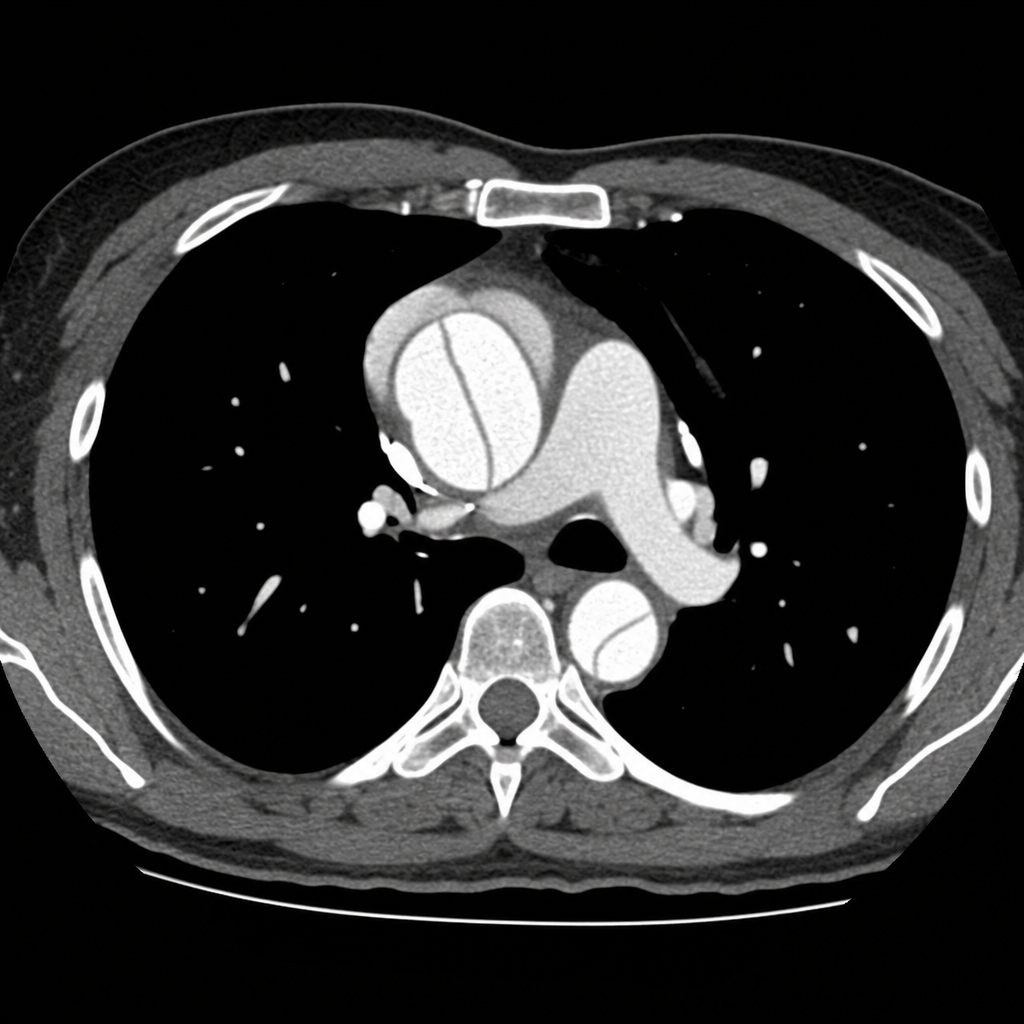
A 45-year-old woman presents to the emergency department with sudden-onset tearing chest pain radiating to her back. She has a history of hypertension and is a current smoker. Blood pressure is 178/96 mmHg in the right arm and 142/80 mmHg in the left arm. Heart rate is 96 bpm. She is diaphoretic but alert and oriented. Chest radiograph shows a widened mediastinum. CT chest with IV contrast demonstrates a Stanford Type A aortic dissection with an intimal flap involving the ascending aorta. After initiating IV beta-blockade for immediate heart rate and blood pressure control, which of the following is the most appropriate next step in definitive management?
Want unlimited practice?
Get full access to all questions, explanations, and performance tracking.
Scan to download app