
Thromboembolectomy procedures — MCQs

A 20-year-old woman is brought to the emergency department because of severe muscle soreness, nausea, and darkened urine for 2 days. The patient is on the college track team and has been training intensively for an upcoming event. One month ago, she had a urinary tract infection and was treated with nitrofurantoin. She appears healthy. Her temperature is 37°C (98.6°F), pulse is 64/min, and blood pressure is 110/70 mm Hg. Cardiopulmonary examination shows no abnormalities. The abdomen is soft and non-tender. There is diffuse muscle tenderness over the arms, legs, and back. Laboratory studies show: Hemoglobin 12.8 g/dL Leukocyte count 7,000/mm3 Platelet count 265,000/mm3 Serum Creatine kinase 22,000 U/L Lactate dehydrogenase 380 U/L Urine Blood 3+ Protein 1+ RBC negative WBC 1–2/hpf This patient is at increased risk for which of the following complications?
A 32-year-old man is brought to the emergency department after a car accident; he was extricated after 4 hours. He did not lose consciousness and does not have headache or nausea. He is in severe pain. He sustained severe injuries to both arms and the trauma team determines that surgical intervention is needed. Urinary catheterization shows dark colored urine. His temperature is 38°C (100.4°F), pulse is 110/min, and blood pressure is 90/60 mm Hg. The patient is alert and oriented. Examination shows multiple injuries to the upper extremities, contusions on the trunk, and abdominal tenderness. Laboratory studies show: Hemoglobin 9.2 g/dL Leukocyte count 10,900/mm3 Platelet count 310,000/mm3 Serum Na+ 137 mEq/L K+ 6.8 mEq/L Cl- 97 mEq/L Glucose 168 mg/dL Creatinine 1.7 mg/dL Calcium 7.7 mg/dL Arterial blood gas analysis on room air shows a pH of 7.30 and a serum bicarbonate of 14 mEq/L. An ECG shows peaked T waves. A FAST scan of the abdomen is negative. Two large bore cannulas are inserted and intravenous fluids are administered. Which of the following is the most appropriate next step in management?
Five days after undergoing a pancreaticoduodenectomy for pancreatic cancer, a 46-year-old woman has 2 episodes of non-bilious vomiting and mild epigastric pain. She has a patient-controlled analgesia pump. She has a history of hypertension. She has smoked one pack of cigarettes daily for 25 years. She drinks 3–4 beers daily. Prior to admission to the hospital, her only medications were amlodipine and hydrochlorothiazide. Her temperature is 37.8°C (100°F), pulse is 98/min, and blood pressure is 116/82 mm Hg. Pulse oximetry on room air shows an oxygen saturation of 96%. Examination shows a midline surgical incision over the abdomen with minimal serous discharge and no erythema. The abdomen is soft with mild tenderness to palpation in the epigastrium. The remainder of the examination shows no abnormalities. Laboratory studies show: Hemoglobin 11.6 g/dL Leukocyte count 16,000/mm3 Serum Na+ 133 mEq/L K+ 3.4 mEq/L Cl- 115 mEq/L Glucose 77 mg/dL Creatinine 1.2 mg/dL Arterial blood gas on room air shows: pH 7.20 pCO2 23 mm Hg pO2 91 mm Hg HCO3- 10 mEq/L Which of the following is the most likely cause of this patient's acid-base status?
A 54-year-old man is brought to the emergency department 1 hour after the sudden onset of shortness of breath, severe chest pain, and sweating. He has hypertension and type 2 diabetes mellitus. He has smoked one pack and a half of cigarettes daily for 20 years. An ECG shows ST-segment elevations in leads II, III, and avF. The next hospital with a cardiac catheterization unit is more than 2 hours away. Reperfusion pharmacotherapy is initiated. Which of the following is the primary mechanism of action of this medication?
A 72-year-old man comes to the emergency department because of severe, acute, right leg pain for 2 hours. The patient's symptoms started suddenly while he was doing household chores. He has no history of leg pain at rest or with exertion. Yesterday, he returned home after a 6-hour bus ride from his grandson's home. He has hypertension treated with ramipril. He appears uncomfortable. His temperature is 37.4°C (99.3°F), pulse is 105/min and irregular, and blood pressure is 146/92 mm Hg. The right lower extremity is cool and tender to touch. A photograph of the limb is shown. Femoral pulses are palpable bilaterally; popliteal and pedal pulses are decreased on the right side. Sensation to pinprick and light touch and muscle strength are decreased in the right lower extremity. Which of the following is most likely to confirm the underlying source of this patient's condition?
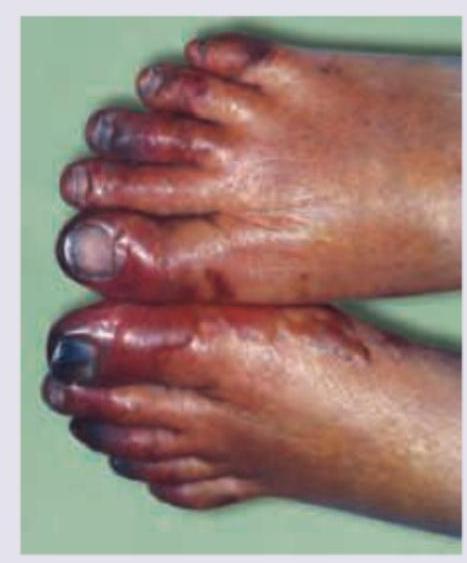
A patient in a phase 1 trial for a novel epoxide reductase inhibitor, being studied for stroke prophylaxis, develops pain and erythema on the right thigh two days after starting the trial. This rapidly progresses to a purpuric rash with necrotic bullae within 24 hours. Lab results show a PTT of 29 seconds, PT of 28 seconds, and INR of 2.15. What is the most likely pathogenesis of this condition?
Four days after undergoing a craniotomy and evacuation of a subdural hematoma, a 56-year-old man has severe pain and swelling of his right leg. He has chills and nausea. He has type 2 diabetes mellitus and chronic kidney disease, and was started on hemodialysis 2 years ago. Prior to admission, his medications were insulin, enalapril, atorvastatin, and sevelamer. His temperature is 38.3°C (101°F), pulse is 110/min, and blood pressure is 130/80 mm Hg. Examination shows a swollen, warm, and erythematous right calf. Dorsiflexion of the right foot causes severe pain in the right calf. The peripheral pulses are palpated bilaterally. Cardiopulmonary examination shows no abnormalities. Laboratory studies show: Hemoglobin 10.1 g/dL Leukocyte count 11,800/mm3 Platelet count 230,000/mm3 Serum Glucose 87 mg/dL Creatinine 1.9 mg/dL Which of the following is the most appropriate next step in treatment?
A 62-year-old man presents to the emergency department with sudden onset of severe left leg pain accompanied by numbness and weakness. His medical history is remarkable for hypertension and hyperlipidemia. His vital signs include a blood pressure of 155/92 mm Hg, a temperature of 37.1°C (98.7°F), and an irregular pulse of 92/min. Physical examination reveals absent left popliteal and posterior tibial pulses. His left leg is noticeably cold and pale. There is no significant tissue compromise, nerve damage, or sensory loss. Which of the following will most likely be required for this patient's condition?
A 31-year-old man presents to the Emergency Department with severe left leg pain and paresthesias 4 hours after his leg got trapped by the closing door of a bus. Initially, he had a mild pain which gradually increased to unbearable levels. Past medical history is noncontributory. In the Emergency Department, his blood pressure is 130/80 mm Hg, heart rate is 87/min, respiratory rate is 14/min, and temperature is 36.8℃ (98.2℉). On physical exam, his left calf is firm and severely tender on palpation. The patient cannot actively dorsiflex his left foot, and passive dorsiflexion is limited. Posterior tibial and dorsalis pedis pulses are 2+ in the right leg and 1+ in the left leg. Axial load does not increase the pain. Which of the following is the best next step in the management of this patient?
A 65-year-old man comes to the emergency department because of sudden, worsening pain in his right calf and foot that started 30 minutes ago. He also has a tingling sensation and weakness in his right leg. He has had no similar episodes, recent trauma, or claudication. He has type 2 diabetes mellitus and was diagnosed with hypertension 20 years ago. His sister has systemic sclerosis. He works as an office administrator and sits at his desk most of the day. He has smoked one and a half packs of cigarettes daily for 30 years. Current medications include metformin and lisinopril. His pulse is 110/min, respirations are 16/min, and blood pressure is 140/90 mm Hg. His right leg is pale and cool to touch. Muscle strength in his right leg is mildly reduced. Pedal pulses are absent on the right. Which of the following is the most likely underlying cause of this patient's symptoms?
Want unlimited practice?
Get full access to all questions, explanations, and performance tracking.
Scan to download app